Learn about GrowGrape AI and its role in revolutionizing viticulture through efficient pest control and nutrient management.
Artificial Intelligence in Viticulture: The Rise of GrowGrape AI in Modern Grape Farming
Estimated reading time: 7 minutes
The Growing Challenges in Modern Grape Cultivation
Technical Demands of Viticulture
Grape cultivation, also known as viticulture, is considered one of the most technically demanding sectors in agriculture. Unlike many field crops, grape farming requires continuous monitoring of diseases, pests, nutrient balance, irrigation schedules, climate conditions, pruning management, and export-quality standards throughout the crop cycle. A small mistake in disease identification or pesticide application can severely affect fruit quality, productivity, and export acceptance. In countries like India, where grape farming contributes significantly to the agricultural economy and export sector, farmers are increasingly facing challenges related to pesticide residue, climate variability, pest resistance as well as rising cultivation costs.
Pesticide Management and Technical Barriers
One of the biggest concerns in modern grape farming is the excessive and unscientific use of pesticides. Grape cultivation often involves the use of hundreds of pesticide formulations, fungicides, insecticides, and plant growth regulators during different crop stages. Managing these chemicals requires deep technical knowledge because improper dosage, wrong spray timing, or unsafe combinations can lead to phytotoxicity, crop damage, residue accumulation, and export rejection. Even mixing two or three pesticides together requires scientific understanding of chemical compatibility, crop stage suitability, active ingredient interaction, and pre-harvest intervals. Many farmers rely on local recommendations or conventional practices, which may not always match international export standards. As a result, there is a growing demand for scientific and technology-driven agricultural guidance systems that can assist farmers in making accurate decisions.
Navigating Global Export Standards
The challenge becomes even more complex in export-oriented grape production. Countries importing grapes impose strict Maximum Residue Limits (MRLs) for pesticide residues. Each country has its own standards, approved molecules, and residue thresholds. A pesticide that may be acceptable in one country could be restricted or banned in another. Therefore, export-quality grape farming requires careful planning of spray schedules, molecule selection, waiting periods, and residue management strategies. Without scientific guidance, farmers often struggle to meet these standards consistently.
The Science and Technology Behind GrowGrape AI
Foundations of GrowGrape AI
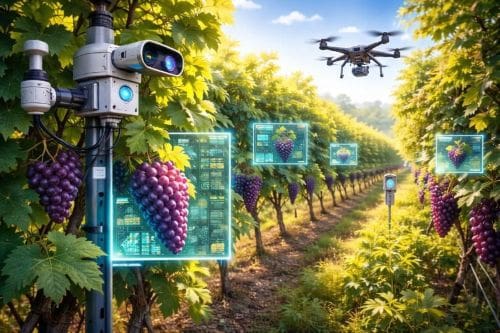
To address these challenges, an Indian-developed agricultural intelligence platform called GrowGrape AI was introduced as a specialized AI ecosystem focused specifically on grape cultivation. The platform was conceptualized under the leadership of agricultural innovator Shivam Satyawan Madrewar, technically developed by Siddhesh Kulkarni, and commercially operated by Taginus Innovations Pvt. Ltd. The platform combines artificial intelligence, machine learning, computer vision, and agronomic science to support scientific vineyard management.
Computer Vision: Teaching Computers to “See” Crops
One of the core technologies behind GrowGrape AI is computer vision. It is a branch of AI that allows computers to analyze and interpret images. In simple language, the system learns to “see” and recognize disease symptoms, pest damage, and nutrient deficiency patterns from plant photographs. The AI model was trained using thousands of real grape field images collected under different environmental and crop conditions. When a farmer uploads a photograph of a grape leaf, berry, or stem, the system analyzes patterns such as color changes, spots, lesions, texture variations, curling symptoms, or fungal growth. Based on the trained data, the AI system predicts the probable disease, pest attack, or nutrient-related issue.
Machine Learning and Dynamic Data Adaptation
The platform also uses machine learning technology, where the system improves continuously as more agricultural data is added and validated. Agricultural conditions are highly dynamic because symptoms may appear differently under changing climates, soil conditions, or crop growth stages. Therefore, the AI system continuously learns from new field data, helping improve diagnostic accuracy over time. This allows faster detection of crop problems and supports early intervention before severe damage occurs.
Dr. DRS: Specialized Conversational Advisory
Another important component is the conversational agricultural advisory system called Dr. DRS. This AI assistant was trained using agricultural literature, scientific crop management documents, fertigation schedules, pest and disease management protocols, and research publications related to grape cultivation. Unlike general chatbots, Dr. DRS focuses specifically on viticulture and provides field-level guidance related to disease management, nutrient scheduling, irrigation practices, canopy management, and scientific pesticide usage. The system also promotes Integrated Pest Management (IPM), Integrated Nutrient Management (INM), organic farming support systems, and the use of bio-rational inputs to reduce excessive chemical dependency.
Key Takeaways and Practical Importance of GrowGrape AI
Focus on Residue-Free and Export-Oriented Farming
One of the most significant aspects of GrowGrape AI is its strong focus on residue-free and export-oriented grape farming. The platform attempts to guide farmers toward scientifically managed pesticide application strategies that reduce unnecessary chemical usage and support safer agricultural practices. By providing consultation on pre-harvest intervals, safe molecule selection, and crop-stage-specific spray schedules, the system aims to help farmers reduce residue-related problems while improving fruit quality and export acceptance.
Scientific Pest and Disease Analysis
Another important contribution is pest and disease analysis through scientific methods. Instead of depending entirely on visual assumptions or conventional field opinions, the platform uses image-based AI diagnostics supported by trained agricultural datasets. This allows more accurate identification of fungal diseases, insect infestations, and nutrient deficiencies at early stages. Early detection is critical because delayed diagnosis often leads to higher crop damage and increased chemical usage.
Encouraging Sustainable and Organic Practices
GrowGrape AI also encourages movement toward organic and sustainable agriculture. The advisory system supports bio-rational pesticides, residue-management practices, integrated nutrient management, and reduced chemical dependency. This is particularly important because consumers and international markets are increasingly demanding safer and residue-free food products. Sustainable farming practices are therefore becoming both an environmental necessity and an economic opportunity for farmers.
Navigating Global Export Compliance
The platform also addresses export-related agricultural challenges. International grape export markets require compliance with different pesticide regulations, approved active ingredients, and MRL standards. GrowGrape AI attempts to support farmers by providing guidance related to export compliance, scientifically planned spray programs, and awareness regarding country-specific residue norms. Such advisory systems can help farmers reduce the risk of export rejection while improving international market access.
Integration of AI and Precision Farming
In addition, the platform demonstrates how agriculture is becoming increasingly connected with artificial intelligence, data science, and precision farming technologies. The use of AI in agriculture is not intended to replace farmers but to strengthen scientific decision-making. By combining practical farming experience with advanced computational technologies, modern agriculture can potentially become more productive, sustainable, and economically resilient.
Founder’s Note: Why the Need for GrowGrape AI Arose
Technical Complexity of Modern Grape Farming
Grape farming is becoming increasingly challenging in the modern agricultural era. The rising pressure of pest resistance, climate variability, export regulations, and pesticide residue management has made grape cultivation one of the most technically sensitive farming sectors. Today, grape farmers often use more than 500 types of pesticides, fungicides, and agricultural formulations during the crop cycle. Managing these chemicals safely requires a high level of technical knowledge because even mixing two or three pesticides together can become scientifically challenging. Incorrect combinations may result in crop damage, phytotoxicity, residue accumulation, or rejection in export markets.
Limitations of Traditional Consultation
For many years, agricultural consultation was mainly dependent on verbal recommendations and physical field visits. However, consultation through individual communication has limitations because it can only reach a limited number of farmers at a time. As grape cultivation expanded and export standards became stricter, it became increasingly difficult to provide continuous scientific guidance manually to every farmer.
Vision for Scalable Agricultural Intelligence
This situation created the need for a scalable agricultural intelligence system capable of supporting farmers scientifically and continuously. The rise of GrowGrape AI emerged from this necessity to help farmers manage grape cultivation more scientifically, reduce residue-related problems, improve awareness about MRL regulations, encourage safer and more sustainable farming practices, and support export-quality grape production. The broader vision behind the platform is not only to diagnose crop problems but also to help farmers understand the science behind farming decisions, improve crop quality, and strengthen India’s position in global grape exports.
As agriculture moves toward a future shaped by artificial intelligence, sustainability, and food safety regulations, technologies such as GrowGrape AI represent an important step toward building intelligent and residue-conscious farming ecosystems.
Additionally, to stay updated with the latest developments in STEM research, visit ENTECH Online. Basically, this is our digital magazine for science, technology, engineering, and mathematics. Further, at ENTECH Online, you’ll find a wealth of information.
References:
- Madeira, M., Porfírio, R. P., Santos, P. A., & Madeira, R. N. (2024). AI-powered solution for plant disease detection in viticulture. Procedia Computer Science, 238, 468–475. https://doi.org/10.1016/j.procs.2024.06.049
- Fuentes, S., Tongson, E., & Viejo, C. G. (2023). New developments and opportunities for AI in viticulture, pomology, and soft-fruit research: a mini-review and invitation to contribute articles. Frontiers in Horticulture, 2. https://doi.org/10.3389/fhort.2023.1282615
- Author
- Latest Posts

Shivam Satyawan Madrewar is an Indian agricultural innovator, researcher, and technology entrepreneur known for combining modern science with practical farming solutions. He is the Founder of GrowGrape.AI, an AI-driven platform focused on precision grape cultivation and residue-free farming, and the Founder of Taginus Innovations Pvt. Ltd., a company dedicated to developing next-generation agricultural technologies and scientific farming solutions.
He completed his graduation in Agricultural Sciences from RCSM Government College of Agriculture, where his strong interest in agricultural innovation, field-level problem solving, and scientific farming technologies began to evolve into practical research and invention. Coming from an agricultural background, Shivam has continuously focused on identifying real-world farming challenges and converting them into scalable, affordable, and technology-oriented solutions for farmers.
With a strong foundation in agriculture, innovation, and applied research, Shivam has emerged as one of the young innovators working at the intersection of agriculture, artificial intelligence, sustainability, and agri-engineering. His work primarily focuses on pest and disease management, precision agriculture, agricultural mechanization, residue-free farming systems, export-oriented crop management, and AI-assisted advisory systems for farmers.
Over the years, Shivam has built an exceptional innovation portfolio, having registered more than 95 patents and successfully secured over 71 granted patents in the agricultural sector. His inventions span across crop protection technologies, agricultural machinery, sustainable farming systems, and scientific cultivation practices. Many of his innovations are specifically designed to reduce unnecessary chemical usage, improve farming efficiency, and make advanced agricultural technologies accessible to grassroots-level farmers.
His contributions toward agricultural innovation and rural technology development have been recognized nationally through 23 prestigious awards received from various Central and State Government organizations, including recognitions from multiple ministries under the Government of India. These honors reflect his dedication toward strengthening Indian agriculture through scientific innovation, sustainable technology, and farmer-centric solutions.
Among his notable initiatives, GrowGrape AI represents a significant advancement in the integration of artificial intelligence into viticulture. The platform combines computer vision, machine learning, and agronomic intelligence to assist farmers in disease diagnosis, scientific pesticide management, residue reduction, export compliance, and precision grape cultivation. Through his work, Shivam aims to bridge the gap between advanced agricultural science and practical farm-level implementation, helping build a smarter, more sustainable, and technology-enabled future for agriculture.