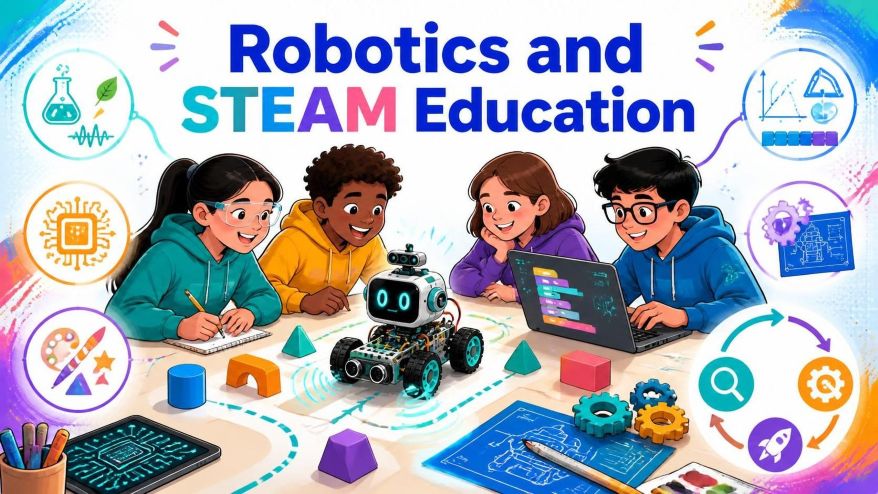
Robotics and STEAM education are reshaping classrooms. Learn how they help students innovate and apply knowledge practically.
Robotics and STEAM Education: Building Future Innovators
Estimated reading time: 7 minutes
The world changes faster than ever thanks to technology. A lot of machines are becoming a part of daily life, from self-driving cars and smart houses to healthcare robots and space travel. To prepare kids for the future, education must also change as these things happen. Combining robotics with STEAM (Science, Technology, Engineering, Arts, and Math) learning is one of the most exciting new things in education today.
There’s a lot more to robotics than just making machines. Students can use it to explore ideas, work together to solve problems, and make their imaginations come to life. When STEAM education is combined with robotics, learning is more fun, useful, and important. Students don’t just learn facts; they also make things, try new things, and find out how what they’ve learned can be used in the real world.
Why Robotics Matters in Education?
Reading, listening, and tests are often the main things that kids do in traditional classrooms. These ways of teaching are important and useful, but students learn best when they can take part. That is exactly what robotics can do.
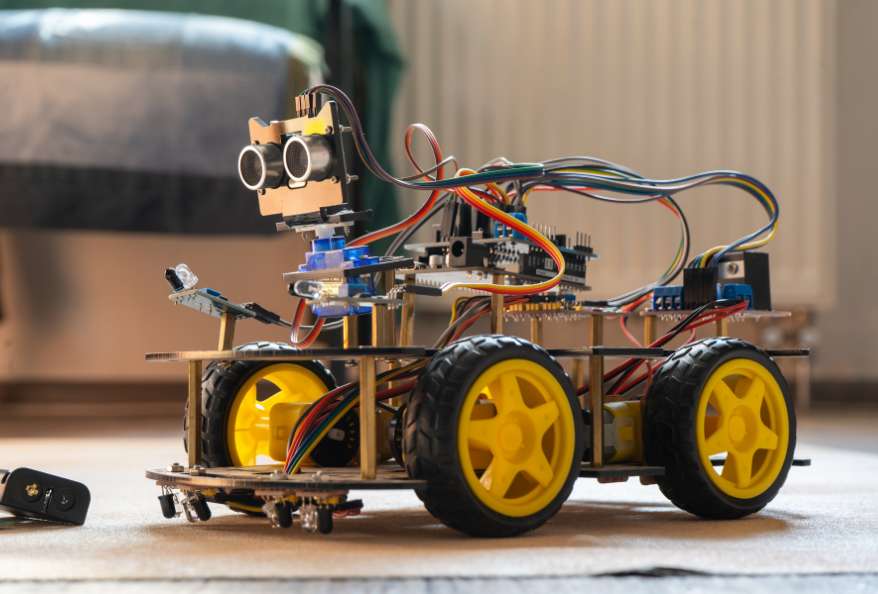
Just picture a group of students working together to make a small robot that can avoid things. They need to know basic science, be able to figure out distances, build a structure, write code, and try out different solutions in order for it to work. Every mistake is a chance to learn something. Students learn that failing is a part of success and that they should not be afraid of it.
This hands-on method helps students become more curious and confident. It makes learning fun and interesting.
Robotics: Bringing STEAM Subjects Together
One of the biggest strengths of robotics is that it connects different subjects in a natural way.
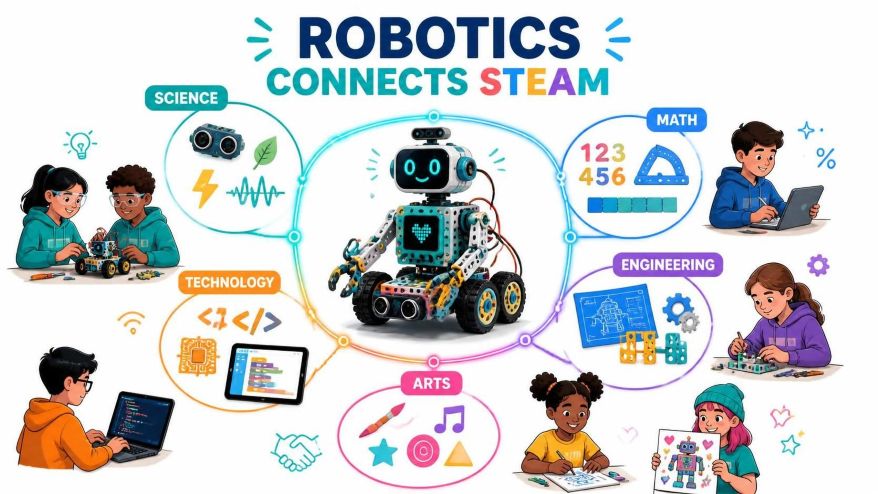
Students learn about sensors, energy, and motion through science. Numbers, angles, and patterns can all be found using math. Engineering teaches people how to plan and build things that can do certain things. Coding and digital tools are made possible by technology. The arts inspire people to be creative, make art, tell stories, and come up with new ideas.
Students might, for instance, make a robot that can help clean up a park. They would need to know about science to understand environmental problems, engineering to build the robot, programming to make it move, and creative thought to come up with a solution that works and looks good. This mix is like the real world, where innovations don’t usually come from just one area of study.
Also Read: Adaptive Robotics Lets Machines Learn Movements Instantly
Learning Through Real-Life Projects
Robotics becomes especially powerful when students work on projects that connect to real-life challenges.
In many schools around the world, students participate in robotics competitions where they design robots to complete specific tasks. These competitions teach teamwork, communication, time management, and also leadership alongside technical skills.
Consider a project where students design a robotic irrigation system for a school garden. The system can monitor soil moisture and automatically water plants when needed. Through this project, students learn about agriculture, environmental sustainability, electronics, and programming while solving a practical problem.
Another example is using robots to assist older people with simple daily tasks. Students working on such projects gain insight into social challenges and learn how technology can improve lives.
Projects like these show students that learning has purpose and impact beyond the classroom.
Also Read: The New Era of Robotics: Why Beginners Have It Better Than I Ever Did
Creativity Is Just as Important as Technology
Many people think robotics is only for students who love mathematics or coding. Instead, creativity plays an equally important role.
Before a robot can solve a problem, someone must imagine a solution. Students often sketch designs, create models, tell stories about how their robots will help people, and think creatively about improving existing ideas. For instance, students might build an interactive robot for a school exhibition. They can design its appearance, create a personality and then program it to communicate with visitors. Such activities combine technical skills with artistic expression.
Innovation happens when logic and creativity work together. Robotics provides a space where both can flourish.
Robotics and STEAM Education: Preparing for Future Careers
Automation, AI, and other advanced technologies will be used more and more in the future workforce. A lot of the jobs that students today might want to do today don’t even exist yet.
This doesn’t mean that robots will take over jobs completely. People and machines will work together instead. People who can think critically, change quickly, solve difficult problems, and also work with others will be in high demand.
Robotics education help kids learn these skills early on. Students will find it useful to be able to understand as well as use technology whether they become engineers, doctors, builders, teachers, artists, business owners or even scientists.
Global workforce studies show that being able to use technology, solve problems, be creative, and work with others are some of the most important skills for getting a job in the future. Robotics naturally helps kids get better at all of these things.
Also Read: Teaching Tomorrow: How AI & Robotics Shape Mindsets and Careers
Making Robotics Accessible for Everyone
While robotics offers tremendous benefits, access remains a challenge in some schools and communities. Robotics kits, computers, and training programs require investment. Not every student has equal access to these resources.
Fortunately, this situation is improving. Affordable robotics kits, online coding platforms, and open-source software are making robotics education more accessible than ever before. Many schools now use low-cost microcontrollers and beginner-friendly programming tools that allow students to start learning without expensive equipment.
Governments, educational institutions, and community organizations also have an important role in ensuring that all students—regardless of their background—can benefit from these opportunities.
Equal access to technology is essential if we want every young person to participate in the future digital economy.
What Students Can Do Today
Students don’t need a fancy lab to start robotics and STEAM subjects. A few small steps can change a lot. To get started, here are some useful tips:
- You can learn the basics of coding for free online.
- Become a part of a school club that does robotics, science, or technology.
- Take part in innovation challenges or contests in your area.
- Use beginner kits to try out simple electronics projects.
- Learn how to do things and do little projects at home.
- Use technology to help your friends solve everyday problems.
- For your project, write down your thoughts, experiments, and what you learned.
The goal is not to become an expert overnight. The goal is to develop curiosity, persistence, and a willingness to learn.
The Classroom of Tomorrow
The classroom of the future will look very different from the traditional classroom of the past. Students will spend more time creating, designing, testing, and collaborating. Teachers will guide exploration rather than simply deliver information.
Robotics and STEAM education are helping drive this transformation. They encourage students to ask questions, investigate solutions, and think beyond textbook answers. Learning becomes active, engaging, and connected to real world challenges.
As technology continues to evolve, education must focus not only on what students know but also on what they can create and contribute. Robotics provides a pathway for students to become inventors, innovators, and problem solvers who can make a positive difference in society.
Conclusion:
The integration of robotics and STEAM education represents a powerful shift in the way students learn and prepare for the future. By combining science, technology, engineering, arts, and mathematics through hands-on experiences, students gain both technical knowledge and essential life skills.
More importantly, robotics teaches students how to think, collaborate, adapt, and innovate. These abilities will remain valuable no matter how technology changes in the years ahead.
The future belongs to those who can imagine solutions, embrace new ideas, and work together to solve challenges. Robotics and STEAM education are helping young people develop exactly those qualities, making classrooms not just places of learning, but places where the future is built.
References:
- UNESCO (2023). STEM and Digital Learning Resources. Available at: https://www.unesco.org
- World Economic Forum (2025). Future of Jobs Report. Available at: https://www.weforum.org
- MIT Open Learning – Robotics and Engineering Education Resources. Available at: https://openlearning.mit.edu
- European Schoolnet (Open Educational Resources for STEM Education). Available at: https://www.eun.org
- National Science Foundation (NSF) STEM Education Resources. Available at: https://www.nsf.gov
- Harvard Graduate School of Education – Project-Based Learning and Student Engagement. Available at: https://www.gse.harvard.edu
- Author
- Latest Posts

Himalaya Shrivastava (M.Tech) is an ICT and STEM Education Leader with over seven years of experience advancing digital pedagogy, curriculum design, and educational technology across India. He specializes in leading primary and secondary digital learning initiatives, integrating AI fundamentals, coding, and robotics into project-based learning frameworks designed to build future-ready skills.
Himalaya plays a key role in institutional EdTech readiness, overseeing ATAL Tinkering Lab (ATL) operations, inspection protocols, and data-driven performance evaluations. Beyond classroom teaching, he conducts Continuous Professional Development (CPD) workshops for educators, collaborates with school leadership on digital transformation, and mentors student teams for national and international STEM competitions.
- Author
- Latest Posts
Himalaya Shrivastava (M.Tech) is an ICT and STEM Education Leader with over seven years of experience advancing digital pedagogy, curriculum design, and educational technology across India. He specializes in leading primary and secondary digital learning initiatives, integrating AI fundamentals, coding, and robotics into project-based learning frameworks designed to build future-ready skills.
Himalaya plays a key role in institutional EdTech readiness, overseeing ATAL Tinkering Lab (ATL) operations, inspection protocols, and data-driven performance evaluations. Beyond classroom teaching, he conducts Continuous Professional Development (CPD) workshops for educators, collaborates with school leadership on digital transformation, and mentors student teams for national and international STEM competitions.