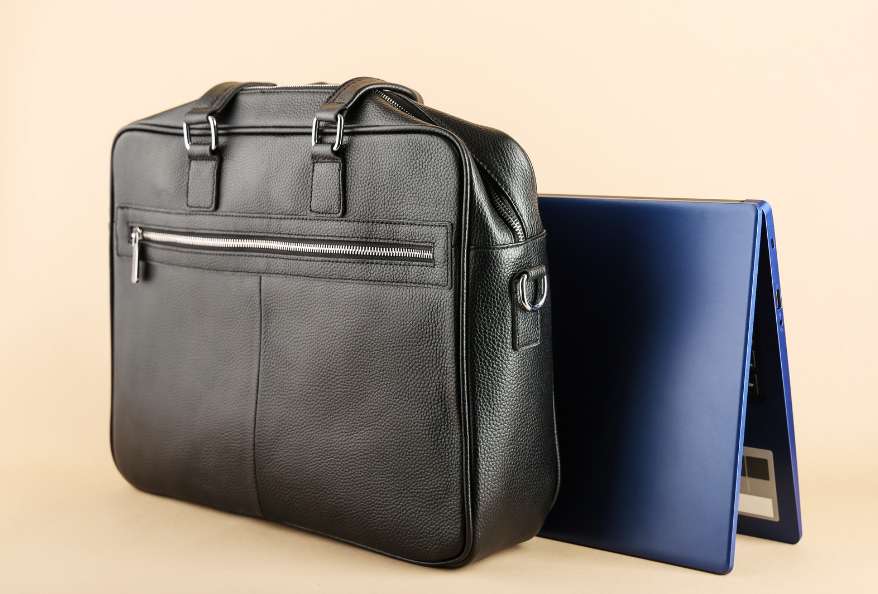
A first work leather bag may need to hold a laptop, charger, notebook, water bottle, umbrella and onboarding forms. Before replacing your lecture backpack, check whether it can carry that load comfortably and close without strain. If you need a replacement, start with these checks:
Read the full material description.
Test the bag with what you carry on an ordinary workday.
Check its care and storage requirements before paying.
What the leather description tells you about bag?
Leather begins as skin, which the Canadian Conservation Institute describes as containing collagen fibres arranged in long, wavy bundles. In skin, these fibres belong to connective tissue, where collagen supplies strength. This explains its underlying structure, but it doesn’t tell you how a finished bag will perform. Processing, finishing and construction also need consideration.
The material description helps you compare bags more carefully, provided you know what the terms mean.
Full-grain describes the surface. The Leather Working Group defines full-grain leather as leather that has kept its entire grain, with none removed by corrective mechanical treatment. The term doesn’t establish a finished bag’s lifespan or describe its stitching and handle attachments.
A pattern can be added. The Leather Dictionary explains that corrected-grain leather is often buffed to a uniform surface and then embossed with a new grain. A pebbled appearance alone therefore can’t establish the original grain.
Read the whole material line. Coach lists its Utility Tote CCW72 BLK as canvas, smooth leather and grosgrain. That makes it a mixed-material example rather than an all-leather equivalent. If the description doesn’t identify the main body’s material, ask the retailer.
Compare the bag with what you carry
Published dimensions usually describe the outside of a bag. They don’t establish usable laptop space. Your laptop also needs to pass through the opening without catching on a pocket or closure.
Measure your largest item. Put your laptop in its sleeve and measure its length, height and thickness in centimetres. A screen-size label or the word large isn’t enough to confirm fit.
Try the loaded bag. Bring the sleeved laptop and your heaviest everyday items to the store. Check that the opening clears the laptop, the bag closes with everything inside, and the straps sit comfortably under the load.
Compare the same details. Inspect the strap attachments, accessible pockets and closure. CHARLES & KEITH’s work-tote guide discusses closure types, including zips and magnetic clasps. Try the closure yourself to judge how easily you can reach your belongings and secure them again.
If you’re deciding between international labels and Malaysian bag brands, Longchamp’s Malaysia leather collection is a practical place to start. You can filter it by size and color, sort by price and check each product’s material and dimensions. Its FAQ also covers how international branded bags compare with local Malaysian brands.
When you compare listings side by side, line up the same details for each bag: the main body’s material, the published exterior size, the closure type and the price. A mixed-material tote and an all-leather tote aren’t direct equivalents, so a price gap between them says little on its own. Prices and availability change, so recheck the listings before deciding.
Before paying, check each retailer’s published returns and repair terms.
Plan for humidity before you buy
METMalaysia identifies high humidity and abundant rainfall as characteristic features of Malaysia’s climate. Consider wet commutes and your storage space alongside the bag’s size and comfort.
Check the care instructions. Follow the instructions for the exact bag you’re considering, since finishes and care requirements differ between products. As a general rule, store a leather bag in a cool, dry place away from direct sunlight, heat and moisture. Don’t assume a leather bag is waterproof unless the maker says so.
Check sourcing claims separately from care instructions. The Leather Working Group’s guidance of 16 September 2025 distinguishes membership from product sustainability claims. Membership alone doesn’t certify a particular bag or establish its sustainability.
Science of Leather: Conclusion
For a first office bag, compare the leather description, actual opening and carry comfort before reacting to price or surface texture. Measure your laptop in its sleeve, check care instructions for Malaysia’s humid conditions, and review each retailer’s returns and repair terms. These checks give you a clearer basis for an everyday work bag.
FAQs: Science of Leather
Does a higher price guarantee a better bag?
Price alone doesn’t establish whether a bag suits your routine. A mixed-material tote and an all-leather tote can sit at very different price points for reasons unrelated to how either handles your commute. Compare material, construction, fit and comfort alongside price.
Will a large tote fit my laptop?
Not necessarily. Exterior dimensions don’t establish internal clearance, and screen-size labels aren’t fit guarantees. Measure your laptop in its sleeve and try it in the bag.
How should I store a leather bag?
Follow the maker’s instructions for your specific bag. As a general rule, keep it in a cool, dry place away from direct sunlight and moisture.
What should I check before paying?
Carry the loaded bag to test comfort, open and close it with everything inside, confirm the main body’s material, and review the retailer’s returns and repair terms.
Sailee Pakhare holds a Master's degree in Biotechnology, with a research background spanning microbiology, molecular biology, and disease biology. Her postgraduate dissertation examined the antimicrobial potential of bioactive peptides from lactic acid bacteria, and her research experience includes molecular identification of bacterial isolates (with sequencing data submitted to NCBI) and work as a Research Assistant at SafeWright Laboratory. She also completed a summer internship at IIT Hyderabad studying circadian rhythms and disease biology using Drosophila melanogaster as a model organism.
Her work has been recognized with the Best Poster award at the 3rd International Conference on Innovations in Biotechnology Research for Sustainable Bioresources and Bioeconomy (2025), and she has contributed to a book chapter on the role of AI and machine learning in climate change.
Sailee is also a co-founder of LifeXtension, a community focused on longevity, ageing, and health science awareness in India. An interdisciplinary thinker, she explores questions ranging from disease biology to space and the origins of life, approaching science as a way of asking questions rather than a fixed body of facts. As a science communicator and researcher, she is committed to translating complex research into writing that is clear, accurate, and engaging.
Sailee Pakhare holds a Master’s degree in Biotechnology, with a research background spanning microbiology, molecular biology, and disease biology. Her postgraduate dissertation examined the antimicrobial potential of bioactive peptides from lactic acid bacteria, and her research experience includes molecular identification of bacterial isolates (with sequencing data submitted to NCBI) and work as a Research Assistant at SafeWright Laboratory. She also completed a summer internship at IIT Hyderabad studying circadian rhythms and disease biology using Drosophila melanogaster as a model organism.
Her work has been recognized with the Best Poster award at the 3rd International Conference on Innovations in Biotechnology Research for Sustainable Bioresources and Bioeconomy (2025), and she has contributed to a book chapter on the role of AI and machine learning in climate change.
Sailee is also a co-founder of LifeXtension, a community focused on longevity, ageing, and health science awareness in India. An interdisciplinary thinker, she explores questions ranging from disease biology to space and the origins of life, approaching science as a way of asking questions rather than a fixed body of facts. As a science communicator and researcher, she is committed to translating complex research into writing that is clear, accurate, and engaging.