These show fast plasma traveling outward at speeds of up to hundreds of kilometers per second.
Young Sun-like Star EK Draconis Emits Powerful Flares and Fast Plasma Jets
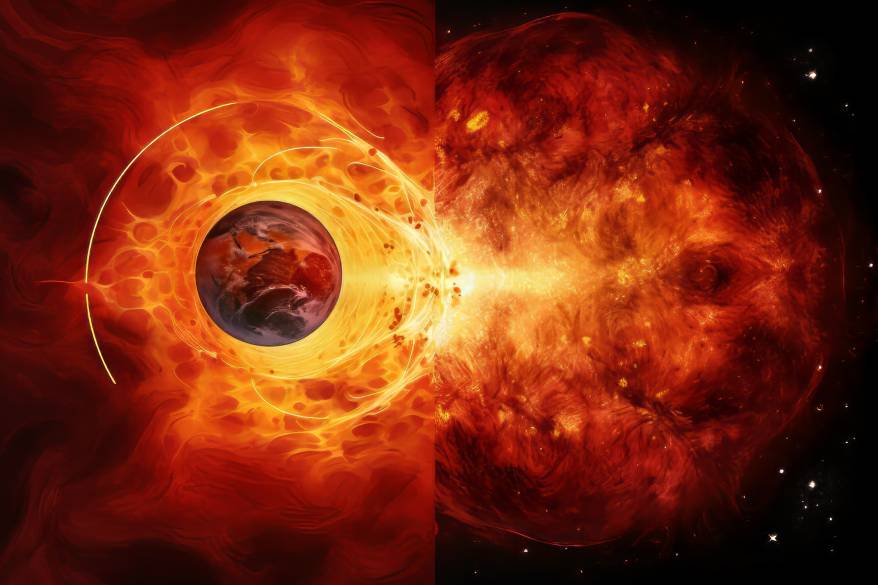
Observing Stellar Explosions in Multiple Colors
Scientists recently observed a young star called EK Draconis that behaves like our Sun did billions of years ago. This star is an exciting subject of study in the field of space weather.Using space telescopes like the Hubble Space Telescope (HST), along with ground telescopes in Japan and South Korea, they watched this star for signs of sudden bursts called flares. Consequently, these flares blasted out hot, fast-moving plasma jets. Moreover, they were similar to the powerful solar eruptions we see on our Sun.
What makes this observation special is that, in fact, researchers carefully studied light from the star at many different temperatures. Consequently, this approach allowed them to track how gases moving away from the star changed over time. This contributed to our understanding of space weather. Moreover, they detected colored shifts in the light spectrum known as Doppler shifts. These show fast plasma traveling outward at speeds of up to hundreds of kilometers per second.
How Did They Detect These Fast Flows?
The scientists analyzed ultraviolet (UV) light lines of elements like carbon (C iii), silicon (Si iv), and hydrogen (Hα) from EK Draconis. These lines tell us about gases at different temperatures. They help explain phenomena related to space weather.
- The UV lines showed bright blueshifted components, meaning plasma was rushing toward us quickly.
- The Hα line, in visible light, also revealed shifting patterns showing cooler plasma jets moving outward after the flare.
- This multi-wavelength study gave a complete picture of how explosion materials move through layers of a star’s atmosphere.
Why Monitor Young Suns Like EK Draconis?
Younger stars like EK Draconis are far more active than our current Sun. Their strong flares and coronal mass ejections (CME) may affect planets orbiting them. They can strip atmospheres or alter chemistry needed for life. Understanding how these massive blasts work helps scientists learn about early Earth conditions. It also helps with planetary evolution around other stars, which is vital for studying space weather.
The Impact on Planetary Systems and Space Weather
How Flares Shape Planet Atmospheres
The powerful eruptive events that happen on young solar analogues like EK Draconis may strongly shape the atmospheres of nearby planets. These eruptions can affect how space weather influences planetary environments and can cause:
- Losing atmospheric gases: Strong space weather can strip away protective layers around planets similar to early Mars or newly forming worlds.
- Chemical changes: High-energy particles might generate important molecules such as greenhouse gases or amino acids needed for life’s building blocks.
A New Window into Stars Like Our Young Sun
This first-time multi-wavelength detection gives researchers valuable data to better understand magnetic explosions beyond our solar system. Moreover, this is crucial for understanding space weather impact. In particular, by linking spectroscopy with observations across UV and visible light ranges, scientists gain insight. Consequently, they learn about the temperatures and speeds of eruptive plasma clouds heading out from stars
Additionally, to stay updated with the latest developments in STEM research, visit ENTECH Online. Basically, this is our digital magazine for science, technology, engineering, and mathematics. Further, at ENTECH Online, you’ll find a wealth of information.
Reference:
Namekata, K., France, K., Chae, J., Airapetian, V. S., Kowalski, A., Notsu, Y., Young, P. R., Honda, S., Kang, S., Kang, J., Lee, K., Maehara, H., Lee, K.-S., Tamburri, C., Ohshima, T., Takayama, M., & Shibata, K. (2025). Discovery of multi-temperature coronal mass ejection signatures from a young solar analogue. Nature Astronomy. https://doi.org/10.1038/s41550-025-02691-8
- Author
- Latest Posts

I’m a web developer and science writer with a Master’s degree in Computer Applications (MCA) from Pune University.
I work in tech, building websites and staying updated with the latest developments. I also love writing about physics, chemistry, technology, robotics, mathematics, and breakthrough innovations. My passion is breaking down complex scientific topics into simple, easy-to-understand stories.
My goal is to help everyone stay informed about the exciting changes happening in science and technology. I believe understanding science shouldn’t be complicated—it should be accessible to all.
- Author
- Latest Posts
I’m a web developer and science writer with a Master’s degree in Computer Applications (MCA) from Pune University.
I work in tech, building websites and staying updated with the latest developments. I also love writing about physics, chemistry, technology, robotics, mathematics, and breakthrough innovations. My passion is breaking down complex scientific topics into simple, easy-to-understand stories.
My goal is to help everyone stay informed about the exciting changes happening in science and technology. I believe understanding science shouldn’t be complicated—it should be accessible to all.