The interstellar comet 3I Atlas has sparked excitement among scientists and space enthusiasts this week. Discovered by the ATLAS survey telescope in July 2025, this rare object travels on a hyperbolic path that took it into our…
Interstellar Comet 3I Atlas: A Visitor from Deep Space
Estimated reading time: 3 minutes
The interstellar comet 3I Atlas has sparked excitement among scientists and space enthusiasts this week. Discovered by the ATLAS survey telescope in July 2025, this rare object travels on a hyperbolic path that took it into our solar system from distant outer space. Unlike most comets that orbit the Sun, 3I Atlas will continue on its journey, eventually leaving our solar system behind.
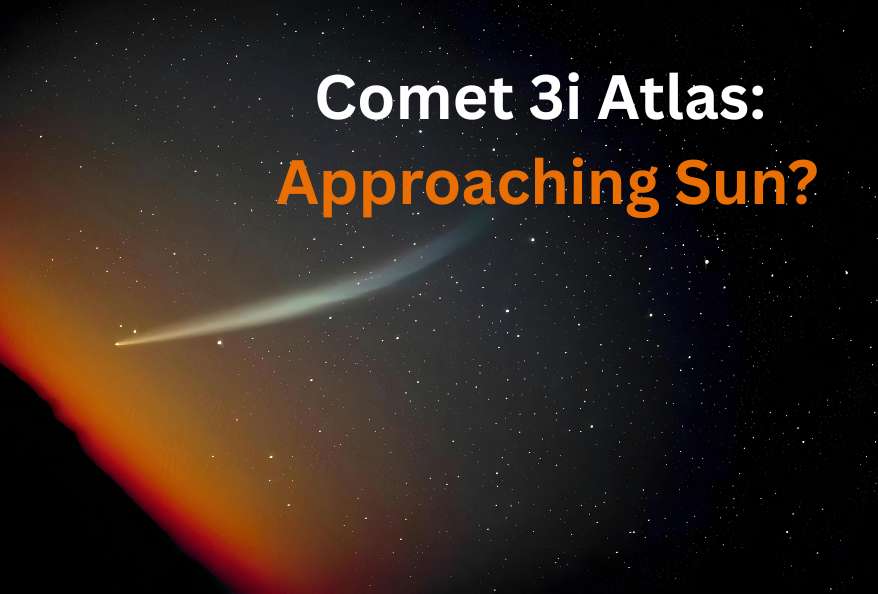
Every comet tells a story. However, this one breaks several established comet rules. Its tail has a strange direction. During July and August, observatories saw its “anti-tail” pointing toward the Sun instead of away, which is unusual. By September, the tail shifted. This behaviour puzzled many astronomers, although some say solar winds and its speed explain the phenomenon.
Interstellar Comet 3i Atlas: Fast Approach and Rare Features
How Will 3I Atlas Affect Earth?
Right now, 3I Atlas is making headlines because of its close approach to the Sun, known as perihelion, on October 29–30, 2025. Its icy surface is heating up, vaporizing, and forming a glowing coma with a long, streaming tail. Observatories worldwide have tracked changes in its brightness and jet activity. Occasionally, ground telescopes see “giant jets” of dust and gas blasting toward the Sun.
Despite dramatic images and scientific discussion, experts confirm 3I Atlas poses no threat. At its closest, it will be 1.8 astronomical units from Earth – over 270 million kilometers away. NASA and the European Space Agency continue monitoring and studying its composition for clues about other worlds.
Also Read: Interstellar Comet 3I Atlas Discovered.
Unusual Composition Intrigues Scientists
Insights from Recent Observations
Another thing that makes 3I Atlas so interesting is its chemical makeup. Recent observations using powerful telescopes like Hubble and the Very Large Telescope found that the comet is rich in carbon dioxide, cyanide gas, and atomic nickel vapor. This nickel detection was surprising because it appeared at extremely cold temperatures, suggesting the comet has some mysterious, ancient origins.
Some scientists, including Harvard’s Avi Loeb, believe the comet might show signs of “non-gravitational acceleration,” changing speed and direction in ways gravity alone can’t explain. Loeb speculated, “The question is, why has such a giant object entered our solar system now?” This excitement led to theories about artificial origins, but most astronomers see natural explanations.
Also Read: Asteroid 2024 YR4: NASA Asteroid Hitting Earth?
Interstellar Comet 3i Atlas: Cosmic Messenger from Beyond
Interstellar comets like 3I Atlas give us fresh insight into objects formed beyond the solar system. Its presence allows scientists to study the chemistry and physical changes of a visitor that likely existed before our Sun was born. No matter what, its journey teaches us more about our galaxy while inspiring lively debate and wonder.
“Every rare visitor unlocks secrets that regular comets can’t reveal,” noted one astronomer in response to 3I Atlas’s latest discoveries.
As 3I Atlas speeds away, its data will help future missions track and predict orbits of other interstellar objects. Scientists will keep watching, hoping to solve more cosmic mysteries one comet at a time.
Additionally, to stay updated with the latest developments in STEM research, visit ENTECH Online. Basically, this is our digital magazine for science, technology, engineering, and mathematics. Further, at ENTECH Online, you’ll find a wealth of information.
- Author
- Latest Posts

Deven Nandapurkar is a Software Engineer, Project Lead; working at the strategic intersection of software engineering, productivity science, and emerging technologies. Driven by a core philosophy of “building things worth building,” he leads cross-functional teams and drives end-to-end technical strategy—from early-stage conceptualization through production-grade deployment.
A Computer Engineering graduate from Pune University, Deven brings a sharp systems-thinking approach to technical leadership, honed by years of managing high-stakes engineering projects and leading teams to top placements in national and international hackathons, including the NASA Space Apps Challenge and the Peerlist GenAI Hackathon.
Deven explores how human cognition and emerging technology converge. He regularly writes about cognitive performance optimization, attention management, AI integration, and the evolving dynamics of the modern workforce – offering actionable frameworks for professionals seeking to maximize their productivity and thrive alongside intelligent systems.
- Author
- Latest Posts

Ashwini Kshirsagar holds a graduate degree in Chemistry and a postgraduate degree in Environmental Science from Shivaji University, Kolhapur. With a strong foundation in scientific principles and a creative flair, she blends her expertise in environmental science with skills in technical writing, graphic design, and video editing. Proficient in Adobe software, Ashwini excels at transforming complex scientific concepts into clear, engaging, and visually compelling content. Her unique ability to merge science and storytelling allows her to create impactful communication materials that are both informative and accessible to a wide audience.