Recently, scientists focused on ultrashort-period (USP) exoplanets like TOI-561 b. These planets orbit their stars extremely quickly, often within a day.
TOI-561 b: A Unique Super-Earth With Surprising Atmosphere
Estimated reading time: 3 minutes
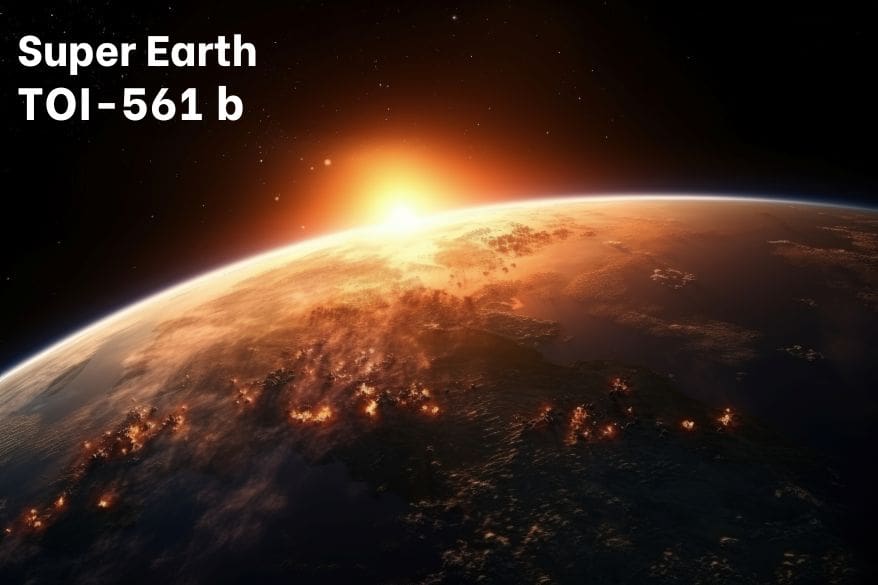
The study of exoplanets provides fresh insights into planetary formation and habitability. Recently, scientists focused on ultrashort-period (USP) planets like TOI-561 b. These planets orbit their stars extremely quickly, often within a day. Yet, TOI-561 b challenges many assumptions about such worlds.
What Makes TOI-561 b Special Among USP Planets?
USP planets typically have very high surface temperatures. They often lose their atmospheres due to intense stellar radiation. Most show compositions similar to Earth’s rocky core with little or no gas envelope. However, TOI-561 b stands out because of its unexpectedly low density.
Also Read: Super Earth GJ887d
Density and Temperature Features
The planet’s density is about 4.3 g/cm³, which is surprisingly low for such a hot planet with an equilibrium temperature around 2300 K. Normally, this temperature would strip a planet entirely of its atmosphere over time.
Possible Volatile Envelopes Defy Atmospheric Loss Theories
The low density hints at a possible volatile envelope , which may consist of gases heavier than hydrogen and helium. This contradicts the common understanding that USP planets lose all volatiles quickly via atmospheric escape mechanisms.
Interestingly, some scientists propose that volatiles could be trapped inside the planet’s interior and then slowly released to form a secondary atmosphere. Moreover, specific processes like radiative cooling might reduce atmospheric evaporation rates.
Also Read: This Scorching Rocky Planet Shouldn’t Have an Atmosphere – But It Does
A Unique Formation Environment
The old age (~10 billion years) and chemical makeup (iron-poor and alpha-rich) of TOI-561’s host star also make this system unusual when compared to our solar system or other USP systems.
The characteristics of TOI-561 b suggest new pathways for how rocky exoplanets can retain atmospheres despite extreme conditions. — Astrophysics Research Team
This makes studying TOI-561 b crucial for understanding the interactions between planetary interiors and atmospheres under extreme irradiation.
How Scientists Observed TOI-561 b’s Atmosphere Using JWST
The James Webb Space Telescope (JWST) played an essential role in obtaining direct emission spectra from the dayside of TOI-561 b. Researchers observed four secondary eclipses using the NIRSpec instrument from May 1–3, 2024.
This approach helped separate the light emitted by the planet from its host star during eclipses when the planet passed behind it. The resulting spectrum covered wavelengths between 2.67 μm and 5.14 μm at high resolution.
Also Read: NASA Celebrates 6,000 Confirmed Exoplanets Beyond Our Solar System
Why Does This Matter?
This new data has multiple implications:
- Possible Secondary Atmosphere: Volatiles might come from within the planet instead of original gas layers lost early on.
- Diverse Formation Paths: Understanding TOI-561 b helps evaluate how USP planets form and evolve differently than expected.
- Astronomical Significance: Finding volatiles challenges previous models mainly based on hydrogen escape physics.
If confirmed across more USP planets, this will broaden perspectives about exoplanet atmospheres and rocky planet habitability prospects.
Implications for Future Research
The intriguing observations open new avenues in exoplanet research by potentially identifying secondary volatile atmospheres on rocky planets never expected to hold them at such extreme temperatures.
Additionally, to stay updated with the latest developments in STEM research, visit ENTECH Online. Basically, this is our digital magazine for science, technology, engineering, and mathematics. Also, at ENTECH Online, you’ll find a wealth of information.
Reference
- Teske, J. K., Wallack, N. L., Piette, A. a. A., Dang, L., Lichtenberg, T., Plotnykov, M., Pierrehumbert, R., Postolec, E., Boucher, S., McGinty, A., Peng, B., Valencia, D., & Hammond, M. (2025). A Thick Volatile Atmosphere on the Ultrahot Super-Earth TOI-561 b. The Astrophysical Journal Letters, 995(2), L39. https://doi.org/10.3847/2041-8213/ae0a4c
- Author
- Latest Posts

Ashwini Kshirsagar holds a graduate degree in Chemistry and a postgraduate degree in Environmental Science from Shivaji University, Kolhapur. With a strong foundation in scientific principles and a creative flair, she blends her expertise in environmental science with skills in technical writing, graphic design, and video editing. Proficient in Adobe software, Ashwini excels at transforming complex scientific concepts into clear, engaging, and visually compelling content. Her unique ability to merge science and storytelling allows her to create impactful communication materials that are both informative and accessible to a wide audience.