The LA basin ranks among the most complex logistics hubs in the country. Brands using third-party logistics companies here quickly discover why. Specifically, Long Beach port congestion, high warehouse lease rates, CARB truck emissions standards, and AB5 contractor rules make picking the wrong partner costly. To help you navigate this market, we reviewed dozens of fulfillment providers across service models, pricing structures, and customer feedback. After all, this guide narrows down to 5 top fulfillment and third-party logistic companies serving in Los Angeles reliably.
The shortlist methodology
This guide reviews third-party logistics companies that run a Southern California warehouse or serve Los Angeles businesses from outside facilities. Specifically, we use company websites, case studies, and public customer feedback to compare warehouse locations, core services, supported products, and order volumes. Furthermore, each “best for” label highlights the ideal business fit for these fulfillment companies rather than an overall ranking. While customer reviews reveal recurring service themes, they do not independently verify reported performance metrics.
Each company was assessed using publicly available information pulled from review platforms, official websites, case studies, and directory listings. Only providers with a documented track record in logistics and fulfillment made the cut, with particular attention paid to service depth and client results.
→ See the full research breakdown
Ops Engine – Best for DTC brands and subscription services needing personalized omni-channel fulfillment
Ship Monk – Best for scaling ecommerce businesses shipping high order volumes monthly
Ship Fusion – Best for ecommerce retailers wanting proprietary software and dedicated account management
Rakuten Super Logistics – Best for ecommerce fulfillment and order logistics
Red Stag Fulfillment – Best for enterprise and fast-growing ecommerce brands handling big, heavy, and bulky products
How Third-Party Logistics Companies serving Los Angeles Impact Your Bottom Line
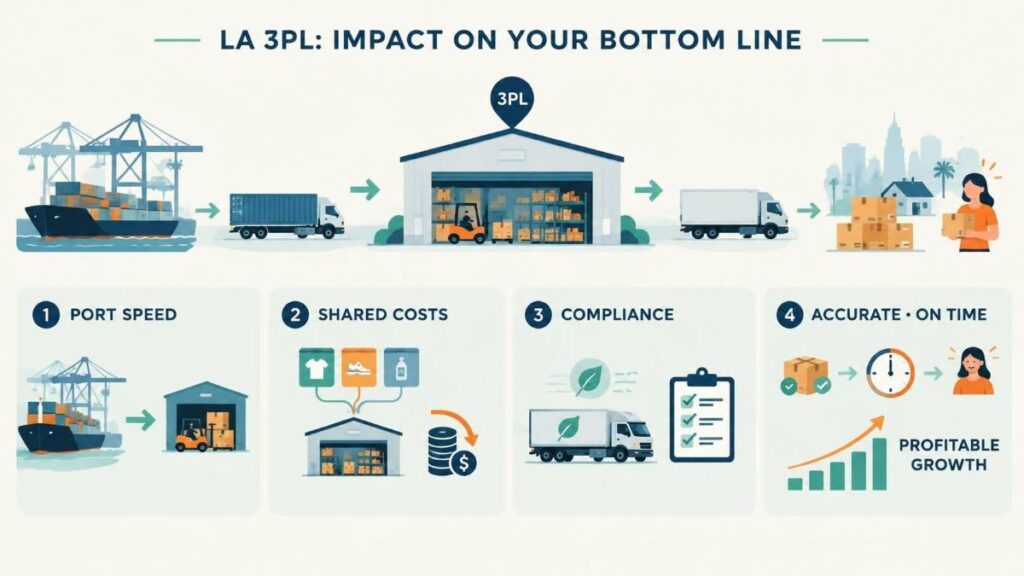
Choosing the right third-party logistics companies serving Los Angeles isn’t just an operational decision. It directly shapes your margins, customer experience and also how fast your brand can grow. The LA/Long Beach port complex creates real pressure on inbound receiving turnaround times. A partner without strong port operations can leave your inventory sitting for days. Consequently, these delays ruin your on-time shipping rate before workers even pick an order.
Warehouse lease costs in the LA basin are some of the highest in the country. A well-matched 3PL absorbs those costs across multiple clients. This brings down your cost per order, in a way that renting your own space simply can’t match. California’s environmental and labor rules add another layer. CARB truck emissions standards and AB5 contractor classifications affect how carriers move your freight. A 3PL that understands these regulations keeps your operation clean and compliant.
Fig. 1: Logistic Impact on Bottom-Line (illustration – AI Generated)
The right partner raises your order accuracy rate. Furthermore, they keep your on-time shipping rate inside agreed windows. All in all, this lowers your blended cost per order to support profitable growth.
Top 5 Third-Party Logistics Companies serving Los Angeles: Specs at a Glance
Note: All data in this table is sourced from review platforms and the official websites of the listed companies.
Table 1: Comparison
Company Name
Years Operating
Headquartered In
Ops Engine
–
Valencia, California, United States
Ship Monk
Est. 2014
Fort Lauderdale, FL
Ship Fusion
Est. 2013-2014
Toronto, Canada
Rakuten Super Logistics
Est. 2001
Las Vegas, NV
Red Stag Fulfillment
Est. 2013
Knoxville, Tennessee
Fulfillment Companies Serving Los Angeles: At a Glance
Ops Engine – Best for DTC Brands and Subscription Services Requiring Personalized Omni-Channel Fulfillment
What Makes Ops Engine Stand Out?
Ops Engine handles fulfillment for direct-to-consumer (DTC) brands and businesses that sell across multiple channels. Its team receives and stores inventory, then picks and packs orders. It also assembles kits and processes returns. According to Ops Engine, its four-step scanning process helps catch errors before orders ship. Brands managing complex subscription boxes or multi-SKU kits benefit greatly from a 3PL fulfillment center like OpsEngine. Specifically, partnering with them places your inventory right near the port complex. On top of that, this location gives you direct access to Southern California’s dense consumer market. Transparent billing and dedicated account management round out what makes them worth considering.
What’s Ops Engine’s Standout Strength for Third-Party Logistics Companies In Los Angeles?
Ops Engine solves a real problem for DTC brands. Specifically, it serves brands that outgrow generic warehousing without needing a full in-house logistics team. Moreover, their personalized model and accuracy guarantee create clear accountability. Growing brands need this reliability to protect their customer experience.
Themes from Real User Reviews:
The website features client testimonials that point to transparency and responsiveness as consistent strengths. Clients value the fact that billing is clear and that their account team actually understands their product. That kind of attentiveness is rare at this price point and service level.
Ship Monk – Best for Scaling Ecommerce Businesses Shipping High Order Volumes Monthly
What Makes Ship Monk Stand Out?
ShipMonk helps growing ecommerce brands fulfill and ship orders. It operates a fulfillment center in San Bernardino and has facilities outside the U.S. Its warehouse software helps brands track inventory and manage orders across large product catalogs. It also includes shipping tools. Before signing, ask ShipMonk to confirm which warehouse would handle your orders, what minimums apply, and how much fulfillment would cost at your monthly order volume.
What’s Ship Monk’s Standout Strength for Third-Party Logistics Companies In Los Angeles?
ShipMonk fills a critical gap for growing brands. Specifically, they step in when order volumes outpace what a boutique 3PL can handle. They also deliver enterprise-level infrastructure without requiring a fully custom enterprise contract. Their proprietary technology and multi-facility reach make them a reliable choice for rapid geographic expansion.
Themes from Real User Reviews:
Reviews reflect strong appreciation for ShipMonk’s technology platform and the visibility it gives into inventory and order status. Users report the setup process to be structured, and integrations with other platforms work smoothly. Some feedback points to customer service responsiveness as an area that can vary depending on account size.
Ship Fusion – Best for Ecommerce Retailers Wanting Proprietary Software and Dedicated Account Management
What Makes Ship Fusion Stand Out?
Ship Fusion runs four fulfillment centers across Chicago, York PA, Las Vegas, and Toronto, covering over one million square feet of fulfillment space. What sets them apart from similarly sized competitors is their own proprietary fulfillment software, which gives clients real-time analytics and a level of customization that off-the-shelf systems can’t match. Every client gets a dedicated account manager at every location, which isn’t standard in this industry. Their US facilities hold SQF certification, and their Toronto location carries Health Canada approval, making them a solid pick for brands that need certified handling. They’ve also appeared on the Deloitte 2021 Technology Fast 500 list.
What’s Ship Fusion’s Standout Strength for Third-Party Logistics Companies In Los Angeles?
Shipfusion gives each client a dedicated account manager. It also offers its own software to help clients track inventory and orders. For example, Shipfusion’s case studies describe how it handles fulfillment for TUSHY and Purity Coffee.
Themes from Real User Reviews:
Clients consistently point to the dedicated account manager model as a differentiator. Having a named contact who knows the account reduces the back-and-forth that slows down problem resolution. Order accuracy and delivery consistency come up repeatedly as reliable strengths.
Rakuten Super Logistics – Best for Ecommerce Fulfillment and Order Logistics
What Makes Rakuten Super Logistics Stand Out?
Rakuten Super Logistics has been in the fulfillment space since 2001, which gives them a network depth that newer entrants haven’t had time to build. Their two-day delivery network covers 98% of the US, and their platform integrates directly with Shopify, Amazon, Magento, Walmart Marketplace, and eBay, covering the major channels most ecommerce brands run on. Their SmartFill, SmartStock, and SmartShip Optimizer tools help clients reduce shipping costs and improve delivery speed without manual intervention. The company has also earned recognition for using AI technology to pursue carbon neutrality. Consequently, this commitment matters greatly as California continues to tighten its environmental standards.
What’s Rakuten Super Logistics’s Standout Strength for Third-Party Logistics Companies In Los Angeles?
ShipNetwork (formerly Rakuten Super Logistics) helps ecommerce brands ship orders nationwide. Brands can use its carrier network instead of setting up their own carrier accounts. In addition, ShipNetwork connects directly to supported ecommerce platforms. These integrations can simplify setup.
Themes from Real User Reviews:
Clients report that Rakuten’s platform integrations are a genuine time-saver, especially for brands already running on multiple sales channels. The two-day delivery network performs consistently, and shipping cost reductions after setup are a commonly mentioned benefit.
Red Stag Fulfillment – Best for Enterprise and Fast-Growing Ecommerce Brands Handling Big, Heavy, and Bulky Products
What Makes Red Stag Fulfillment Stand Out?
Red Stag was founded by ecommerce operators, and that background shows in how they’ve structured their service guarantees. They cover DTC parcels, retail pallets, Amazon FBA prep, and Seller Fulfilled Prime across two warehouse locations totaling 1.2 million square feet in Tennessee and Utah. That positioning lets brands reach 96% of the US within two days via ground shipping. What stands out is that they back their accuracy, on-time shipping, zero shrinkage, and fast receiving promises with financial penalties if targets are missed (not many 3PLs put money on the line like that). They’ve made the Inc. 5000 list and been named one of the best 3PLs for small businesses six consecutive years by Fit Small Business.
What’s Red Stag Fulfillment’s Standout Strength for Third-Party Logistics Companies In Los Angeles?
Red Stag directly addresses the challenge brands face when shipping heavy or oversized products, a category that generic 3PLs often handle poorly, with fees and damage rates that erode margins quickly. Their performance-backed guarantees shift the accountability to the fulfillment partner, which gives merchants a meaningful layer of financial protection.
Themes from Real User Reviews:
Reviewers frequently highlight Red Stag’s handling of heavy and bulky freight as a standout skill. Specifically, their damage rates remain much lower than what clients experienced with previous providers. Above all, their guarantee structure gives operations teams real confidence before peak seasons arrive.
Third-Party Logistics Companies serving Los Angeles: Research Approach and Quality Filters
The process of building this list started from scratch, not from a pre-existing shortlist. Research was conducted across multiple layers of publicly available information, with the goal of identifying which logistics and fulfillment providers in and around the Los Angeles market actually deliver consistent results for the brands they serve.
The Data Gathering Phase
A broad longlist was assembled by pulling company names from fulfillment-specific directories, regional business databases, and logistics-focused review platforms. Official company websites were reviewed alongside any available case studies, press coverage, and third-party feature breakdowns. The focus stayed on providers with a documented presence in the LA-area market or with infrastructure serving LA-basin shippers.
Narrowing the Field of Applicants
From the broader longlist, providers without verifiable operational history or publicly accessible client feedback were removed. Review patterns were analyzed across platforms to identify companies with consistent, recurring themes rather than isolated positive mentions. Providers with thin or unverifiable track records were filtered out at this stage, regardless of how polished their marketing appeared.
How Claims Stack Up Against Evidence
Every claim made on a company’s website, whether about accuracy rates, delivery speed, or service capabilities, was cross-referenced against available client feedback, case studies, and third-party recognition. Where a company claimed a 99.9% accuracy rate, that figure was checked against whether clients actually reported that level of performance in their reviews. Gaps between marketing claims and real-world feedback were noted and factored into final rankings.
The Reputation Audit
Each shortlisted company was checked for industry recognition, including appearances on growth rankings like the Inc. 5000, awards from business intelligence organizations, and mentions in logistics or ecommerce trade publications. This wasn’t about collecting badges, but about identifying which companies have earned external validation of their performance over time, as opposed to companies that simply present well online.
Where Third-Party Logistics Companies In Los Angeles Evidence Lives
The strongest evidence was found on dedicated service pages that go into specific operational detail, verified client reviews that name real outcomes (order accuracy improvements, cost reductions, faster receiving turnaround), and case studies that show before-and-after results for real brands. Generic testimonials without specifics were weighted lower than detailed accounts of measurable performance changes. Companies with richer, more specific evidence of fulfillment results ranked higher in the final selection.
Match a Third-Party Logistics Companies serving Los Angeles to Your Workflow
Finding the right third-party logistics companies serving Los Angeles comes down to understanding where your operation sits today and where it needs to go. The five companies on this list each cover a different part of the market, so the right choice depends on your product type, your order volume, and how much support your team actually needs from a fulfillment partner.
Fig. 2: Match your workflow – 3PL Fullfilment providers (illustration – AI Generated)
Industry/Domain Experience: Look for a 3PL that has worked with brands in your specific product category. A provider that handles subscription boxes daily understands kitting in a way that a general freight warehouse does not.
Features and Services: Map out the services your operation actually uses, including returns processing, retail prep, FBA prep, kitting, and cold storage, before signing anything. Not every 3PL covers all of these.
Pricing Structure: Cost per order varies widely depending on pick-and-pack operations, storage footprint, and outbound shipping volume. Get a blended cost estimate before comparing providers on price alone.
Results Measurement: Ask every provider how they report on order accuracy rate and on-time shipping rate. If they can’t show you a live dashboard or regular reporting, that’s worth noting.
Industry Knowledge and Compliance: California’s CARB truck emissions rules and AB5 classifications affect carrier costs and contractor relationships. A 3PL familiar with these regulations saves you from unexpected compliance issues down the line.
Key Takeaways:
Picking the right third-party logistics companies serving Los Angeles requires matching your product type, order volume, and service needs to an experienced local partner. Specifically, Ops Engine fits brands needing precision and personalized service. Meanwhile, ShipMonk and Ship Fusion support scaling ecommerce businesses. Rakuten also provides broad reach, while Red Stag dominates the heavy freight category. Because fulfillment expectations keep rising and California regulations continue to evolve, the right partner acts as a true growth asset rather than a mere cost center.
Once you narrow your shortlist to two or three providers, request quotes using the exact same order profile. Specifically, include your monthly volume, product dimensions, item weights, and common shipping destinations. Additionally, ensure each quote names your assigned warehouse and separates receiving, storage, pick-and-pack, and shipping fees. Consequently, this breakdown lets you easily compare your total cost per order. After all this, you can clearly see whether a Southern California warehouse outperforms an out-of-region option.
Deven Nandapurkar is a Software Engineer, Project Lead; working at the strategic intersection of software engineering, productivity science, and emerging technologies. Driven by a core philosophy of "building things worth building," he leads cross-functional teams and drives end-to-end technical strategy—from early-stage conceptualization through production-grade deployment.
A Computer Engineering graduate from Pune University, Deven brings a sharp systems-thinking approach to technical leadership, honed by years of managing high-stakes engineering projects and leading teams to top placements in national and international hackathons, including the NASA Space Apps Challenge and the Peerlist GenAI Hackathon.
Deven explores how human cognition and emerging technology converge. He regularly writes about cognitive performance optimization, attention management, AI integration, and the evolving dynamics of the modern workforce - offering actionable frameworks for professionals seeking to maximize their productivity and thrive alongside intelligent systems.