This study maps global research trends (1992–2024) on metallic pollutants, showing rapid growth in heavy metal toxicity studies driven by rising environmental and health concerns
Tracing Toxicity: Three Decades of Heavy Metal Pollution

Estimated reading time: 5 minutes
Rapid industrial growth is intensifying heavy metal pollution, filling our environment with toxic metals that do not break down and persist for long periods. As a matter of fact, these contaminants accumulate in soil, water, and living organisms. What’s more, it causes serious health problems in humans and wildlife. Scientists Sankar Ganesh Palani, Brindha Rethinam and their team have published a research on tracing toxicity. Their research highlights that metals such as lead, mercury, and cadmium are among the most harmful. In fact, they are capable of damaging vital organs like the brain and kidneys. At the same time, emerging metals such as aluminum are worsening the situation, with heavy metal pollution increasingly disrupting food chains and ecosystems worldwide.
TL;DR ‘Heavy Metal Pollution’
It identifies key themes like bioremediation, nanotechnology, and risk assessment while highlighting research gaps in chronic exposure and understudied metals. By bringing together multiple disciplines, this breakthrough connects biology, chemistry, and health science. In doing so, it inspires students to pursue future careers in
Key Takeaways on Toxic Metal Pollution
- Toxic metals persist in the environment without natural breakdown.
- Main sources include mining, industrial discharge, battery making.
- These metals enter humans via drinking water, food, air, or skin contact.
- Health impacts: organ damage targeting brain, kidneys, liver.
- Heavy metals dominate research, but lighter ones also show toxic potential.
- Toxicity depends on dose and chemical reaction, not just metal weight.
- Research gaps remain: Effects of low-dose chronic exposure need study.
The study of toxic metals integrates chemistry with biology (toxicology) as well as earth sciences; in addition, specialists focus on detecting contaminants in various environments. Furthermore, they work to develop effective cleanup methods, particularly bioremediation, to mitigate pollution. Moreover, experts aim to create safer industrial practices; as a result, environmental and human health risks are significantly reduced. To that end, recently newer topics like nanomaterials have entered research focus because they behave differently at tiny scales but may be toxic too.
The Science Behind Metal Toxicity Explained Simply
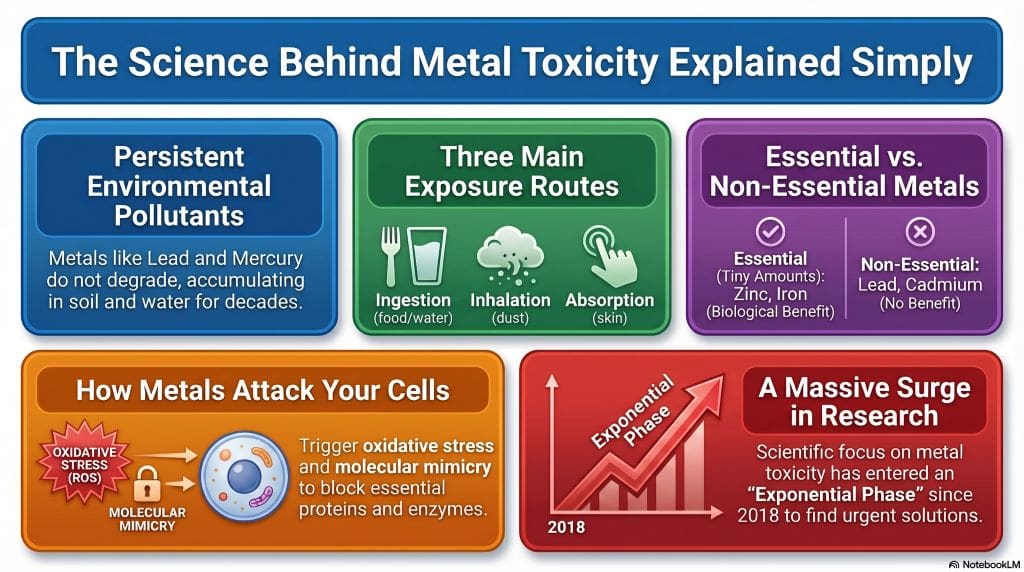
Toxicity works by:
- Create oxidative stress by making harmful reactive oxygen species (ROS).
- Deny enzymes their function by binding to protective molecules called thiols (-SH groups).
- Mimic essential metal ions causing biochemical disruption inside cells.
- Affect gene expression leading to mutations or epigenetic changes over time.
Categorizing Metals: Essential vs Nonessential
Metals can be grouped into two types: essential trace metals and nonessential toxic metals. Each type affects our health and the environment in different ways.
Essential trace metals, like iron (Fe) and zinc (Zn), are important for the body. We only need them in small amounts, but they play big roles. Also, they help with things like enzyme activity, boosting the immune system, and carrying oxygen in the blood.
On the other hand, nonessential toxic metals, such as lead (Pb) and mercury (Hg), are harmful. They don’t have any health benefits. Even in tiny amounts, they can cause damage. These metals interfere with how cells work and can lead to serious health problems.
Knowing the difference between these metals is very important. It helps guide efforts to clean up pollution and protect people. This is especially true for vulnerable communities. By understanding the risks of contaminated food and water, we can take action. This knowledge allows us to reduce exposure and improve public health.
Bioremediation Magic
Bioremediation is an exciting and eco-friendly way to fight pollution and clean up toxic waste. Microbes play an important role by breaking down harmful substances and stabilizing heavy metals in soil and water. Plants also help through a process called phytoremediation, where they remove poisons from the soil. Nanomaterials are another great tool. They trap toxic metal ions and make it easier to get rid of pollutants.
Advanced sensors can now detect even the tiniest water pollutants. At the same time, data predictions help us spot future contamination risks. Special materials, like activated carbon, are used to clean up dangerous metals like chromium. Zinc oxide is also effective at killing harmful bacteria. Plus, green chemistry is creating safer and more sustainable materials to support cleanup efforts.
Together, these innovations are changing how we protect the environment. You can be part of this change too! By learning about green chemistry, designing better sensors, or diving into STEM fields, you can make a difference. With science and teamwork, we can create a cleaner, healthier planet for everyone.
Future Research Potential in Avoiding Heavy Metal Pollution
For the most part, gaps exist.
- Rare earth metals need study.
- Low doses cause unknown harm.
- Deep sea habitats lack data.
- Sensors need better field tests.
- Models need real world data.
- Arctic regions remain completely neglected.
- Rural water needs thorough checks.
- Long term effects remain blurry.
In due time, you can help. We need more bright students. Biology and physics merge here. Your brain will solve problems.
In like manner, teamwork is vital. Different countries share lab data. They fight global pollution together. This teamwork saves our Earth
Frequently Asked Questions
Q1: Why can’t heavy metals be removed easily?
A: They do not degrade naturally due to stable chemical bonds. Specialized cleanup requires biological agents or complex machinery.
Q2: Are all heavy metals equally harmful?
No; toxicity depends on dose and individual metal’s interaction with biology.
Q3: Can humans avoid exposure to heavy metal pollution altogether?
Almost impossible given widespread use; prevention focuses on regulation & education instead.
Q4: How can I start a related STEM career?
Study chemistry & biology deeply while gaining computer skills for modern analyses.
Additionally, to stay updated with the latest developments in STEM research, visit ENTECH Online.
Reference:
- Balachandran, P. D., Shanmugam, R., Varadarajan, V., Rethinam, B., Palani, S. G., & Sharma, A. (2026). Tracing toxicity: A scientometric perspective on three decades of metallic pollutants research. Journal of Toxicology, 2026, Article 8884503. https://doi.org/10.1155/jt/8884503
- Author
- Latest Posts

I completed my Master of Science from the University of Allahabad in 2017 with a strong academic background in life sciences and chemistry. My specialization included Molecular Biology, Microbiology, Genetics, Plant Breeding, Phycology, Paleobotany, and Bioinformatics, along with Organic Chemistry, Inorganic Chemistry, and Physical Chemistry. This multidisciplinary training provided me with a comprehensive understanding of biological systems and analytical scientific approaches.
After completing my postgraduate studies, I gained valuable professional experience in both the education and social development sectors. I worked at A.M. Oxford Public School, where I was actively involved in guiding students toward academic excellence. In this role, I focused on creating an engaging learning environment, encouraging critical thinking, and nurturing students’ curiosity for scientific learning. My experience as an educator strengthened my communication, mentoring, and classroom management skills.
In addition to my teaching experience, I worked with Jeevan Jagriti Foundation, where I contributed to community-based initiatives aimed at improving educational access and awareness among underprivileged sections of society. Through this work, I participated in programs designed to support social development and promote the value of education in marginalized communities.
These professional experiences helped me develop strong interpersonal, leadership, and organizational skills while reinforcing my commitment to education and community service.