The combination formula simplifies selection processes.
Combination Formula (nCr): Definition, Steps and Examples

A combination is a way of choosing items from a group when the order does not matter. The combination formula, written nCr, counts how many such selections are possible. This guide explains the formula in simple terms, shows how to calculate it step by step, and compares combinations with permutations.
What is the Combination Formula?
Definition and Key Elements
The combination formula allows us to select things. It doesn’t mind the sequence we choose them in. Say you have five fruits in a basket but you want to select two. Using combinations, it tells how many pairs can be made.
The formula used is:
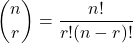
It is also denoted as nCr
Here’s what these symbols mean:
- n: Total items.
- r: Items chosen at a time.
- !: Indicates factorial.
Factorial represents the product of an integer and all the integers below it. For instance, 4! is 4 x 3 x 2 x 1 = 24.
Many fields use combinations. They are tools in statistics, probability, and daily choices. A humble tool in math, yet powerful enough to answer many questions.
How to Calculate Combinations
Basic Steps to Follow
Calculating combinations involves a few steps. First, determine n and r. Decide how many items you have, and how many you wish to pick. Use the combination formula:
- Write down the values.
- Apply them into the formula: nCr =
 .
- Solve each factorial.
- Simplify the formula.
 .
Let’s practice with an example. Imagine having seven books. You want to pick three. Here, n is 7, and r is 3. Substitute these into the formula:
7C3 = 
This simplifies to:
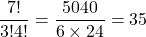
Thus, there are 35 ways to choose three books.
More Worked Examples
Example 2: choosing a committee. A class of 5 students must pick 2 representatives. Here n is 5 and r is 2, so 5C2 = 5! / (2! × 3!) = 120 / (2 × 6) = 10. There are 10 possible pairs.
Example 3: choosing a team. A coach must pick 4 players from 10. Here n is 10 and r is 4, so 10C4 = 10! / (4! × 6!) = 210. There are 210 possible teams.
A useful shortcut: choosing r items is the same as leaving out the other n − r items, so nCr = nCn − r. For example, 7C3 and 7C4 both equal 35.
Common Mistakes to Avoid
Mistakes often stem from overlooking the factorial rules. People tend to mix up permutation with combination. These errors lead to wrong outcomes. Here’s how to keep them at bay:
- Use only the combination formula when order doesn’t matter.
- Ensure factorials are calculated correctly.
- Double-check n and r values.
The combination formula simplifies selection processes. Practice helps avoid errors and improves accuracy.
Difference between Permutation and Combination
Permutations and combinations are often confused. However, they serve different purposes. While permutations are about arrangement, combinations care about selection.
Permutations are for arranging items in sequence. When using permutations, the order is vital. Think about arranging letters in a word. It matters if you spell ‘DOG’ or ‘GOD’.
With combinations, the order doesn’t concern us. If you choose two friends from a group of three, it doesn’t matter who’s first.
Consider these simple equations:
- Permutation: ( nPr =
 )
- Combination: ( nCr = )
 )
So we get a relation between combination and permutation as
nCr = nPr ÷ r!. For example, 7P3 = 210, and 210 ÷ 3! = 210 ÷ 6 = 35, which matches 7C3.
Combining understanding with practical application, the differences reveal themselves.
Real-World Applications
Using Combinations in Daily Life
Combinations appear often in our routine. When deciding on a food menu, you’re likely using combinations. Choose two toppings from four for your pizza, the order won’t matter. Let’s illustrate:
- Toppings Available: Tomato, cheese, olives, mushroom.

Selecting two toppings will use combinations. You have options such as tomato and cheese, or mushroom and olives. The order doesn’t change the set. With four toppings and two choices, 4C2 = 6, so there are six possible pairs.
Combinations simplify complex decisions. They pop up even when you least expect, like picking a team or wardrobe for the day.
Examples from Science and Math
Scientists frequently apply combinations. Genetics use them to predict traits. If a trait can go multiple ways, combinations come into play.

In math, combinations help in probability. Computing chances of events becomes hinge on combinations.
Consider a multiple-choice test. You need to find how many ways you can pick three questions to answer from seven available. Here, the combination formula shines.
It’s amazing how this simple mathematical formula shapes decisions. It bridges theory and real-world problems seamlessly.
Conclusion
Grasping the combination formula opens doors to insight. It guides our decision-making where order isn’t a priority. From daily decisions to intricate scientific analysis, it stands the test of time. Understanding the formula empowers and enlightens. As concepts mature, combinations remain simple and essential.
FAQs
1. What distinguishes combinations from permutations?
Permutations care about order; combinations don’t.
2. How is a factorial calculated?
A number multiplied by all below it gives its factorial.
3. What does ‘n’ and ‘r’ represent in the formula?
n is the total items, and r is the selection amount.
4. Where do combinations apply in real life?
Choosing food, teams, or outfits uses combinations.
5. What mathematical fields use combinations?
Probability, statistics, and genetics widely use combinations.
References
- Wasserman, N. H., & Galarza, P. (2017). Conceptualizing and justifying sets of outcomes with combination problems. In Investigations in Mathematics Learning (Vol. 11, Issue 2, pp. 83–102). Informa UK Limited. DOI: 10.1080/19477503.2017.1392208
- MANDARIA, G. (2018). The Methodology of Teaching Algorithms of Combinatorics: Permutations, Combinations, Arrangements. In Journal of Technical Science and Technologies (Vol. 7, Issue 2, pp. 1–6). International Black Sea University. https://doi.org/10.31578/jtst.v7i2.139
- Pittman, L. C., & Herman, G. L. (2015). Documenting students’ faulty schema and misconceptions about combinations and permutations. In 2015 IEEE Frontiers in Education Conference (FIE) (pp. 1–9). IEEE. DOI: 10.1109/fie.2015.7344035