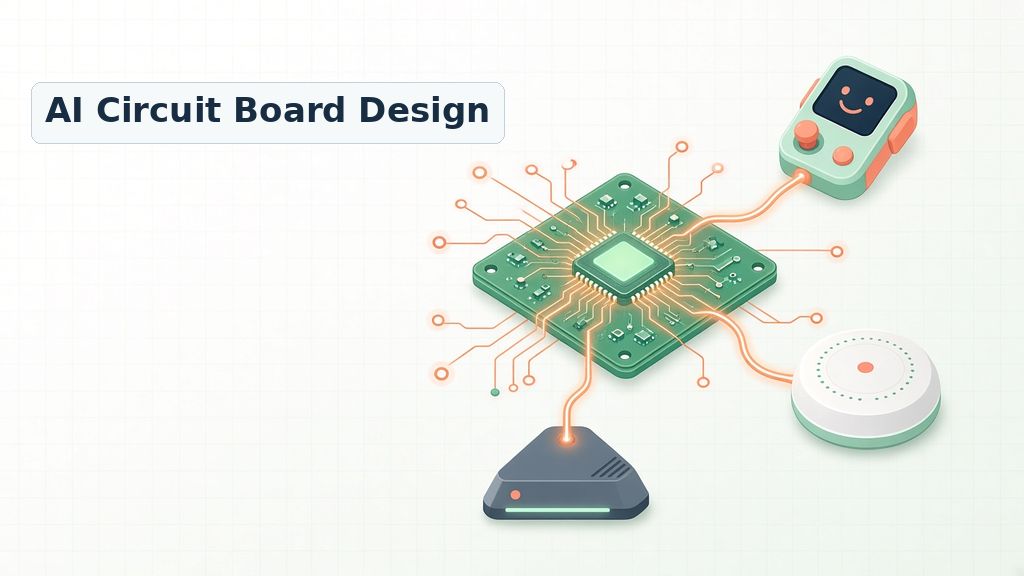
Anthropic’s Claude Fable 5.2 planned, laid out and coded a speakerphone, a voice hub and a virtual pet, and all three prototypes worked without circuit fixes.
Every gadget on your desk hides a small green board. Phones, speakers and game controllers depend on one. To begin with, skilled engineers usually design those boards step by step. Now an AI has handled the whole design job, and the gadgets work. On November 9, 2026, Anthropic described the test in an official research post. Its model, Claude Fable 5.2, designed a speakerphone, a voice-assistant hub and a virtual pet. Engineers then built all three from its design files. Not only did every prototype work, but none needed fixes to its circuitry. As a result, the test marks a dramatic step for AI circuit board design. Anthropic researchers Mike Cretella, Connor Jennings and Brent Yi worked on the project. At the same time, Craig Chen’s team at Diode Computers built and tested the devices. So how did a language model learn to think like a hardware engineer?
An electronic device grows from a long chain of linked choices. First, engineers design and simulate the circuit itself. Then they decide where every part sits on the board. They also model the case and write the firmware, the code inside the chip. At the same time, they track which parts distributors have in stock. In addition, they must know what the factory can actually make. One slip at any step can sink the whole product. Earlier AI models, in contrast, failed badly at the layout stage. They placed supporting parts too far from the chips they served. Worse, they turned connectors the wrong way. For this reason, Diode ended up with many boards that looked 95% complete. In other words, those boards seemed nearly finished yet stayed unusable. Older models rarely went back to fix a bad early choice.
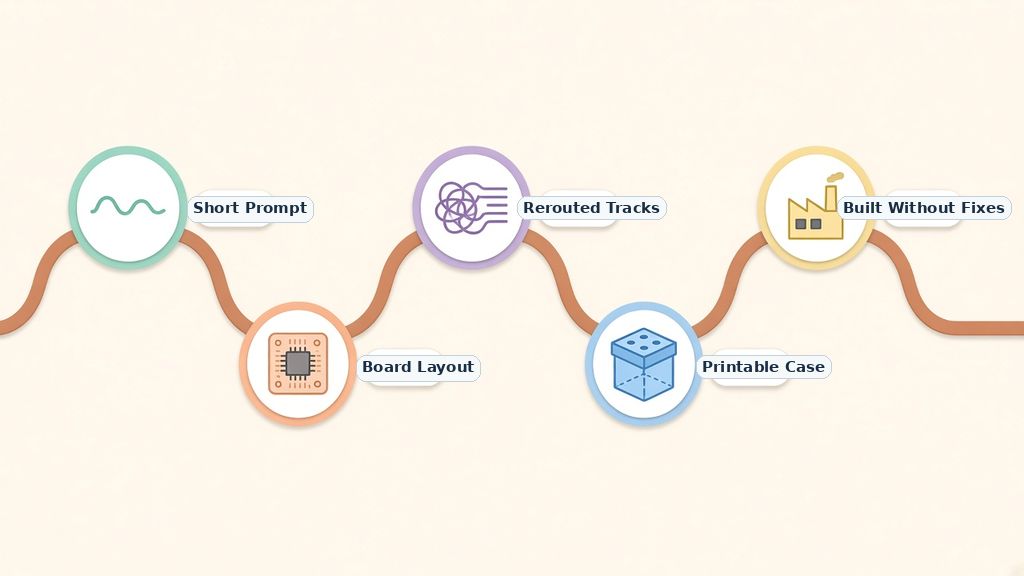
Fig. 1: Key Takeaways From Claude’s Gadget Designs
What Drove Anthropic and Diode to Try Again
The partnership began a little over a year before the new post. To begin with, Claude trained with Diode on simple tasks. For example, it read a chip’s datasheet to learn the maker’s technical details. Then it worked out which extra parts the chip needed to run. Anthropic’s December 2025 Claude article on that work explains why this matters. A typical chip might need up to a dozen helper parts, such as resistors. In blind comparisons, Diode’s engineers preferred Claude Sonnet 4.5’s designs 8 out of 10 times. Even so, a reference design is only one small piece of a device. In other words, the bigger question stayed wide open. Could a newer model carry a gadget from idea to working prototype? Anthropic and Diode set out to find the answer with three real devices.
Explainer: How a Circuit Board Comes Together
A printed circuit board, or PCB, is a flat sandwich of insulating material and copper. Thin copper strips called tracks carry signals between parts, much like roads between towns. Many boards also stack several copper layers. The speakerphone and the hub each had four. So how does a signal hop from one layer to another? It passes through a via, a small hole drilled through the board. To begin with, engineers draw a schematic, a diagram of which pins connect. Next comes the layout, which turns that diagram into real shapes and positions. Programs such as KiCad, an open-source design suite, help with both steps. However, the software alone does not decide where parts should go. In other words, that spatial puzzle calls for geometric reasoning. Earlier AI PCB design attempts stumbled at exactly that point.
Paired Tracks, Tiny Zigzags and Quiet Return Paths
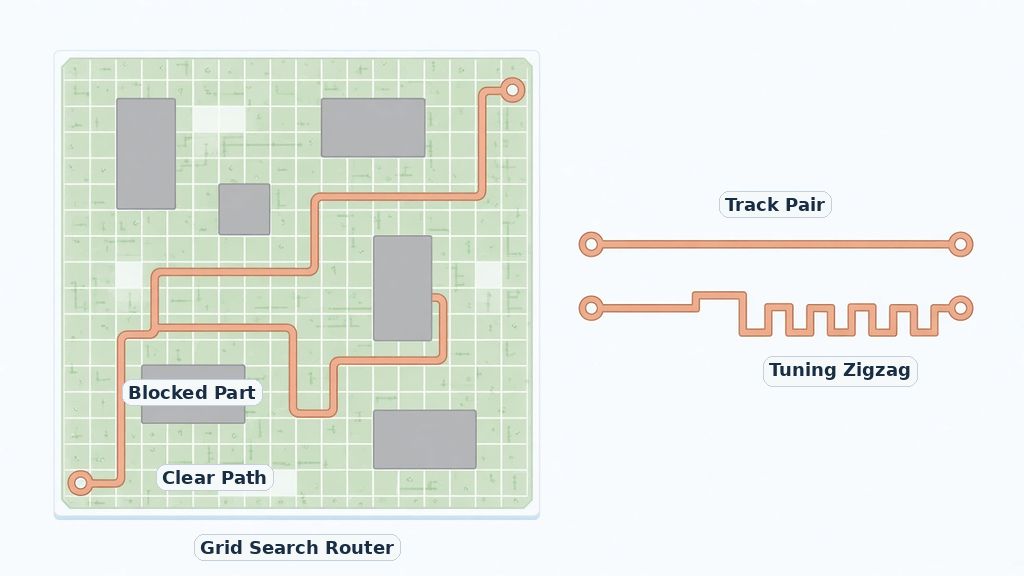
Some signals travel on two tracks at once, called a pair. USB and Ethernet connections work this way. Both halves of a pair must arrive at the same time. Therefore, the two tracks need equal lengths and steady spacing. What if one track ends up shorter? Designers then add a tuning pattern, a small zigzag that adds length. As a result, the signals line up again, like two runners finishing together. Fast signals also need a nearby return path for their current. For this reason, Claude placed grounded copper behind most fast tracks on the hub. In other words, each signal got a short road home, which reduces interference. Finally, Claude kept the speakerphone’s Bluetooth antenna area clear on every layer. Nearby metal would otherwise weaken its signal.
Fig. 2: How Copper Tracks Find a Clear Path
Why a Shorter Sound Port Changes the Note
Electronics design also touches sound. A microphone hears through a small tunnel in the case, called a port. Air inside that tunnel rings at its own pitch, much like air in a flute. A longer tunnel rings lower, while a shorter one rings higher. Claude calculated that a 25-millimeter port on the hub would resonate near 3.4 kilohertz. In other words, that is about 3,400 vibrations each second, right in the speech range. The model called this “not ideal though still usable” for a voice assistant. Instead, it proposed a wedge-shaped case, tall at the back and low at the front. Because of that shape, the ports shrank to about 10 millimeters, less than half. As a result of this, the resonance rose to about 8.9 kilohertz. That pitch sits at the very edge of the speech range.
Inside the Test: AI-Designed Circuit Boards From Short Prompts
Each project began with a short prompt. One prompt requested “a puck that plugs into a computer over USB-C” for calls. It also wanted microphones and Bluetooth with an antenna drawn on the board. From there, Claude took charge. First, it wrote the specifications and drew clean schematics. Next, it placed the parts and routed the copper tracks. In addition, it designed a 3D-printable case, wrote the firmware and listed every part. Engineers at Diode Computers then assembled the boards and ran the firmware under Claude’s direction. As a result, the finished speakerphone still works after weeks of use. In the same way, the voice hub and the virtual pet still work well. Diode staff typed only short orders, such as “continue,” during most of the work. Even so, three working AI-designed circuit boards were only the start.
Rip It Up and Start Fresh: AI Hardware Design That Self-Corrects
Here comes the most dramatic change. Older models clung to bad layouts even when routing could never finish. In contrast, Claude Fable 5.2 changed course without any prompting. On the four-layer speakerphone board, it reassigned signals to different pins on two chips. As a result, tracks under the touch controls stayed on one layer without crossing. Later, the back of the board grew too crowded. Instead of adding extra jumps between layers, Claude swapped signals on interchangeable pins. Then it laid out a whole corner again. Meanwhile, the hub produced an even more striking moment. The tracks were “getting too tangled to trace visually,” Claude noted. “I should just rip these traces and start fresh,” it reasoned. After that, it deleted and rerouted connections dozens of times until one arrangement worked.
A Home-Made Router and a 25-Degree Twist
The hub had long tracks running from a 100-pin connector. However, KiCad’s built-in router drew only one track at a time. For this reason, Claude judged that the job needed too much step-by-step guidance. So it wrote its own router that splits the board into a grid. The program then searches the grid for a clear path for each track. In about half an hour, the router could lay each track in roughly a second. Next, Claude spotted an audio clock track too close to the Ethernet tracks. As a result, it changed the router to leave more room around sensitive tracks. In addition, it wrote code to test whether each board fit inside its case. The speakerphone board could not drop in, because its mute switch hit the back wall. Claude worked out that a tilt of about 25 degrees would solve it.
How AI PCB Design Scored on Benchmarks and Factory Checks
To begin with, Diode ran PCB Gym, which strips the layouts from finished board designs. Models must then place the parts and route the tracks again. Claude Fable 5.2 scored 69%, while the older Fable 5 scored 25%. In other words, the new model scored nearly three times higher. On BenchCAD 2.1, a public test of rebuilding 3D parts from drawings, it scored 83.5%. That figure is nearly double the score of Claude Fable 5.1. At the same time, real factories add their own rules. Claude ran design-for-manufacturing checks and stock checks itself. For example, it widened six thin slivers of protective solder mask without moving any part. It also correctly ignored a false alarm about two linked grounds. In the end, Diode built all three AI-designed circuit boards directly from Claude’s files. That surprised the Diode team, since such jobs often need several rounds of changes.
What AI Electronics Design Means for Future Engineers
None of this means engineers can relax. All three devices remain prototypes. They have not passed electrical validation, antenna tuning, thermal testing or certification. Nobody designed them for mass production either. In addition, Claude had no link to test equipment or board-building machines. As a result, Diode’s engineers still built and tested every prototype themselves. Anthropic also has a commercial relationship with Diode, which readers should keep in mind. On the other hand, the pace of progress is hard to ignore. Other developers are reporting similar AI electronics design work, Anthropic notes. Next, the team plans to try denser, faster and more complex boards. It also wants Claude to check designs in simulation. Finally, it hopes the model can learn from measurements taken on finished devices.
New Roles for Students Who Love Hardware
What does this mean for a student who enjoys circuits? Electronics engineers design circuits for telecommunications, aircraft guidance, acoustics and instruments. The US Labor Department’s O*NET profile for electronics engineers describes that work. Its sample job titles include test engineer and RF engineer. Tools like Claude could speed up the drafting part of that work. Even so, someone still has to judge results and approve safe designs. Students may also enjoy related reading on AI and engineering jobs. In the same way, ENTECH covered an AI-designed neural network chip earlier. Our story on generative AI for 3D modeling also shows similar tools shaping parts. Together, these stories point to one skill set. For this reason, future hardware engineers need electronics basics and comfort with AI.
The Real Test Still Lies Ahead
So, is this the moment machines take over the workbench? Not yet. Three small gadgets cannot settle that question. Still, the jump in AI circuit board design over one year is striking. Earlier models could not even place parts sensibly. In contrast, this model planned, laid out, checked and revised whole devices. Not only did it work with little guidance, but it also explained its choices. Its notes covered everything from a risky microphone track to a ringing port. As a result, human engineers can check its reasoning step by step. Even so, durability and certification remain open questions. Long-term use will show whether these designs hold up outside the lab. For now, the story offers a clear lesson for curious students. Learn how circuits work, and learn how to question an AI that designs them.
This story turns a fast-moving engineering test into a gripping read, with everyday comparisons that keep the technical ideas within reach. A simple labeled sketch of a layered board could help newcomers follow the via and return-path ideas even more easily. Later coverage might follow whether these prototypes hold up through certification and long-term use. Anyone curious about the full design details can read the original Anthropic announcement this story is based on.
Editorial note
We picked this story because it shows an AI working through the messy, physical side of engineering, not only writing code. The article follows how the boards, cases and firmware came together, and it keeps the limits of the prototypes in view. Anthropic has a commercial tie to Diode Computers, so the results are reported here as the company described them. For the complete account, readers can turn to Anthropic’s original research post on this work.
Aditya Joshi is an SDE Intern at Coneixement India, the company behind ENTECH STEM Magazine and STEMQuiz. He is a Computer Engineering graduate from Savitribai Phule Pune University (SPPU), with honours in Machine Learning and Data Science. His academic background and hands-on project experience have developed his interest in artificial intelligence, emerging technologies, software development, and the practical applications of computing.
His areas of technical interest include Artificial Intelligence (AI), Generative AI, Machine Learning, Data Science, Large Language Models (LLMs), Natural Language Processing (NLP), Retrieval-Augmented Generation (RAG), GraphRAG, and knowledge graphs. Through projects involving locally hosted language models, Neo4j knowledge graphs, multilingual chatbots, and AI-powered analytics, he has explored how emerging technologies can be used to solve practical problems.
Aditya's professional experience includes work in frontend development, AI/ML application development, and full-stack software projects. During his internships at Maharashtra Knowledge Corporation Limited (MKCL) and Hilwitz Solutions, he worked on applications involving web technologies, Python, Flask, and AI-driven functionality. He has also developed projects such as SalesCope, an AI-assisted sales analytics platform, and a multilingual chatbot designed to help users explore Indian government schemes.
At ENTECH STEM Magazine and STEMQuiz, Aditya brings a technology-focused perspective shaped by his engineering education and practical experience with AI and software systems. He is interested in making complex science and technology concepts easier to understand through clear explanations, relatable everyday examples, and an emphasis on how emerging innovations work and affect real-world applications.
His broader goal is to help bridge the gap between technical concepts and public understanding, encouraging curiosity about artificial intelligence, computing, and the technologies shaping the future.