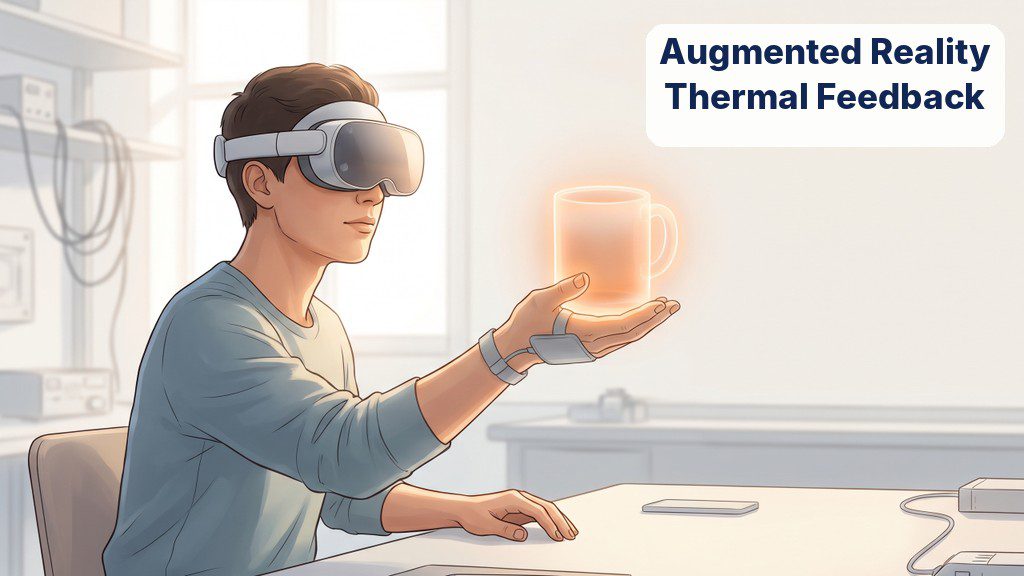
Augmented reality headsets can already show convincing digital objects and play realistic sounds. Touch, however, still lags far behind sight and sound. Temperature is especially tricky, because most thermal gadgets cover the fingertips. That is a problem in AR, where users still grab real tools and surfaces. Now a Vanderbilt University team has built a palm-worn pad that tackles this. It gives augmented reality thermal feedback while leaving every fingertip uncovered. The pad can also copy the temperature of real objects the palm touches. In tests, twelve volunteers judged real and virtual temperatures with 94.8% accuracy. The study appeared on November 13, 2026, in the open-access journal Communications Engineering. So how does a palm pad fool the skin, and where could it lead?
Warmth and coolness tell us a lot about the things we touch. For example, a hot mug or cold metal rail warns us early. Immersive systems that add temperature can therefore feel more believable. For the most part, existing thermal devices sit in gloves, rings or controllers. In AR, by contrast, people still handle real tools and real surfaces. Covering the fingers would get in the way of grasping and feeling those objects. As the authors put it, AR must balance real-world touch with virtual sensation. With this in mind, the team set three design goals. First, keep the fingertips free by moving feedback to the palm. Second, let users keep sensing the temperature of real objects. Third, make warmth and coolness move across the hand when needed.
Explainer: How a Peltier Module Heats and Cools
The heart of the device is a tiny part called a thermoelectric module. It is also known as a Peltier device, after the effect it uses. Inside, two kinds of semiconductor are joined in a chain. When direct current flows through, heat is pumped from one face to the other. At the same time, one face gets cooler while the opposite face warms. By the same token, reversing the current swaps the hot and cold faces. In other words, one small chip can both heat and cool the skin. There is a catch, though: the chip makes waste heat that must be removed. For that reason, the team built water channels into the device itself.
Inside the Palm-Worn Thermal Device
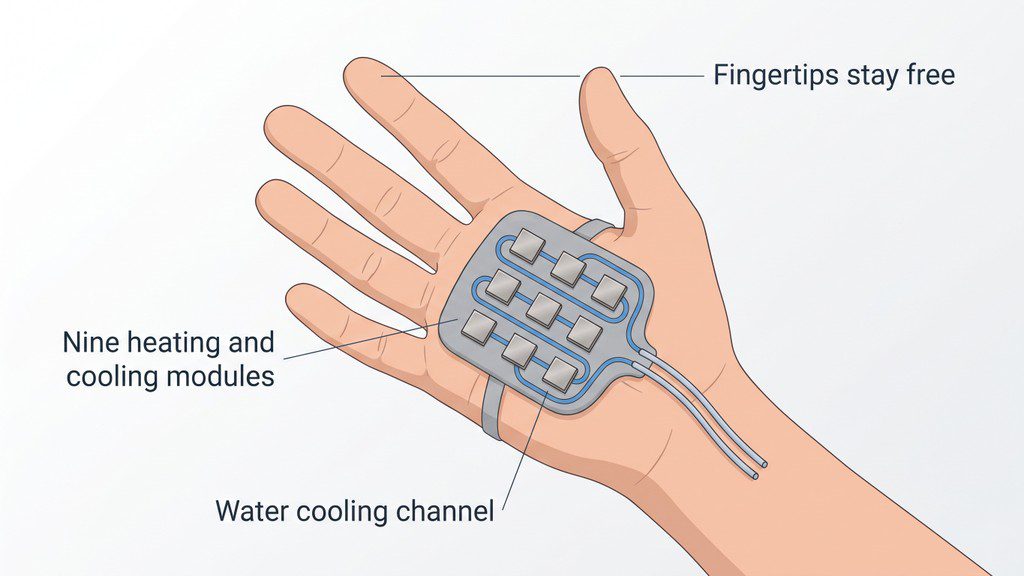
This augmented reality thermal feedback prototype straps onto the palm with a Velcro band. Against the skin sits a 3-by-3 grid of Peltier modules, each 6.5 millimeters wide. Each module has its own temperature sensor for precise control. All nine sit on small aluminum plates inside a soft, flexible silicone base. Water flows through channels in that base to carry away waste heat. On the outer side, nine more sensors face the world. Each one pairs a temperature sensor with a small contact detector. Together, they let the pad notice when the palm presses a real object. They also measure that object’s temperature right away. A single microcontroller runs the control software for all nine modules.
Fig. 1: Inside the Palm-Worn Heating and Cooling Pad
Fast Enough to Fool the Skin
Speed matters for augmented reality thermal feedback, since slow cues feel disconnected. On a real palm, warming reached its target with a 1.4-second rise time. By comparison, cooling was slower, with a rise time of about 2.4 seconds. The team explains that the chip’s own waste heat helps warming but resists cooling. In addition, the pad can work about 15 °C above or below skin temperature. From touching an object to starting the response took about 55 milliseconds. By comparison, skin usually needs about 300 to 700 milliseconds to react to temperature. In short, the pad responds before the skin can sense a delay.
Testing the Palm-Worn Thermal Device With Twelve Volunteers
Twelve students from Vanderbilt took part, each attending four one-hour sessions. For the most part, they had little or no experience with AR headsets. They wore the pad along with a HoloLens 2 headset during five experiments. To begin with, the team measured how sensitive the palm is to changes. On average, people noticed differences of about 2.5 to 3.9 °C. Changes seemed slightly easier to spot with all nine modules working, though not significantly. Equally important, the team asked how it feels when feedback lands elsewhere. For instance, what if you touch a virtual object with your fingertips? The warmth would then arrive at the palm instead.
Fingertip Touch, Palm Feedback
In this test, volunteers touched a warm or cool virtual object two ways. That is to say, they used either their fingertips or their palm. Either way, the warmth or coolness arrived at the palm. On a 7-point scale, realism dropped from 6.17 to 2.88 for fingertip touches. That makes sense, because the feeling arrived in a different place than expected. On the other hand, immersion and comfort stayed about the same in both cases. Immersion scored 5.83 for fingertips and 6.13 for the palm. That gap was too small to be meaningful. In other words, users stayed absorbed even when the sensation was slightly misplaced. On the whole, the authors argue exact placement is not always needed in AR.
Thermal Passthrough Brings Real Objects Back
Any pad on the palm blocks that skin from feeling the real world. To solve this, the team designed what they call active thermal passthrough. When the palm presses a real object, the outer sensors read its temperature. After that, the inner modules recreate that temperature on the skin. In testing, volunteers compared a heated or cooled metal stand with a virtual copy. They judged whether the two felt the same, with 94.8% accuracy in warm trials. In the same way, cool trials gave similar results, at about 95.4%. On the other hand, wearing the pad was clearly less accurate than a bare hand. Even so, volunteers rated the realism at 5.75 out of 7 on average.
Fig. 2: Thermal Passthrough Lets the Palm Feel Real Objects
Moving Warmth Across the Palm
Real touches are rarely uniform, so the team also tested patterns. First, volunteers felt warmth or coolness on different rows and columns of the grid. On average, they spotted changes between patterns about 78% of the time. At that point, the team moved on to a more lifelike task. Volunteers slowly brushed their palm across a warm or cool virtual surface. One version used a fixed cross-shaped pattern during contact. In contrast, the second version moved the warm spot with the hand. As a result, realism jumped from 3.46 to 6.13 with the moving pattern. In the same way, immersion rose from 5.13 to 6.42. Notably, the device created this motion using heat alone, without vibration.
Business Opportunities in AR Haptics
Touch is often called the missing sense of mixed reality. In the meantime, makers of AR wearables could test all three design ideas. With this in mind, portable versions could later support training involving heat or cold. Technicians, surgeons and firefighters, for instance, might rehearse tasks with realistic warmth cues. Remote handling, gaming and rehabilitation could also use augmented reality thermal feedback. Notably, the authors list education, workforce training and healthcare as growing AR fields. Of course, none of these uses has been tested with this prototype yet. Our story on a high-resolution digital touch display shows another route.
Careers and What to Study
Augmented reality thermal feedback projects need several kinds of engineers working together. Mechanical engineers handle heat transfer, while electrical engineers design the sensors and driver circuits. Software developers then link hand tracking to the thermal patterns. Finally, human factors researchers design the experiments with volunteers. According to the US Bureau of Labor Statistics, mechanical engineers earned a median $104,110. That figure is from May 2025, with 11% growth projected through 2035. Computer hardware engineers earned a median of $161,740 in May 2025. These are US figures, although AR hardware work is growing worldwide. For study, consider mechanical, electrical or computer engineering, plus some psychology. Our explainer on the technology behind VR and AR systems is a useful starting point.
Limits Worth Keeping in Mind
Note that this is a proof-of-concept lab prototype, not a finished product. It still connects to bench-top electronics and a water reservoir by cables and tubes. For this reason, users must stay near a tabletop while wearing it. Uneven pressure against the palm also made some modules respond differently from others. In addition, only twelve people took part, all from one university. The tests used simple virtual objects rather than real training tasks. In future versions, cooling and batteries could move to the forearm or a backpack. With these limits in mind, the study still offers a clear design path. In the long run, augmented reality thermal feedback could become standard in AR wearables.
References
Watkins, A., Ghosh, R., Chow, E., & Sarkar, N. (2026). Immersive and wearable bi-directional thermal rendering for physical and virtual interaction in augmented reality. Communications Engineering. https://doi.org/10.1038/s44172-026-00817-y
The article explains Peltier modules and thermal passthrough in clear, student-friendly terms. Its figures match the open-access paper, including the 94.8% passthrough accuracy and the rise times. The limits section notes the small sample, the bench-top tether and the simple virtual objects. Readers who want the methods and measurements in full should check the original paper this story draws on.
Editorial note
ENTECH is running this story because touch is still the weakest sense in augmented reality, and temperature is harder still. The Vanderbilt study shows students how a design problem can be solved by moving feedback to the palm. It also links heat transfer, sensors, software and human testing in one clear project. The device is a tethered lab prototype tested with twelve people, so portable versions are still to come. For the full details, we suggest readers turn to the original open-access research paper.
Aditya Joshi is an SDE Intern at Coneixement India, the company behind ENTECH STEM Magazine and STEMQuiz. He is a Computer Engineering graduate from Savitribai Phule Pune University (SPPU), with honours in Machine Learning and Data Science. His academic background and hands-on project experience have developed his interest in artificial intelligence, emerging technologies, software development, and the practical applications of computing.
His areas of technical interest include Artificial Intelligence (AI), Generative AI, Machine Learning, Data Science, Large Language Models (LLMs), Natural Language Processing (NLP), Retrieval-Augmented Generation (RAG), GraphRAG, and knowledge graphs. Through projects involving locally hosted language models, Neo4j knowledge graphs, multilingual chatbots, and AI-powered analytics, he has explored how emerging technologies can be used to solve practical problems.
Aditya's professional experience includes work in frontend development, AI/ML application development, and full-stack software projects. During his internships at Maharashtra Knowledge Corporation Limited (MKCL) and Hilwitz Solutions, he worked on applications involving web technologies, Python, Flask, and AI-driven functionality. He has also developed projects such as SalesCope, an AI-assisted sales analytics platform, and a multilingual chatbot designed to help users explore Indian government schemes.
At ENTECH STEM Magazine and STEMQuiz, Aditya brings a technology-focused perspective shaped by his engineering education and practical experience with AI and software systems. He is interested in making complex science and technology concepts easier to understand through clear explanations, relatable everyday examples, and an emphasis on how emerging innovations work and affect real-world applications.
His broader goal is to help bridge the gap between technical concepts and public understanding, encouraging curiosity about artificial intelligence, computing, and the technologies shaping the future.