Learn about the autonomic nervous system and how it controls heartbeat, breathing, and digestion automatically.
Autonomic Nervous System: Control of Involuntary Body Functions
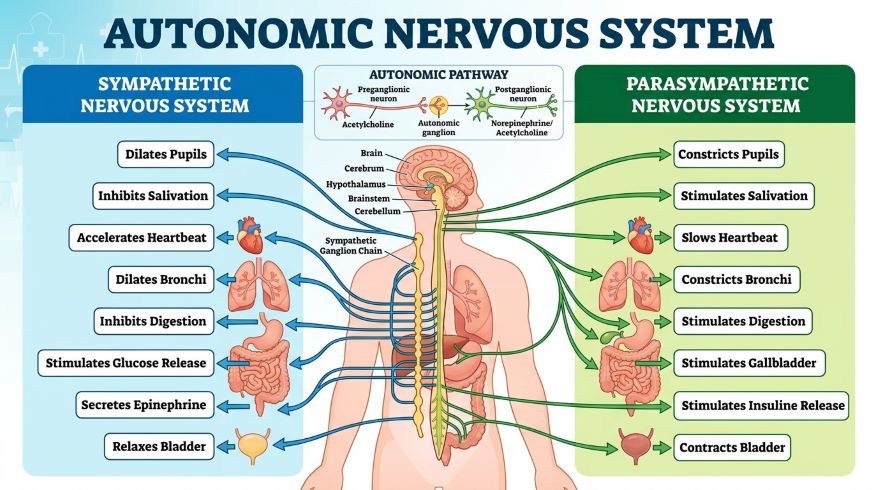
Your autonomic nervous system works automatically. It runs your heartbeat, breathing, and digestion. You don’t have to think about it. It has two main parts. One gets you ready for action. The other helps you rest and relax. These two parts work together all the time to keep your body in balance.
Key Takeaways: Involuntary Nervous System
- It runs your body without you thinking.
- It controls your heart, your lungs, and your gut.
- It has two main parts.
- One part speeds you up for a fight or a run.
- The other part slows you down to rest and digest.
- These two parts work as a team.
- It keeps your body in good balance
Sympathetic vs. Parasympathetic Systems
The autonomic nervous system has two key parts. One is the sympathetic system. It gets you ready to act fast. It makes your heart beat hard. The other part is the parasympathetic system. It helps you calm down. It helps your gut work well. These two parts work in a push and pull way. Together, they keep your body safe and in balance.
Involuntary Nervous System: Heart rate

Your heart rate is not something you think about. It is run by the autonomic nervous system. This system has two jobs. One job is to speed your heart up. The other job is to slow your heart down. When you need to run, the autonomic nervous system makes your heart beat fast. When you rest, it lets your heart beat slow. This keeps your heart rate just right for what you are doing.
Digestion
First, your autonomic nervous system controls your digestion without you thinking. For example, when you eat food, this system gets to work. As a result, your stomach and gut start to break the food down. Next, the autonomic nervous system helps move the food along. Then, it adds fluids to help with the process. In fact, your body needs this system to get energy from food.
Breathing
First, breathing is a simple act you do all day. However, you do not have to think about it. Instead, the autonomic nervous system runs it for you. For example, when you run, this system makes you breathe faster. As a result, you get more air. Then, when you rest, it slows your breathing down. In fact, the autonomic nervous system checks your body all the time. Finally, it changes your breathing speed to fit what you need. Consequently, you get just the right amount of air without any thought.
Rest-And-Digest Responses
First, the autonomic nervous system has two main jobs. One job is for stress. For example, when you are scared or in a rush, it gets you ready to act fast. Your heart beats hard, and your breath gets quick. Then, it also has a job for rest. In fact, when you are safe and calm, it helps you slow down. Your heart beats slow, and your gut can do its work well. As a result, these two parts work as a team. So, the autonomic nervous system helps you handle stress. Next, it helps you rest and digest. This keeps your body in good shape all day long.
Frequently Asked Questions: Involuntary Nervous System
What is the autonomic nervous system?
In simple terms, the autonomic nervous system is the automatic pilot in your body. In fact, it works all the time without you thinking. As a result, you do not have to tell your heart to beat or your stomach to work. Next, this system has two main parts that work together. First, one part speeds you up. Then, the other part slows you down.
What are the main parts of the autonomic nervous system?
First, the autonomic nervous system has two main parts. These two parts work in opposite ways. For example, one part speeds things up. In contrast, the other part slows things down. Specifically, the first part is the sympathetic system. As a result, this part gets you ready for action. For instance, it makes your heart beat fast. Next, the second part is the parasympathetic system. In fact, this part helps you rest and relax. For example, it calms your heart down.
What does the sympathetic nervous system do?
The sympathetic nervous system is one part of the system. Its main job is to get your body ready to act fast. For example, when you are scared or need to run, this system kicks in. As a result, it makes your heart beat harder and faster. It also opens up your airways so you can breathe more air.
References
Tobaldini, E. (2020). Autonomic Nervous System: From Bench to Bedside. Journal of Clinical Medicine, 9(10), 3180. https://doi.org/10.3390/jcm9103180
Chen, T., Yang, Y., Shi, K., Si, F., Wen, Y., & Yang, X. (2025). The developments and emerging trends of Autonomic Nervous System Research in Arrhythmia: a bibliometric study from 2004 to 2024. Frontiers in neuroscience, 19, 1595253. https://doi.org/10.3389/fnins.2025.1595253
- Author
- Latest Posts

I completed my Master of Science from the University of Allahabad in 2017 with a strong academic background in life sciences and chemistry. My specialization included Molecular Biology, Microbiology, Genetics, Plant Breeding, Phycology, Paleobotany, and Bioinformatics, along with Organic Chemistry, Inorganic Chemistry, and Physical Chemistry. This multidisciplinary training provided me with a comprehensive understanding of biological systems and analytical scientific approaches.
After completing my postgraduate studies, I gained valuable professional experience in both the education and social development sectors. I worked at A.M. Oxford Public School, where I was actively involved in guiding students toward academic excellence. In this role, I focused on creating an engaging learning environment, encouraging critical thinking, and nurturing students’ curiosity for scientific learning. My experience as an educator strengthened my communication, mentoring, and classroom management skills.
In addition to my teaching experience, I worked with Jeevan Jagriti Foundation, where I contributed to community-based initiatives aimed at improving educational access and awareness among underprivileged sections of society. Through this work, I participated in programs designed to support social development and promote the value of education in marginalized communities.
These professional experiences helped me develop strong interpersonal, leadership, and organizational skills while reinforcing my commitment to education and community service.