when you stand up, your body works fast. It helps keep blood pressure regulation on track. Next, your kidneys also help. They control water and salt. This is a key part of blood pressure regulation.…
Blood Pressure Regulation and Its Importance
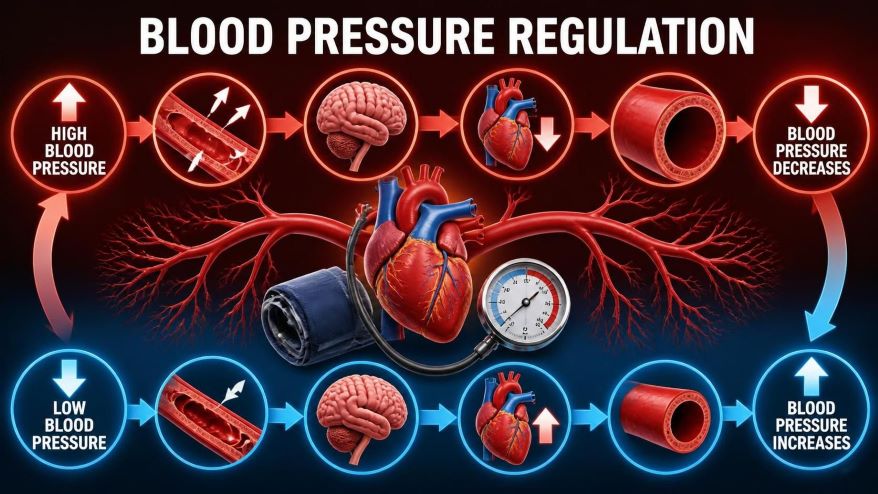
Blood pressure regulation is the process by which your body keeps blood flow steady. First, your heart pumps blood. This push raises your blood pressure. Then, your blood vessels relax. This lowers your blood pressure. In short, blood pressure regulation is a careful balance. For example, when you stand up, your body works fast. It helps keep blood pressure regulation on track. Next, your kidneys also help. They control water and salt. This is a key part of blood pressure regulation. Finally, your nerves send signals. They tell your heart and blood vessels how to respond. In conclusion, blood pressure regulation occurs continuously. It keeps you healthy and safe.
Key Takeaways: Blood Pressure Regulation
- First, blood pressure is the force of blood against the walls of blood vessels.
- Next, the heart pumps blood to make this push.
- Then the push increases when the heart beats.
- Thereafter, the push decreases as the heart rests.
- Furthermore, small tubes can open up to lower the push.
- In addition, small tubes can become tight, increasing the push.
- Next, the kidneys help by removing excess water.
- Less water means less push on the tube walls.
- Furthermore, the brain sends fast signals to the heart.
- For example, it tells the heart to beat slowly or fast.
- Finally, all these parts work together to maintain normal blood pressure.
Systolic/Diastolic Pressure

Blood pressure has two numbers. First, the top number is systolic pressure. This push is high when the heart beats. Next, the bottom number is diastolic pressure. This push is low when the heart rests. Both numbers are a key part of blood pressure regulation. For example, your body works to keep systolic pressure from getting too high. In addition, it also works to keep diastolic pressure steady. First, small tubes can open up to lower systolic pressure. Then, the kidneys help control diastolic pressure by managing water. Finally, the brain sends signals to the heart for both numbers. As a result, blood pressure regulation keeps you healthy every day.
Baroreceptors
Baroreceptors are special sensors in your body. First, they are located in key blood tubes. Second, they feel the push of blood. This push is blood pressure. Next, when blood pressure goes up, baroreceptors send a fast signal. For example, the signal goes to your brain. Then, your brain tells the heart to slow down. As a result, blood pressure goes back down. In addition, when blood pressure goes down, baroreceptors send a different signal. This time, the brain tells the heart to beat faster. Also, small tubes get tight to raise the push. Finally, baroreceptors work all the time. In short, they are a key part of blood pressure regulation.
Autonomic Nervous System
The autonomic nervous system is a part of your body. First, it works without you thinking about it. Second, it helps control blood pressure regulation. For example, it has two main parts. First, the sympathetic part speeds things up. It tells the heart to beat faster. This makes blood pressure go up. Next, the parasympathetic part slows things down. It tells the heart to beat slower. This makes blood pressure go down. In addition, the autonomic nervous system signals small tubes. It can make them open up or get tight. For instance, when tubes get tight, blood pressure goes up. When tubes open up, blood pressure goes down. Finally, these two parts work together all day. As a result, blood pressure regulation stays steady and just right.
Kidneys
The kidneys are key organs in your body. First, they filter your blood every day. Second, they help with blood pressure regulation. For example, the kidneys can take out extra water. Less water means less push on your blood tube walls. This lowers blood pressure. In addition, the kidneys can hold on to water. More water means more push on tube walls. This raises blood pressure. Next, the kidneys release a special signal. This signal tells small tubes to get tight. As a result, blood pressure goes up. Also, the kidneys work with other parts of your body. They listen to signals from the brain and from baroreceptors. Finally, the kidneys work all the time. In short, they are a vital part of blood pressure regulation.
Hormones
Hormones are chemical signals in your body. First, they travel in your blood. Second, they help with blood pressure regulation. For example, one hormone is adrenaline. It makes your heart beat faster. This raises blood pressure. Next, another hormone is angiotensin. It makes small tubes get tight. This also raises blood pressure. In addition, there is a hormone called aldosterone. It tells the kidneys to hold on to water and salt. More water and salt raise blood pressure. Then, there is a hormone called ANP. It does the opposite. It tells the kidneys to let go of water and salt. This lowers blood pressure. Finally, all these hormones work together. As a result, blood pressure regulation stays balanced and healthy.
Exercise, Stress, and Lifestyle
Exercise, stress, and lifestyle all affect blood pressure regulation. First, exercise is beneficial. For example, when you run or walk fast, your heart gets stronger. A strong heart pumps blood with less effort. This helps lower blood pressure over time. Next, stress can raise blood pressure. When you feel worried or tense, your body releases hormones. These hormones make your heart beat faster. As a result, blood pressure goes up. A healthy lifestyle also helps regulate blood pressure. For instance, eating less salt is beneficial. Too much salt makes your body hold on to water. More water means higher blood pressure. Furthermore, getting enough sleep is important. Sleep helps your body rest and reset. Finally, avoiding too much alcohol is also helpful. In short, exercise, stress control, and good lifestyle choices are key to blood pressure regulation.
Frequently Asked Questions: Blood Pressure Regulation
What is blood pressure regulation?
Blood pressure regulation is how your body keeps blood pressure just right. First, blood pressure is the push of blood on your blood vessels. Too much push is bad. Too little push is also bad. So, your body works hard to keep it steady. For example, your heart can beat faster or slower. This action changes the push. Next, your small tubes can open up or get tight. This also changes the push. In addition, your kidneys remove or retain water.
How does the nervous system regulate blood pressure?
The nervous system helps regulate blood pressure. First, it works without you having to think about it. This is the autonomic nervous system. It has two main parts. First, the sympathetic part speeds things up. For example, it tells the heart to beat faster. This raises blood pressure. It also makes small tubes get tight. This also raises blood pressure. Next, the parasympathetic part slows things down. It tells the heart to beat slower. This lowers blood pressure. In addition, the nervous system uses special sensors. These sensors are called baroreceptors.
What role do the kidneys play in blood pressure regulation?
The kidneys play a major role in regulating blood pressure. First, they filter your blood every day. Second, they control how much water stays in your body. For example, when you have too much water, the kidneys remove it. You get rid of it as urine. Less water in your blood means less pressure on your blood vessel walls. This lowers blood pressure. In addition, when you have too little water, the kidneys hold on to it. More water in your blood means more pressure on your blood vessel walls. This raises blood pressure.
References
Raven, P. B., & Chapleau, M. W. (2014). Blood pressure regulation XI: overview and future research directions. European Journal of Applied Physiology, 114(3), 579–586. https://doi.org/10.1007/s00421-014-2823-z
Joyner, M. J., & Limberg, J. K. (2014). Blood pressure regulation: every adaptation is an integration?. European journal of applied physiology, 114(3), 445–450. https://doi.org/10.1007/s00421-013-2636-5
- Author
- Latest Posts

I completed my Master of Science from the University of Allahabad in 2017 with a strong academic background in life sciences and chemistry. My specialization included Molecular Biology, Microbiology, Genetics, Plant Breeding, Phycology, Paleobotany, and Bioinformatics, along with Organic Chemistry, Inorganic Chemistry, and Physical Chemistry. This multidisciplinary training provided me with a comprehensive understanding of biological systems and analytical scientific approaches.
After completing my postgraduate studies, I gained valuable professional experience in both the education and social development sectors. I worked at A.M. Oxford Public School, where I was actively involved in guiding students toward academic excellence. In this role, I focused on creating an engaging learning environment, encouraging critical thinking, and nurturing students’ curiosity for scientific learning. My experience as an educator strengthened my communication, mentoring, and classroom management skills.
In addition to my teaching experience, I worked with Jeevan Jagriti Foundation, where I contributed to community-based initiatives aimed at improving educational access and awareness among underprivileged sections of society. Through this work, I participated in programs designed to support social development and promote the value of education in marginalized communities.
These professional experiences helped me develop strong interpersonal, leadership, and organizational skills while reinforcing my commitment to education and community service.