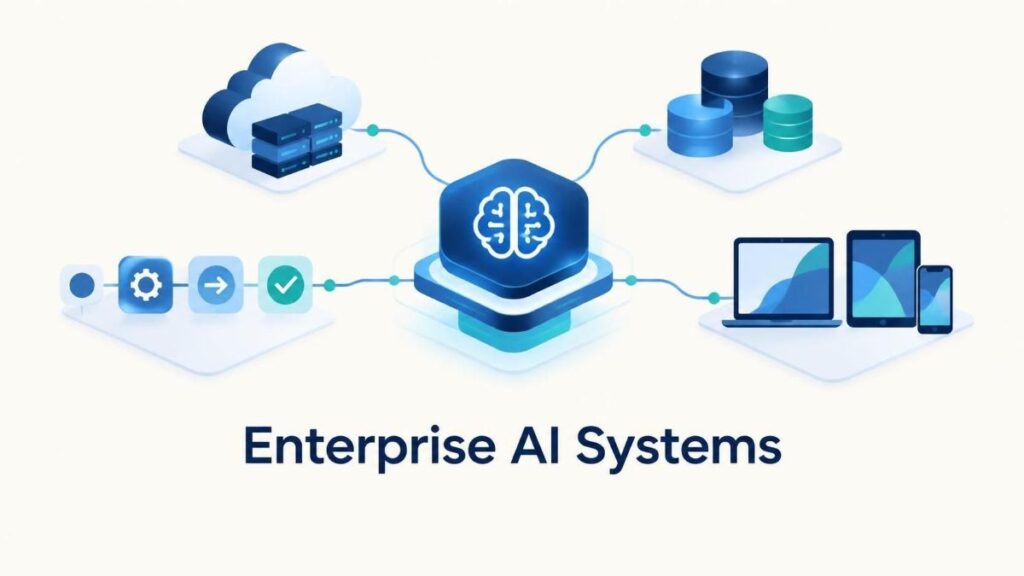
The future of enterprise technology includes Digital Twins, AI Command Centers, Hyperautomation, and intelligent infrastructure systems that continuously learn, predict, and optimize operations. Artificial Intelligence is rapidly transforming how organizations manage technology, infrastructure, operations, and decision-making. Enterprise AI Systems connect these four pillars into one shared platform. Moreover, they give teams a single, clear view of the whole business. This article explores each pillar in turn. First, we look at Digital Twins. Next, we examine AI Command Centers. Finally, we connect everything to student skills and real careers.
Enterprise AI Systems are platforms that study data, spot patterns, and act on what they learn. They support people rather than replace them. Consequently, teams make faster decisions with fewer surprises. These platforms also watch over huge, complex environments every single day. Therefore, they need structure, clear rules, and steady oversight. Above all, they need people who understand how the pieces fit together.
The Six Pillars of Enterprise AI Platforms
Enterprise AI platforms combine monitoring, analytics, prediction, automation, governance, and intelligent orchestration. Together, these pillars work as one team. As a result, they create fully connected intelligent ecosystems.
Fig. 1: Six Pillars of Enterprise AI Platforms (illustration – AI Generated)
Monitoring tracks systems and services around the clock. It shows what is healthy and what needs attention. Analytics turns raw data into clear patterns and useful insight. Prediction uses those patterns to forecast what happens next. Automation handles routine tasks, so people can focus on harder problems. Governance sets the rules for safe, fair, and accountable AI use. Intelligent orchestration ties every pillar together. It makes them work as one coordinated system. Together, these six pillars keep operations smooth, secure, and efficient.
From Connected Tools to Intelligent Ecosystems
These pillars do not work in isolation. Instead, data flows freely between them. Monitoring feeds analytics. Analytics feeds prediction. Prediction feeds automation. As a result, the whole environment learns and improves over time. That is how Enterprise AI Systems turn connected tools into truly intelligent ecosystems. Each part strengthens the others, and the system grows smarter with every cycle.
Digital Twins: Virtual Mirrors of Real Systems
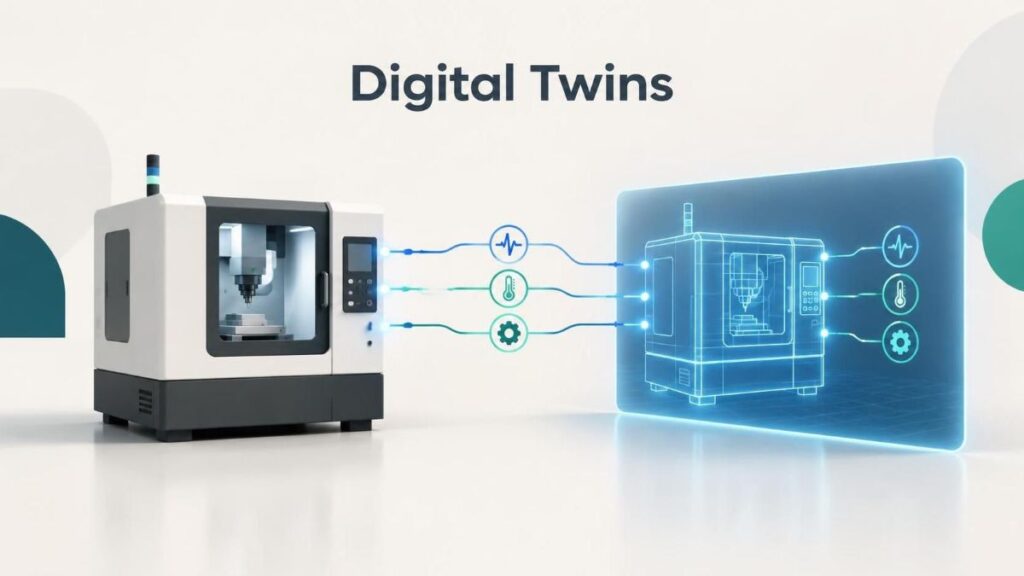
A Digital Twin is a virtual representation of a real-world system. It mirrors the real thing, but it lives in software. For instance, a company can model an entire data center or network in a virtual space. Above all, the twin stays in sync with reality. It updates whenever the real system changes.
Fig. 2: Digital Twins (illustration – AI Generated)
Organizations use Digital Twins to:
Simulate infrastructure behavior
Predict failures
Optimize operations
Improve performance
How Digital Twins Work
Live data flows in from sensors, logs, and monitors. The twin uses that data to run simulations. Then teams test ideas safely, without touching the real environment. In short, live data comes in, and simulation comes out. That simple loop creates real operational value every day.
Key Applications
Simulating infrastructure behavior lets teams see how a system reacts before they change it. Predicting failures helps organizations act before a breakdown ever happens. Optimizing operations means finding faster, cheaper, and smarter ways to run things. Improving performance turns small gains into lasting, measurable improvements. Finally, these four uses work best when teams apply them together.
AI Command Centers: Real-Time Operational Intelligence
Modern AI command centers give teams one place to watch everything. They combine many signals into a single, readable picture. Furthermore, they highlight problems before people even notice them.
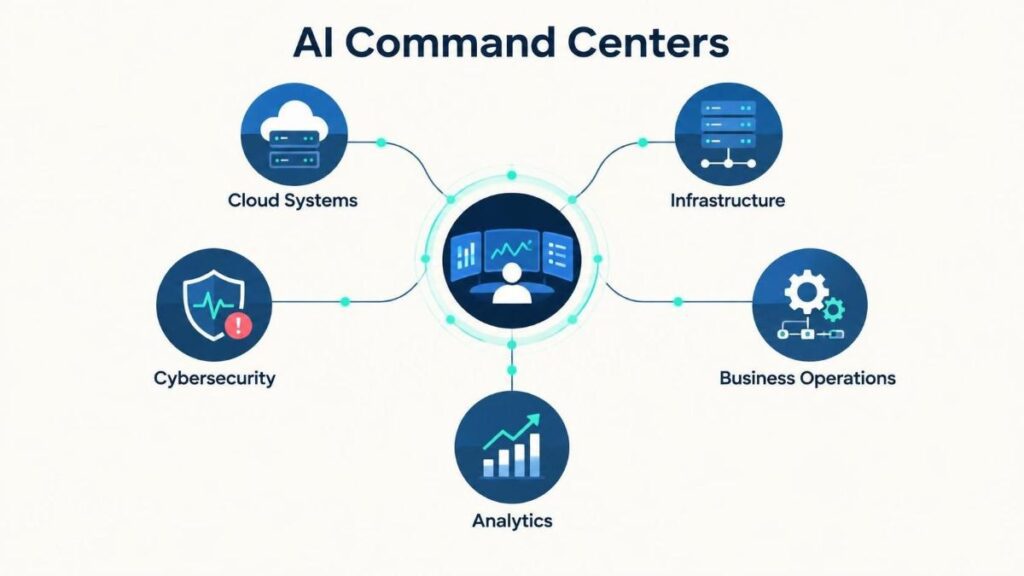
Fig. 3: AI Command Centers (illustration – AI Generated)
What Modern Command Centers Monitor
Modern AI command centers monitor cloud systems, enterprise infrastructure, cybersecurity events, business operations, and operational analytics. Cloud systems show how applications and services are running. Enterprise infrastructure covers servers, networks, and core platforms. Cybersecurity events reveal threats and unusual activity as they appear. Business operations connect technology to real business outcomes. Operational analytics turn all that noise into clear, useful trends. Similarly, each area feeds the others with valuable context. As a result, these environments give organizations real-time operational intelligence.
Cloud systems show how applications and services are running. Enterprise infrastructure covers servers, networks, and core platforms. Cybersecurity events reveal threats and unusual activity as they appear. Business operations connect technology to real business outcomes. Operational analytics turn all that noise into clear, useful trends. Similarly, each area feeds the others with valuable context.
Why Real-Time Visibility Matters
Real-time visibility turns slow reactions into fast decisions. Teams see an issue and respond within minutes, not days. Thus, downtime shrinks and confidence grows. Also, leaders plan with facts instead of guesses. That kind of speed is a genuine competitive advantage.
Educational Opportunities: Building Skills for Enterprise AI
Every great STEM career begins with one curious step.
Students can explore Enterprise AI, Digital Transformation, Cloud Computing, Cybersecurity, Intelligent Automation, and AI Governance. They can start building these skills today. Enterprise AI teaches how intelligent platforms support large organizations. Digital Transformation shows how technology reshapes the way companies work. Cloud Computing explains where modern applications live and run. Cybersecurity prepares students to protect systems and data. Intelligent Automation explores how machines handle repetitive work. AI Governance covers the rules that keep AI safe and fair. Besides, every one of these areas connects to the others.
Fig. 3: Building Skills for Enterprise AI (illustration – AI Generated)
Students can start building these skills today. Enterprise AI teaches how intelligent platforms support large organizations. Digital Transformation shows how technology reshapes the way companies work. Cloud Computing explains where modern applications live and run. Cybersecurity prepares students to protect systems and data. Intelligent Automation explores how machines handle repetitive work. AI Governance covers the rules that keep AI safe and fair. Besides, every one of these areas connects to the others.
Career Path: Next-Generation STEM Roles
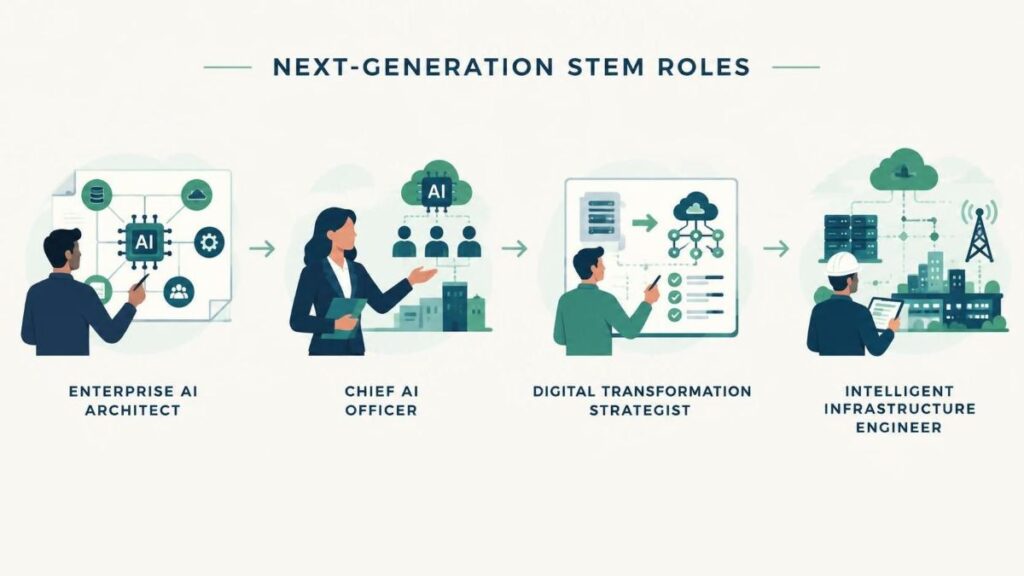
Future technology careers are wide open. They include Enterprise AI Architect, Chief AI Officer, Digital Transformation Strategist, and Intelligent Infrastructure Engineer. Each role helps organizations build smarter, safer, and more connected workplaces.
Fig. 4: Next-Generation STEM Roles (illustration – AI Generated)
Future technology careers are wide open. An Enterprise AI Architect designs intelligent platforms that serve the whole organization. A Chief AI Officer leads AI strategy and keeps it aligned with business goals. A Digital Transformation Strategist guides companies through big technology changes. An Intelligent Infrastructure Engineer keeps complex systems fast, reliable, and secure. In addition, every role blends technical skill with clear communication. Students who understand AI-powered infrastructure, automation, and digital transformation will be well prepared for next-generation STEM careers.
Conclusion: Preparing for the Intelligent Workplace
Enterprise AI Systems represent the future of intelligent workplaces. They bring monitoring, analytics, prediction, and automation into one connected whole. Therefore, organizations that adopt them will move faster and decide better. Students who learn these ideas now will lead that change. Indeed, the intelligent workplace is already taking shape. Those with the right skills will step into it with confidence.
Series Conclusion: AI-Powered IT Operations
This ENTECH series introduced students to the exciting world of AI-powered IT Operations Management. From Service Discovery and Monitoring to Predictive Analytics and Enterprise AI Systems, students explored how intelligent technologies support modern digital environments and shape the future of enterprise operations.
References:
Bhaskaran, S. V. (2025). EnterpriseAI: a Transformer-Based framework for cost optimization and process enhancement in enterprise systems. Computers, 14(3), 106. https://doi.org/10.3390/computers14030106
Sharma, N. (2026). Generative AI in Enterprise Decision intelligence: Opportunities and challenges. Journal of Intelligent Decision Making and Information Science, 3(8s), 1161–1173. https://doi.org/10.59543/jidmis.v3.2179
Srikanth Madabhushi is an AI Automation & Workflow Specialist with an MS in Artificial Intelligence. He designs innovative ServiceNow and AI-driven enterprise solutions that help organizations automate, optimize, and predict operational outcomes. Srikanth mentors students on emerging technologies, problem-solving, and career pathways in AI and automation.