Discover the adaptations of epiphytic orchids. Learn how tissues like the velamen and pseudobulbs help these unique canopy plants survive without soil.
Epiphytism: The Secret Life of Orchids
Estimated reading time: 5 minutes
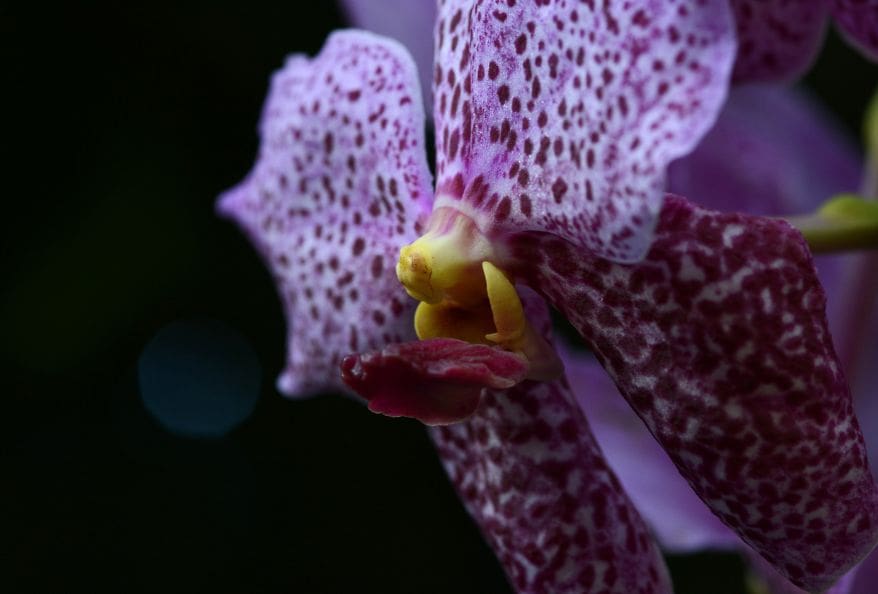
The plant kingdom is so massive, often hiding its most breathtaking wonders where the average person rarely looks. If you wander into the humid, emerald-green forests of Northeast India or the mist-covered Western Ghats, you might notice High above the forest floor, comfortably on the mossy “shoulders” of ancient, towering trees, are vibrant bursts of color and uniquely shaped leaves. These are the orchids: the elite acrobats of the botanical world. They sit in the canopy, stretching their flowers toward the sun as if they are trying to catch a clearer glimpse of the sky.
But they aren’t just sitting there. They are surviving in a “green desert” where there is no soil, no steady groundwater, and no safety net. To understand how they do it is to understand one of the most sophisticated lifestyles in nature: Epiphytism.
Epiphytic Orchids: The Great Vertical Escape
To understand why a plant would choose to live on a branch instead of in the fertile soil, we must look at the forest from the perspective of a seedling. On the forest floor, life is a battle for light. Huge trees create a dense umbrella, or canopy, that blocks nearly 98% of the sun’s rays. For a small flowering plant, staying on the ground is a death sentence by shadow.
Evolution provided a brilliant “escape” . This is called Epiphyte (from the Greek epi meaning ‘upon’ and phyton meaning ‘plant’).
But this move came with a massive technical challenge: how do you drink when your straw doesn’t reach the ground?
The Anatomy of an Air-Dweller (orchids)

The most striking feature of an epiphytic orchid is its roots. Unlike the brown, underground roots of a rose or a wheat plant, orchid roots are often thick, silvery-white and snake-like, twisting around the bark of their host tree.
If we look at these roots through a microscope, we find a physiological masterpiece called the Velamen. The velamen is a multi-layered, spongy tissue made of dead cells that acts as a sophisticated moisture harvesting system.
When the forest is dry, the velamen look silver because the cells are filled with air, reflecting the harsh sunlight to keep the root cool. But the moment a cloud passes by or a monsoon rain hits, these cells act like a high-speed sponge. They pull moisture directly from the humid air, turning green and translucent as they reveal the chlorophyll underneath.But drinking is only half the battle; storage is the other. Because rain is unpredictable in the canopy, many orchids have developed a “bucket” for water known as Pseudobulbs. These thickened stems store water and nutrients, allowing the orchid to survive for weeks without a single drop of rain. It is a perfect example of biological engineering – a plant that carries its own reservoir.
Parasitism v/s Commensalism
One of the most common misconceptions among forest visitors is that these orchids are “stealing” from the trees. It’s easy to see why we often associate one organism living on another with parasitism. However, in the world of the orchids, the relationship is much more gentlemanly.
This is the core concept of Commensalism. In ecology, commensalism describes a relationship where one species (the orchid) benefits, while the other species (the tree) is neither helped nor harmed.
Epiphyte orchid uses the tree strictly for physical support, “stairway to the sun.” It brings its own “groceries” by harvesting dust, bird droppings and rainwater. The giant tree, with its massive root system deep in the earth, isn’t even aware that its tiny guest is there. The orchid gets the light it needs to bloom, and the tree continues its life undisturbed.
Orchids as Ecological helper

While the relationship between the orchid and the tree is commensal (neutral for the tree), the orchid often becomes a “benefactor” for others. As orchid roots grow and trap falling leaves and forest debris, they create a “hanging soil”, high in the air.
This suspended organic matter becomes a micro-habitat. Ants may build nests within the tangled roots, and tiny insects may also hide in the crevices. These insects, in turn, attract birds and lizards. By simply being there, a single orchid can turn a bare branch into a thriving mini-ecosystem. In the grand tapestry of the forest, the orchid acts as a bridge, connecting the life of the sky with the nutrients of the earth.
Epiphytic Orchids: Why it Matters?
Orchids are Indicators for forest health. Because they lack a connection to the ground, they are the first to feel the effects of a changing climate. If the atmosphere becomes too dry or the mist disappears due to deforestation, the orchids are the first to wither.
When we look at an orchid on a branch, we shouldn’t just see a beautiful flower. We should see a triumph of evolution , a plant that learned to live on air, and a tiny organism that creates a home for many others. They remind us that nature doesn’t always work through competition and theft. Sometimes, the most successful way to survive is through a gentle, independent coexistence.
Life is not just about what happens on the ground, but about the “Sky-Dwellers” who teach us how to reach for the light without taking anything away from those who support us.
Additionally, to stay updated with the latest developments in STEM research, visit ENTECH Online. Basically, this is our digital magazine for science, technology, engineering, and mathematics. Further, at ENTECH Online, you’ll find a wealth of information.
References:
- Akhalkatsi, M., Mosulishvili, M., Kimeridze, M., & Maisaia, I. (2014). Orchids as indicator species of forest disturbances on limestone quarry in Georgia (South Caucasus). Journal of Environmental Science and Engineering, 3, 218–229. https://www.researchgate.net/publication/262047557
- Bottom, S. (2019). Orchids: Adaptation to epiphytic lifestyle. St. Augustine Orchid Society. https://staugorchidsociety.org/PDF/EpiphyticLifestylebySueBottom.pdf
- De, L. C., & Biswas, S. S. (2022). Adaptational mechanisms of epiphytic orchids: A review. International Journal of Bio-resource and Stress Management, 13(11), 1312–1322. https://doi.org/10.23910/1.2022.3115a
- De, L. C., & Medhi, R. P. (2014). Diversity and conservation of rare and endemic orchids of North East India: A review. Indian Journal of Hill Farming, 27(1), 138–153. https://epubs.icar.org.in/index.php/IJHF/article/view/46868
- Gowland, K. M., Wood, J. T., Clements, M. A., & Nicotra, A. B. (2011). Significant variation in orchid–fungus associations and carbon isotope ratios across orchid species and site age in a post-mining chronosequence. Annals of Botany, 107(3), 441–451. https://doi.org/10.1093/aob/mcq254
- Rao, S., & Shanthala, M. S. (2018). Physiological roles of the green pseudobulb in tropical epiphytic orchids. Advances in Plants & Agriculture Research, 8(3), 295–300. http://medcraveonline.com/APAR/APAR-08-00295.pdf
- Author
- Latest Posts

Devendra holds an M.Sc. in Botany from the University of Rajasthan and a B.Sc. B.Ed. in Biological Sciences, He is a passionate science communicator. He actively leverages various multimedia platforms to bridge the gap between scientific research and public understanding.
With proven experience as a Biology Educator, Devendra specializes in ICT-enabled pedagogy, student-centered learning, and educational design. As an active freelance science writer and digital content creator, he produces compelling articles, visual resources, and educational materials covering biology, environmental science, and scientific literacy. His work focuses on simplifying intricate biological processes into intuitive formats that inspire curiosity and foster inclusive STEM outreach.
As an author for ENTECH Magazine, Devendra shares insights into biological sciences, environmental awareness, and effective science communication, empowering readers to connect classroom science with real-world applications.