The world's next war won't be fought with bullets. It will be fought with brain cells, broken problems, and bold experiments. Are you ready — or are you still memorizing?
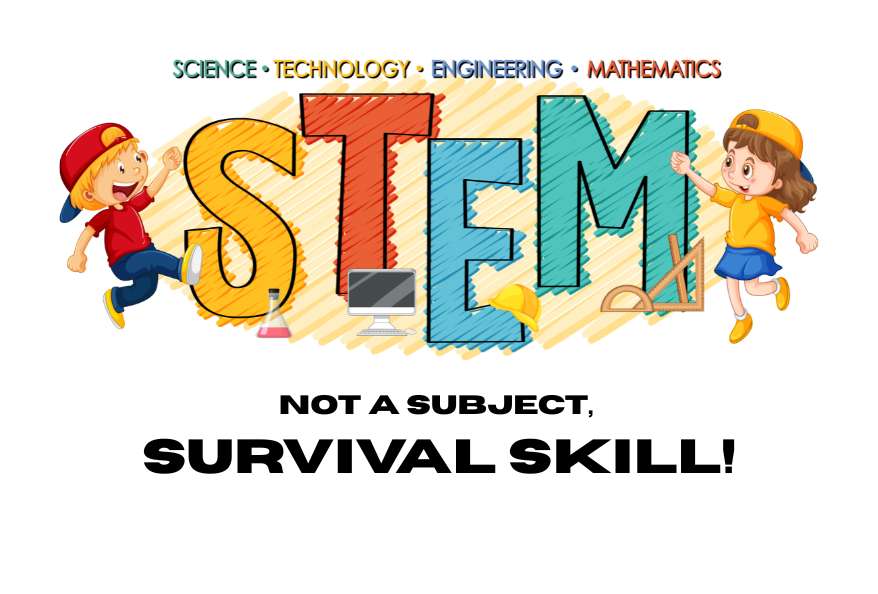
STEM Is Not a Subject, It’s a Survival Skill.
Estimated reading time: 8 minutes
“He who does not study science today will become a product of science tomorrow.”
(“Jo aaj science nahi padhega, woh kal science ka product ban jayega.”)
Let me tell you about Meera. She’s 16. She lives in a two-room house in Nagpur. Her father drives an auto-rickshaw. Her mother stitches blouses. Every evening, Meera sits under a single yellow bulb and solves physics problems — not because she has to, but because she believes those problems are her way out. Not out of her family. Out of a future designed to keep her small.
Meera is not an exception. She is the rule of what happens when a young person understands — in her bones — that STEM is not a collection of difficult subjects. STEM is the grammar of the future. Mastering this grammar is the ultimate STEM Survival Skill for the modern world. And if you don’t speak it, you’ll spend your life being spoken to – by algorithms, by bosses, by systems you never understood and never got to shape.
I’m writing this to every student who has ever said: “Sir, I’m not a science person.” To every parent who pressures their child toward medicine and engineering without explaining why. And to every teacher who still teaches science as a set of facts to be memorized rather than a set of questions to be lived.
This is not an article about STEM careers. This is a call to arms. A movement invitation. A mirror held up to a generation that has more access to knowledge than any generation in human history – and is still, somehow, afraid of a chemistry equation.
The Lie We Were Told About STEM
For generations, we were sold a story: STEM is for the brilliant, for the naturally gifted. It is for those rare children who are “good at math.” Everyone else — the storytellers, the artists, the emotionally intelligent — should find their place in the humanities.
This is perhaps the most expensive lie ever told to a developing nation
Research from Stanford University’s Carol Dweck demonstrates conclusively that mathematical ability is not a fixed trait — it is a developed capability. The brain that struggles with algebra today is not a brain that cannot do algebra. It is a brain that has not yet been given the right environment, the right encouragement, or the right permission to fail safely and try again.
We don’t tell a child learning to walk, “You are not a walking person.” But we tell 13 year-olds, “You are not a math person.” Consequently, we strip away their confidence before they can master a single STEM Survival Skill. And then we wonder why India, a civilization that gave the world the number zero, struggles to produce enough engineers with creative problem-solving skills.
“The brain that struggles with algebra today is not incapable — it simply hasn’t been given permission to fail safely, and try again.”
~ Dr. Rajesh Debroy
Why STEM Is the Language of Human Energy
At Servant2Success, we have built an entire movement around one central truth: we are living in the Human Energy Era. A time when activated human potential — not artificial intelligence, not fossil fuels, not geopolitical power — is the world’s most vital and renewable force.
And the fuel of human energy is curiosity. The structure of human energy is scientific thinking. The output of human energy is innovation.
Consequently, STEM isn’t a department — it’s the operating system of human transformation. Every critical problem-solving technique we teach is fundamentally a STEM Survival Skill. For instance, when a farmer in Punjab deploys drones to optimize irrigation, that’s STEM in action. Similarly, a dabbawala in Mumbai who uses data-driven logistics to outperform trained supply-chain experts is also practicing STEM. Moreover, a 17‑year‑old in Kerala who builds an AI model to detect early diabetic retinopathy for rural clinics is also applying STEM to save lives.
STEM lives wherever a human being says: “I see a problem. I want to understand it, solve it and I will not stop until I do.”
“Knowledge is that lamp which shows the path even in the deepest darkness.”
STEM is not about memorizing the periodic table. It is about building the lamp — so that you, your family, your community, and your country can walk forward even when every other light has gone out.
5 Reasons Why Every Indian Student Must Embrace STEM Survival Skill Now
1) India’s Demographic Dividend Is a Time Bomb — or a Gold Mine
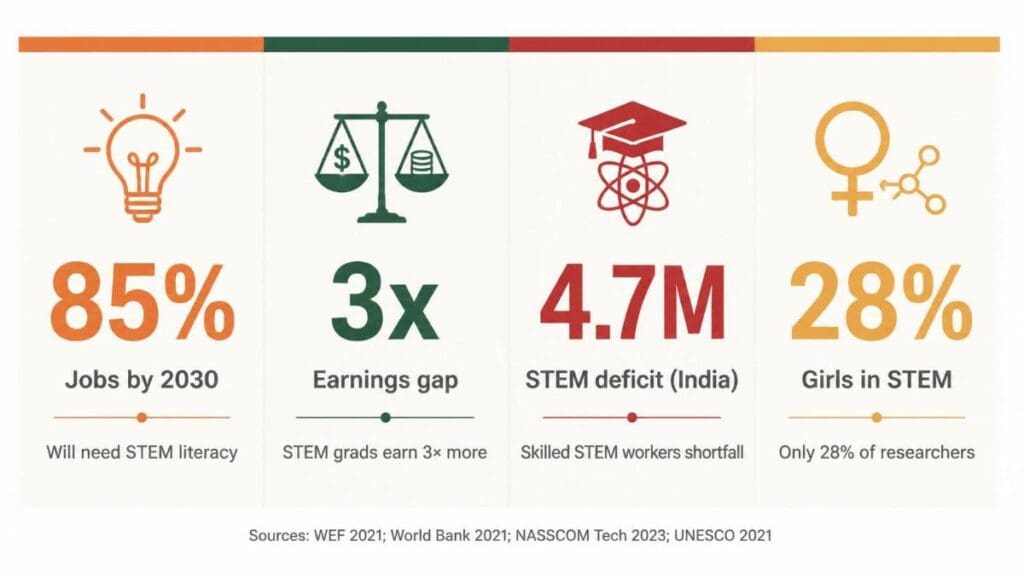
India is the world’s most populous nation with a median age of 28. By 2030, 1 in 5 workers globally will be Indian. This is either our greatest asset or our greatest catastrophe – depending entirely on whether our youth are skilled for a science-driven economy. The window is not infinite, instead the urgency is now.
2) AI Will Not Steal Your Job — But a STEM Literate Person Will
The World Economic Forum’s Future of Jobs Report (2023) confirms that while AI will automate 85 million roles globally by 2025, it will simultaneously create 97 million new ones — almost all requiring digital fluency, data reasoning, and computational thinking. The question is not whether to fear AI. The question is whether you will be the one who builds it — or the one it replaces.
3) Climate Change Is India’s Greatest STEM Exam
India faces existential threats from rising temperatures, water scarcity, and also food insecurity — all of which require STEM-based solutions developed by Indians, for Indian conditions. We cannot import our solutions from Silicon Valley. The Ganga needs Indian engineers. The farmer of Vidarbha needs Indian soil scientists. The child of the Sundarbans needs Indian
climate modelers.
4) Health Is Wealth — But Only If We Have the Scientists to Protect It
India has 0.7 doctors per 1,000 people — contrarily to the WHO benchmark of 1 per 1,000. We lose millions to preventable diseases because of diagnostic gaps in rural areas. Every student who enters biomedical sciences, public health technology, or medical engineering is literally saving lives — lives that would otherwise be lost to ignorance dressed up as fate.
5) The Vijay Path Is Paved with Problem-Solvers
Our Servant2Success movement speaks of Vijay Path — the path of victory through service. The greatest service any young Indian can render to their nation today is to become someone who solves real problems with real knowledge. Not someone who passes exams, nor someone who impresses relatives. But someone who changes the equation – literally as well as figuratively.
The STEM Classroom India Deserves
Here is my vision — and it is not a polished policy document. It is a fire.
I want classrooms where failure is celebrated as data. Where a student who gets an experiment wrong is not scolded — but asked: “Interesting. What did you learn?” Where science teachers are paid like the nation-builders they are. Where every school has a makerspace, not just a prayer hall. Where girls are not gently steered away from physics. And also where the National Curriculum treats coding as essential as cursive, recognizing it as a foundational STEM Survival Skill for the modern world.
Finland transformed its education system in one generation by making learning curiosity-driven and teacher-led. Similarly, South Korea’s investment in STEM education is directly correlated with its economic miracle — a country with no natural resources that became a technology superpower through sheer human capital development.
India has something neither Finland nor Korea has: 1.4 billion stories of hunger for a better life. That hunger is the raw material. STEM is the refinery. And the students reading this article – you are the builders.
“I don’t want students who score 95% in science. I want students who wake up at 3 AM because a problem they couldn’t solve is keeping them up. That obsession — that is STEM. That is the Vijay Path.”
~ Dr. Rajesh Debroy
A Direct Word to You — The Student Reading This
You are sitting somewhere right now — perhaps a hostel room, a train, a kitchen table, a library — reading these words. You may be 14 or 24, may/may not already love science, or you may have been told you’re not made for it.
I want to say this directly, without corporate language, without the padding of politeness: You are the Human Energy Era. Not a promise of it, nor a future possibility. You — right now, with all your doubts and half-formed dreams — are the most powerful renewable energy source on this planet. But energy without direction is just noise. Energy with STEM is a revolution.
Ultimately, to channel this energy, you need a fundamental STEM Survival Skill: the ability to look at a mess and ask the right questions.
Therefore, pick up one problem today. Not a textbook problem. A real problem. The contaminated water in your village. The traffic that paralyzes your city every morning. The mental health crisis no one in your school talks about. The food wastage at every wedding in your mohalla.
Ask: What is the science here? What does the data say? How has someone tried to solve this before? And finally, what can I do — with what I have, where I am, starting now?
That is STEM. That is service. And that is the Vijay Path.
Additionally, to stay updated with the latest developments in STEM research, visit ENTECH Online. Basically, this is our digital magazine for science, technology, engineering, and mathematics. Further, at ENTECH Online, you’ll find a wealth of information.
References:
- India Tech Industry Digital talent Demand and Supply 2023. (2023, March 2). Nasscom. https://nasscom.in/knowledge-center/publications/india-tech-industry-digital-talent-demand-and-supply-2023
- The Dabbawala system: On-Time Delivery, every time – Case – Faculty & Research – Harvard Business School. (n.d.). https://www.hbs.edu/faculty/Pages/item.aspx?num=38410
- Brant, A., Singh, P., Yin, X., Yang, L., Nayar, J., Jeji, D., Matias, Y., Corrado, G. S., Webster, D. R., Virmani, S., Meenu, A., Kannan, N. B., Krause, J., Thng, F., Peng, L., Liu, Y., Widner, K., & Ramasamy, K. (2025). Performance of a deep learning diabetic retinopathy algorithm in India. JAMA Network Open, 8(3), e250984. https://doi.org/10.1001/jamanetworkopen.2025.0984
- UNFPA India Annual Report 2023. (n.d.). UNFPA India. https://india.unfpa.org/en/publications/unfpa-india-annual-report-2023
- The Future of Jobs Report 2023. (n.d.). World Economic Forum. https://www.weforum.org/publications/the-future-of-jobs-report-2023/in-full/
- Climate Change 2022: Impacts, adaptation and Vulnerability. (n.d.). IPCC. https://www.ipcc.ch/report/ar6/wg2/
- Author
- Latest Posts

Dr. Rajesh Debroy is a visionary leader, strategist, and passionate advocate for human-centric growth with over 25 years of hands-on experience building and scaling organizations across diversified industries.
He holds advanced qualifications from premier institutions, including a specialization course in Supply Chain & Logistics Management from IIT Delhi, an Advance Diploma in Hospitality Management from the Indian School of Business, and certifications in Corporate Strategy from Ahmedabad Management Association, IOSH Managing Safely (UK), and Essential Skills for Managers. He has also completed an Advanced Pranic Healing course from the World Pranic Healing Foundation, Manila, reflecting his deep interest in holistic well-being and inner energy management.
At the heart of Dr. Debroy’s philosophy lies Servant2Success — a powerful movement and mindset that goes beyond titles and hierarchies. It calls for awakening the human spirit of service, harnessing Human Energy as the most underutilized infrastructure for sustainable success. He believes true progress comes from uplifting people, building enduring economies, and fostering genuine connections that transcend borders and cultures. His mantra “Helping World Win Everyday” drives every initiative, blending leadership with humility, empathy, and purposeful action.
With rich cross-industry expertise spanning rock mining & construction, property & asset management, integrated facility management (IFM), supply chain & logistics, digital lending, ESG, MSME financing, hospitality, and strategic partnerships, Dr. Debroy brings a unique 360-degree perspective to complex business challenges. He has led high-impact roles, including regional responsibilities with global organizations like Cushman & Wakefield, and currently drives strategic growth at Rockmining Construction Services Pvt Ltd.
Whether mentoring leaders, exploring sustainability and energy transition, or sharing reflections on leadership and geopolitics, Dr. Rajesh Debroy remains committed to humanizing the world — one conscious step at a time.
#Servant2Success #HumanEnergy #Leadership #StrategicThinking