In human plasma, extracellular vesicles act as miniature cargo carriers for proteins, lipids, and nucleic acids. Their circulation in the blood is a key to understanding diverse biological processes.
Mapping Extracellular Vesicles in Human Plasma: A Step Forward in Science
Estimated reading time: 3 minutes
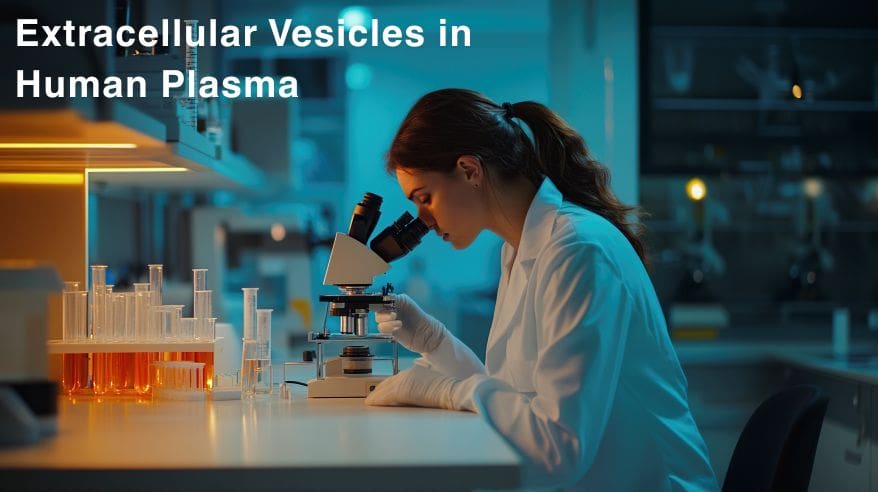
Extracellular vesicles (EVs) in human plasma are tiny particles released by cells. Additionally, they carry proteins, lipids, and nucleic acids. These notable particles travel through our bloodstream. Here, they perform vital roles. Therefore, their presence in plasma is a key to understanding many biological processes.
Understanding Extracellular Vesicle Isolation from Human Plasma
Efficient isolation of Extracellular vesicles EVs from plasma is challenging because plasma contains many other particles. These non-EV components—like lipoproteins and proteins—are present at much higher levels, making isolation tricky. However, a recent study used a top-down density gradient separation method to separate small EVs effectively.
The isolated EVs showed distinct membrane-limited spherical shapes while non-EV particles appeared as aggregates or lipoprotein-like structures. This method produced clean fractions of EVs with minimal contamination.
Detailed Mapping of Proteins and Lipids in Circulating EVs
The research team identified 182 proteins and 52 lipids as the core components of circulating EVs. They refer to these as “EV hallmark features.” These molecular markers distinguish EVs from other plasma particles.
This precise mapping of proteins and lipids helps understand how EVs form, carry cargo, and interact with cells throughout the body. Interestingly, many previously known markers found in cell cultures differ significantly from those in human plasma EVs, underscoring the uniqueness of human biology.
Implications for Medicine and Research
Decoding the core molecular composition of circulating extracellular vesicles is key, It opens doors for diagnostics and therapeutic innovations.
The findings hold potential for improving liquid biopsy technologies that diagnose diseases like cancer or cardiovascular ailments without invasive methods. Besides diagnostics, understanding these molecular maps could guide the engineering of better drug delivery vehicles based on EV membranes.
Also Read : https://entechonline.com/plasma-state-understanding-its-place-in-matter/
Advanced Techniques Enhance Understanding of Plasma Extracellular Vesicles
The researchers used multiple techniques including Western blotting, nanoparticle tracking analysis, and cryo-electron microscopy to verify their findings.
This multifaceted approach ensured high-confidence results relating to particle size distribution (30–300 nm) and negative charge properties consistent with previous reports on small EVs. Such detailed characterization also allows for machine learning models that classify particles precisely using biomarkers like ADAM10 protein and PS(36:1) lipid.
Additionally, to stay updated with the latest developments in STEM research, visit ENTECH Online. Basically, this is our digital magazine for science, technology, engineering, and mathematics. Also, at ENTECH Online, you’ll find a wealth of information.
Reference:
- Rai, A., Huynh, K., Cross, J., Poh, Q. H., Fang, H., Claridge, B., Duong, T., Duarte, C., Shaw, J. E., Marwick, T. H., Meikle, P., & Greening, D. W. (2025). Multi-omics identify hallmark protein and lipid features of small extracellular vesicles circulating in human plasma. Nature Cell Biology. https://doi.org/10.1038/s41556-025-01795-7
- Author
- Latest Posts
Ashwini Kshirsagar holds a graduate degree in Chemistry and a postgraduate degree in Environmental Science from Shivaji University, Kolhapur. With a strong foundation in scientific principles and a creative flair, she blends her expertise in environmental science with skills in technical writing, graphic design, and video editing. Proficient in Adobe software, Ashwini excels at transforming complex scientific concepts into clear, engaging, and visually compelling content. Her unique ability to merge science and storytelling allows her to create impactful communication materials that are both informative and accessible to a wide audience.