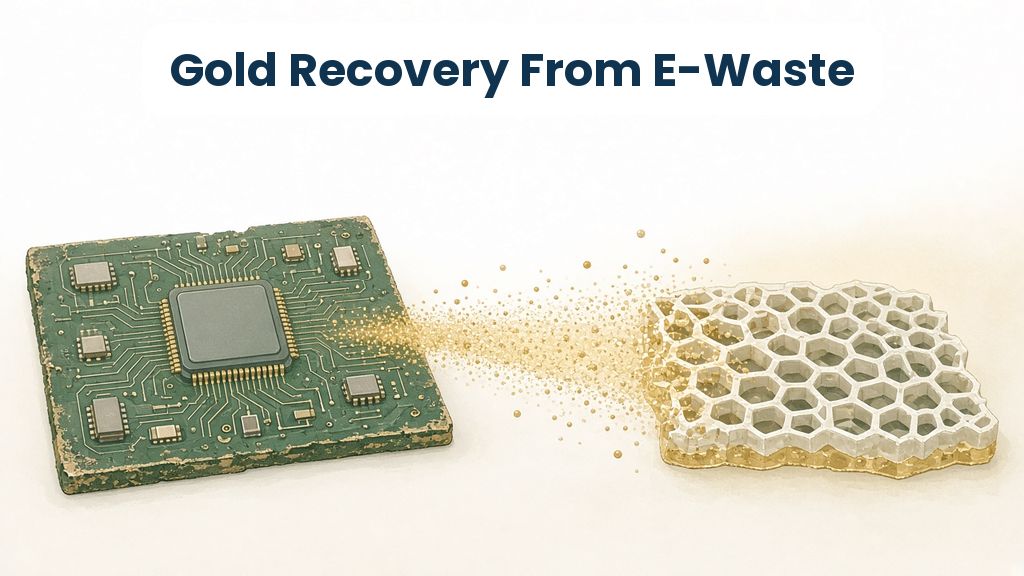
Nanjing chemists locked chain-like crystals into flat sheets that grab gold quickly and selectively, even from leachate made from old computer processors.
Most households keep an old phone or laptop tucked inside a drawer. Inside those gadgets, tiny gold contacts carry electrical signals reliably. Now, chemists in China have built a porous crystal that captures that gold quickly. Zhigao Zhu, Qing Xu and Jiansheng Li led the project. In addition, the team works at Nanjing University of Science and Technology (NJUST). Partners came from SARI, the Shanghai Advanced Research Institute of the Chinese Academy of Sciences. The team published its study in Nature Communications on October 30, 2026. Readers can find it through DOI 10.1038/s41467-026-78532-7 (Zhu et al., 2026). The material is a crystal sponge held together by hydrogen bonds. As a result, its gold-grabbing sites sit open rather than buried. In laboratory tests, it even picked gold out of liquid made from discarded computer processors. The work points toward better urban mining of electronic waste.
Challenges and Motivation Behind Gold Recovery From E-Waste
Electronic waste, or e-waste, is one of the fastest-growing waste streams worldwide. According to ITU and UNITAR (2024), the world generated 62 million metric tons in 2022. That amount could climb to 82 million tonnes by 2030. Meanwhile, documented recycling only reached 22.3% in 2022. In fact, e-waste generation is rising almost five times faster than documented recycling. At the same time, discarded devices hold valuable metals. For example, one million recycled phones yield 75 pounds of gold (U.S. EPA, n.d.). Most of that gold sits on printed circuit boards and chips. Mining fresh gold is also becoming harder. According to the paper, ore grades are declining and mines are growing deeper. Environmental rules are also tightening around traditional mining. As a result, the authors call e-waste an attractive secondary source of gold. In other words, old circuit boards can act like a rich ore.
Why Gold Recovery From E-Waste Is Hard
Recyclers first dissolve metals from shredded electronics in acidic chloride solutions. Chemists call that liquid a leachate. In practice, the leachate behaves like a crowded soup of dissolved metals. Inside it, gold exists mostly as a charged ion called tetrachloroaurate. However, the same liquid also carries copper, nickel and many other metals. Because of this, a good capture material must prefer gold over its neighbors. It must also work quickly and hold large amounts. Porous crystals called covalent organic frameworks, or COFs, look promising for this job. They offer enormous internal surfaces and adjustable, chemically tunable binding sites. Even so, many COFs bury their binding sites deep inside narrow pores. As a result, gold ions move slowly and miss many available sites. In short, the material wastes much of its built-in capacity. For this reason, the Nanjing team searched for a way to expose those sites.
Science Explained: How Hydrogen Bonds Open the Sponge
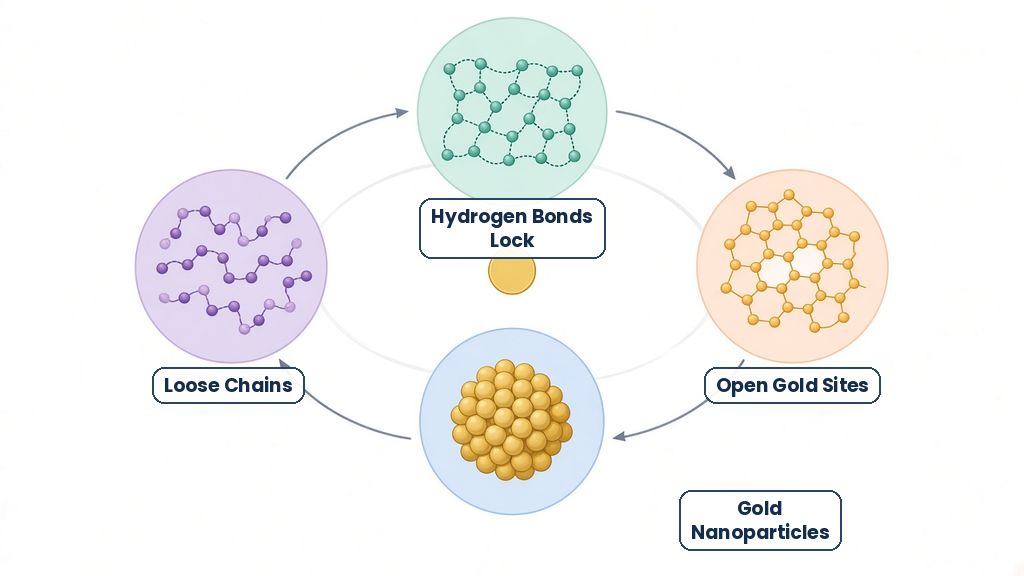
Picture a COF as a molecular scaffold with regular, repeating holes. Most COFs stack flat sheets tightly, like pages in a closed book. On the other hand, some COFs grow as flexible one-dimensional chains. These chains offer easier access, yet they twist and pack poorly. To solve this, the team placed hydroxyl groups on the chain building blocks. Hydroxyl groups contain oxygen and hydrogen, and they form hydrogen bonds. These bonds connect neighboring chains, much like interlocking zipper teeth. As a result, the chains lock into a flatter, quasi-two-dimensional structure. In other words, the material behaves almost like open, layered sheets. The team named this material Py-HP-COF. For comparison, a similar chain COF without the extra hydrogen bonds served as a control. The new framework reached a surface area of 734.75 square meters per gram. Earlier gold extraction methods often depend on harsher chemistry.
Capture, Reduction and Growth
Gold capture happens in three main steps inside the framework. First, open sites near the pores attract and grab gold ions. Next, the framework passes electrons to that gold. This reduction step turns dissolved gold into solid gold atoms. After that, those atoms gather into tiny gold nanoparticles on the surface. Computer models helped explain why the flatter structure works better. In particular, the team used density functional theory, or DFT. This method calculates how electrons behave in molecules and materials. The calculations showed a smoother electric landscape along the pore walls. In addition, the energy gap between key electron orbitals shrank to 0.53 electron volts. By contrast, the two chain models showed gaps of 1.72 and 1.64. A smaller gap means electrons move more easily. As a result, the framework strips chlorine from gold ions and reduces them more readily.
Fig. 1: How the Crystal Sponge Captures Gold
Key Findings on Gold Recovery From E-Waste
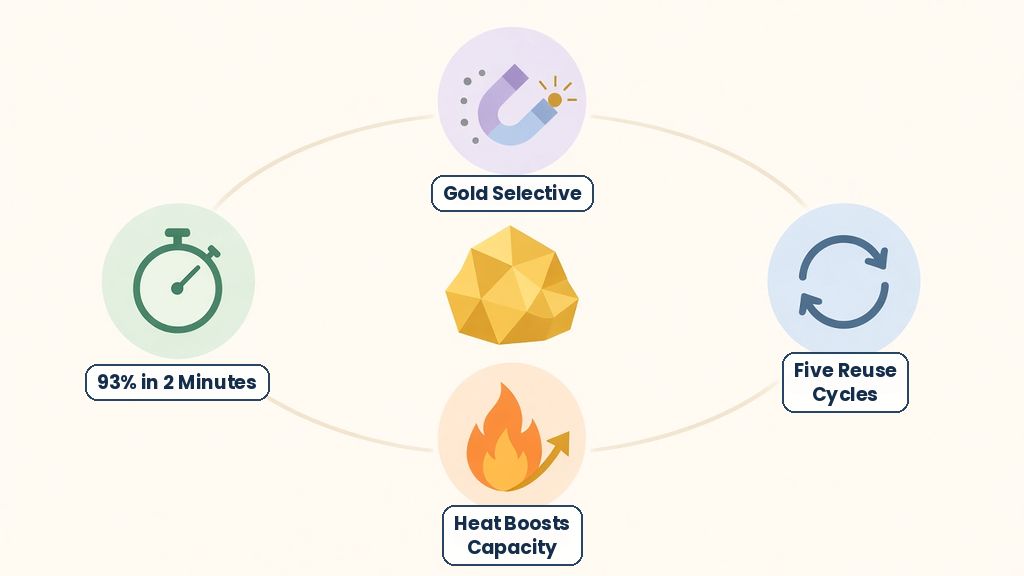
Speed matters enormously in any industrial recycling facility. In tests, both COFs removed more than 93% of dissolved gold within 2 minutes. They also reached about 99% removal within 20 minutes. Capacity, or the total gold each gram can hold, told a clearer story. At 25 °C, the fitted maximum uptake for Py-HP-COF reached 3,444.40 milligrams per gram. By comparison, the chain COF without extra hydrogen bonds held 1,478.06 milligrams per gram. In other words, the hydrogen-bonded version captured more than twice as much gold. On top of that, both materials kept near-complete extraction from pH 2 to pH 10. That broad range covers acidic to near-neutral solutions. However, performance dropped sharply at pH 12. Next, the team ran most tests at pH 3 to mimic acidic industrial leachates. The study (Zhu et al., 2026) also found gold nanoparticles spread across exposed outer surfaces.
Real Processor Leachate and Reuse Tests
Next, the team moved from purified laboratory solutions to genuine electronic waste. They prepared a leachate from discarded AMD computer processors, model X830. This liquid contained gold plus several other competing metal ions. Even so, both COFs kept high gold extraction efficiency in that processor leachate. Gold also won out over palladium and platinum, two chemically similar precious metals. In particular, Py-HP-COF showed stronger selectivity than the control framework. For reuse, the team captured gold and then released it again. Over five capture-and-release cycles, extraction efficiency stayed above 99%. Almost all captured gold also came back off the material afterward. However, the crystal order weakened somewhat over those cycles. X-ray patterns stayed visible, but their peaks grew weaker. According to the authors, gold particles inside pores may strain the layers. Still, chemical tests indicated that the framework itself remained largely intact.
The 5,082 Milligram Record and Its Conditions
The headline number, however, comes with important conditions attached. First, the team raised the solution temperature in a lab gold-chloride solution. Between 25 and 55 °C, uptake rose from 2,493.51 to 3,809.72 milligrams per gram. After that, the researchers combined heating with vibration, or steady shaking. Under heat plus vibration at 55 °C, capacity reached 5,082.32 milligrams per gram. In other words, each gram of material captured about 5 grams of gold. Importantly, this record came from a lab gold-chloride solution, not the processor leachate. As a control, the team heated and shook gold solution without any COF. In that blank test, the gold concentration barely changed at all. As a result, the material itself caused the extra uptake. Electron microscope images showed gold nanoparticles merging into denser clusters. For now, the processor leachate tests demonstrate selectivity, not this record capacity.
Fig. 2: Key Takeaways From the Gold Study
Implications: Urban Mining, Careers and Limits
Urban mining means recovering metals from discarded products instead of fresh ore. This study offers a promising new tool for that idea. For example, recyclers and refiners could test similar sorbents against current resins. Better gold capture could also support a circular economy, where materials return to new products. In addition, sorting and dismantling remain essential first steps. Here, robotic e-waste disassembly shows how automation can speed up that front end. On a larger scale, countries are also building global e-waste management strategies. Together, these efforts link chemistry with collection, policy and manufacturing. According to the authors, their hydrogen-bond design may apply to other compatible COF systems. That could guide future materials for other precious metals. Even so, the paper presents a laboratory design principle, not an industrial process. In short, the opportunity is real, but much engineering work remains.
Careers in Gold Recovery From E-Waste
This research connects several growing career paths. Materials chemists design porous crystals and test how they capture metals. Meanwhile, hydrometallurgy engineers dissolve metals from scrap and recover them from solution. Analytical chemists measure which metals remain in each test sample. Environmental engineers manage acidic waste streams and protect water supplies. As a result, students who enjoy chemistry and the environment have many options. Useful college majors include chemistry, chemical engineering and materials science. In addition, environmental engineering suits students drawn to recycling systems. Computational chemists also run DFT models like those in this study. Therefore, coding skills in Python add real value. In the meantime, high school students can build strong chemistry and mathematics foundations. Science fair projects on metal recovery can also offer early hands-on experience. Recycling companies, refineries and research laboratories all hire people with these valuable skills.
Limits and Next Steps
Several important caveats still apply to this promising laboratory work. First, the tests used milligram amounts of material in small liquid volumes. For example, the leachate selectivity tests used just 2 milligrams of COF. Second, the record capacity required both heating and shaking. Third, the crystal order weakened somewhat over five reuse cycles. On top of that, the paper reports no cost analysis or scale-up data. The study is also an Article in Press, an unedited accepted manuscript. For these reasons, nobody can yet say how the material performs in a full plant. Next steps could include larger batches, longer reuse trials and real refinery tests. In addition, engineers would need to measure how much material survives many cycles. Even so, the design idea gives chemists a clear new direction. In the long run, hydrogen-bond locking could help many porous materials work better.
Conclusion: Open Sites, Faster Gold Capture
Chemists at NJUST and SARI have advanced gold recovery from e-waste in the lab. Their key move used hydrogen bonds to lock flexible chains into flatter sheets. As a result, gold-binding sites sat open instead of hidden deep inside pores. In short, open sites made the difference. The new COF removed more than 93% of gold within 2 minutes. At room temperature, its fitted capacity reached 3,444.40 milligrams per gram. With heat and shaking in a lab gold solution, capacity hit 5,082.32. In addition, the material preferred gold in leachate from old AMD processors. However, tests stayed at milligram scale, and no cost data exists yet. The crystal order also weakened somewhat over repeated reuse cycles. Even so, the paper (Zhu et al., 2026) offers a clear blueprint for future sorbents. In the long run, old electronics could become a steady source of recycled gold.
I checked the brief against the Article in Press PDF. Most numbers match: a fitted Langmuir capacity of 3,444.40 mg/g, a maximum of 5,082.32 mg/g at 55 °C with heating and vibration, near-quantitative extraction from pH 2 to 10, selectivity in leachate from discarded AMD processors, and more than 99% extraction over five cycles. One correction was made: the original headline said the material pulls 5 grams of gold per gram "from dissolved computer chips," but the 5,082.32 mg/g value was measured in a lab gold-chloride solution, not in CPU leachate. The headline and the results paragraph were revised to separate the two tests. Lab scale and the loss of some crystal order over reuse are correctly flagged. Verdict: accurate after one correction.
ENTECH runs this story because e-waste is one of the fastest-growing waste streams, and recovering its gold is both a business and an environmental opportunity. Nanjing University of Science and Technology researchers designed a porous framework that captures large amounts of gold and selects it from real leachate made from discarded processors. For teens, it shows how chemistry and materials design can feed the circular economy, with jobs in recycling, refining and environmental engineering. The caveats: tests used milligrams of material, the top capacity needs heating and shaking, and no cost or scale-up data are given. Takeaway: smarter sorbents could make urban mining of gold more practical.
Ishika Tawar is a biotechnology researcher and science enthusiast with a curiosity for understanding how life works at the molecular and cellular level. That curiosity started somewhere around school, wandered through a lot of unrelated corners of science and physics, and eventually settled on something she actually wants to spend her life on: aging and longevity. She supports transhumanism and believes that science and technology should be explored seriously as tools to overcome some of the biological limitations of the human body.
Ishika holds a Master's degree in Biotechnology and has experience in both wet-lab and computational research. At ACTREC, she worked on a project studying the interaction of the TG2 protein with the ribosome, where she gained experience in cloning, site-directed mutagenesis, transformation, and gene knockdown. She was also involved in studying ribosomal heterogeneity using R and publicly available single-cell RNA sequencing datasets from different cancers. As a Research Assistant at SafeWright, she worked on client-based projects involving microbial culturing, biochemical tests, and analysis, along with literature research, report writing, and preparation of laboratory protocols. She has also worked with Python-based analysis to study differential DNA methylation in breast cancer.
Her current areas of interest include epigenetics, genomics, gene therapy, stem cell biology, computational biology, and the use of AI in biological research. She is particularly interested in how these areas can contribute to understanding aging and developing ways to extend healthy human lifespan. She has explored this interest through research projects and hackathons focused on AI, aging, and longevity. She enjoys following ideas across biology, technology and physics, and she believes in evidence, questioning ideas and staying curious about things that are not yet understood.
Outside research, Ishika enjoys reading and talking about science and scientific ideas. She loves travelling and is especially fond of mountains. She also enjoys science communication and hopes to make scientific topics easier to understand without making them inaccurate or oversimplified.