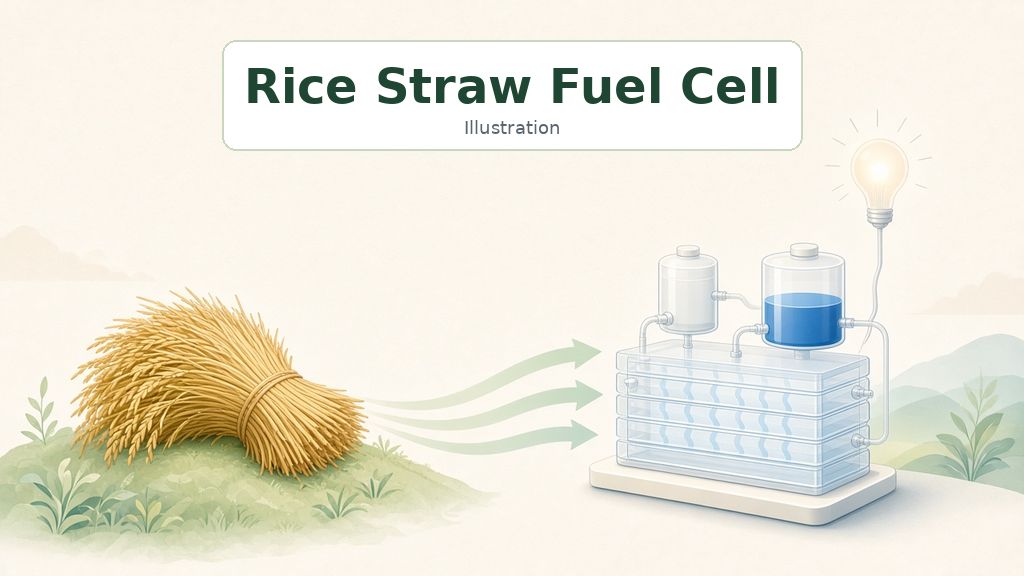
After every rice harvest, farms pile up mountains of dry, leftover straw. That leftover straw looks useless, yet it stores plenty of chemical energy. Now, a Korean team converts it into electricity with a rice straw fuel cell. Hojin Lee and Hyeong-Jin Lee led the study as equal first authors. Professors Eun Seon Cho and Hee-Tak Kim supervised the work at KAIST. That name stands for the Korea Advanced Institute of Science and Technology. In addition, the Korea Institute of Science and Technology and a defense agency joined. Their best single cell delivered 218.6 milliwatts of power per square centimeter. Next, a 10-cell stack ran for 15.6 hours on raw, unpurified straw. The team reported the work on October 25, 2026, in Advanced Science (DOI: 10.1002/advs.78361). As a result, crop waste now looks like a more practical power source.
The Science Explained: How a Rice Straw Fuel Cell Works
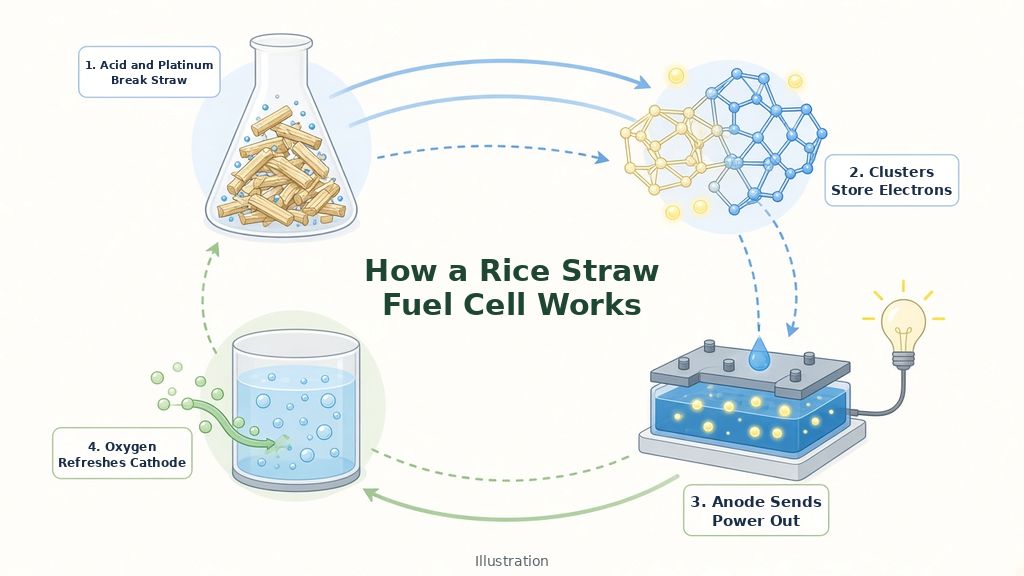
Every fuel cell turns chemical energy straight into electricity without burning anything. A hydrogen fuel cell, for example, splits hydrogen and sends electrons into a wire. The U.S. Department of Energy explains this setup on its fuel cell overview page. In the same way, a biomass flow fuel cell runs on plant waste. Its fuel is a liquid that has already pulled electrons from the biomass. Pumps then push this charged liquid past the anode, where it hands over its electrons. On the other side, a second liquid at the cathode accepts them. Bubbling oxygen later refreshes that cathode liquid so that it can work again. According to the paper, such cells run below 100 °C in water. Because of this, they skip the heat limits that cap biomass-burning power plants. In other words, the cell trades fire for direct chemistry.
Fig. 1: How a Rice Straw Fuel Cell Works
Polyoxometalates Act as Electron Sponges
The charged liquid holds a polyoxometalate, a tiny cage of metal and oxygen atoms. Chemists call this one PMo12 because it holds twelve molybdenum atoms. Each cluster can soak up several electrons, much like a sponge holds water. Scientists track this with a number called the reduction degree. It counts how many electrons, on average, each cluster carries. As the cluster fills, it absorbs more red and near-infrared light. For this reason, the team tracked its charge with light tests and magnetic scans. These tests revealed two-electron and four-electron charged forms. A fuller sponge, in turn, means stronger fuel for the anode. In most earlier systems, however, the clusters stayed only lightly charged. Liu and colleagues described one such polyoxometalate flow fuel cell in a 2018 open-access study. On the cathode side, the KAIST team used a related cluster called PMoV.
How Catalysts Break Tough Bonds in Straw
Rice straw contains three main parts: cellulose, hemicellulose and lignin. Lignin acts like glue that holds plant fibers together. Its atoms link through tough carbon-carbon bonds as well as weaker carbon-oxygen bonds. Breaking a carbon-carbon bond in lignin takes about 70 to 130 kilocalories per mole. For this reason, the team added two helpers to the PMo12 liquid. First, sulfuric acid snipped the ether and ester links, which are carbon-oxygen bonds. Second, a platinum-on-carbon catalyst, called Pt/C, attacked the stubborn carbon-carbon links. Platinum did this through a step called hydrogen atom transfer. Normally, leftover electrons build up on platinum and switch it off. Here, the cluster grabbed those electrons and protons from the platinum surface. As a result, the catalyst stayed active instead of getting poisoned. Small lignin pieces called monolignols then charged each cluster with up to 4.2 electrons.
Challenges and Motivation Behind Biomass Fuel Cells
Plant waste is cheap and plentiful, and farms renew it every growing season. Burning it for power, however, wastes energy and causes heavy carbon dioxide emissions. According to the paper, heat-engine limits restrict combustion, and drying the fuel costs extra energy. Biomass fuel cells, by contrast, work at low temperature in water. They can also support decentralized power, such as small units close to farms. A 2020 open-access review in Engineering surveyed these low-temperature biomass-to-electricity methods. Even so, earlier devices produced little power and rarely grew beyond small lab cells. The chemistry, on the one hand, works on many plant fuels. Raw biomass, on the other hand, breaks down slowly and only partly. Readers who want a wider view can explore how clean energy resources help cut pollution. In short, a wide gap between promise and output drove the KAIST team.
The Electron-Harvesting Ceiling
The authors call the main barrier an electron-harvesting ceiling. Tough plant bonds let the liquid pull out only a few electrons. As a result, earlier polyoxometalate liquids stayed at shallow reduction states. Their low charge then capped both the voltage and the power of each cell. So the team measured this limit directly. Untreated lignin, for instance, gave each cluster only about 0.4 electrons. Sugar-type pieces did better, at 1.4 to 2.5 electrons. In contrast, lignin fragments cut by platinum reached far higher values. That pattern pointed to a clear goal. If catalysts could break more carbon-carbon bonds, the sponge could fill much further. At the same time, platinum had to avoid poisoning by sticky reaction fragments. Earlier biomass cells had not solved both problems together. Scaling up added a third challenge, because small lab cells often struggle in larger stacks.
Key Findings From the Rice Straw Fuel Cell Study
To begin with, the team tested four liquids on raw straw at 100 °C. Each test lasted a full 12 hours. PMo12 with sulfuric acid reached a reduction degree of 1.88. Adding Pt/C instead lifted it to 2.92. With both helpers, the value climbed to 3.58. Peak power, in turn, followed the same order across all four recipes. Plain PMo12 gave 64.6 milliwatts per square centimeter, while acid raised that to 81.8. Platinum alone delivered 119.6, and the full mix gave 149.4. In short, acid and platinum worked better together than apart. After that, the team inspected the used platinum catalyst. X-ray and microscope images showed the tiny platinum particles, about 2 nanometers wide, stayed intact. Reused straw, in addition, still charged the liquid, to 0.87 and then 0.81. Regenerated liquid, meanwhile, reached 1.08 when it met fresh straw again.
Fig. 2: Key Numbers From the Rice Straw Study
Peak Power From a Super-Reduced Rice Straw Fuel Cell
Next, the researchers tuned the recipe for more electrons. They ground the straw to 100 micrometers and broke it down at 150 °C. This pushed the reduction degree to 4.5, so each cluster held over four electrons. The team calls this a super-reduced electrolyte, and it formed without any outside voltage. Power density rose to 200.1 milliwatts per square centimeter. That figure beat the 250-micrometer, 100 °C recipe by 1.34 times. Then the team swapped in a thinner Nafion membrane. With that change, a 6-square-centimeter cell reached 218.6 milliwatts per square centimeter. The authors call this the highest value among such cells over the past several years. A larger 25-square-centimeter cell also held 209.6 at a faster flow rate. However, the paper’s full text notes that values above about 2.5 electrons rely on extrapolation. Those numbers, as a result, carry some analytical uncertainty.
Scaling Up to a 10-Cell Stack
To test scale, the team linked 10 cells with 250 square centimeters of active area. Two liters of straw-charged liquid fed the anode side of the stack. Meanwhile, two liters of PMoV liquid served the cathode, refreshed by bubbling oxygen. The stack produced 59.2 watt-hours over 15.6 hours of steady discharge. By comparison, a conventionally prepared liquid gave 29.1 watt-hours over 8.4 hours. So the new recipe roughly doubled the energy from the same hardware. Even so, the stack used only part of its stored charge. It delivered about 23.4 amp-hours, compared with about 72 amp-hours in theory. That equals a Coulombic efficiency, or charge-use rate, of roughly 32.5%. In practice, only about 1.5 electrons per cluster reached the circuit. The authors link this gap to slow oxygen refreshing at the cathode. Faster cathode regeneration, in other words, could raise the usable energy.
Business and Careers in Farm-Waste Power
Small power units that run on crop residue could serve farms and rural villages. The paper, for example, describes a path to distributed bioenergy and closed-loop material cycles. In the near term, fuel cell developers can study the stack design and electrolyte recipe. Within about five years, pilot units might turn rice straw into local electricity. Longer term, waste-to-power plants could reuse catalyst and liquid many times. However, several hurdles remain before any commercial system appears. The best recipe relies on platinum, a costly metal, as well as strong sulfuric acid. It also breaks down straw at 150 °C before the liquid enters the cell. For these reasons, cost and safety studies must come next. According to the authors, faster oxygen-driven regeneration at the cathode is the key next step. Better cathodes would let the stack use far more of its stored charge.
Rice Straw Fuel Cell Careers and Study Paths
This research mixes chemistry, engineering and agriculture, so it opens several career paths. Fuel cell and electrochemical engineers design electrodes, membranes and stacks like this one. Chemical engineers who focus on catalysis tune recipes, such as the acid and platinum mix. Bioenergy process engineers plan how to collect, grind and feed straw at scale. Renewable energy project developers then match small power units with farms and villages. To prepare, students can study chemical engineering, chemistry or environmental engineering. Courses in electrochemistry and catalysis matter most for this kind of lab work. Agricultural and biosystems engineering also fits, because farm logistics shape every waste-to-power plan. ENTECH Magazine outlines the educational path for agricultural engineering step by step. In addition, work on a heme-derived carbon electrocatalyst shows how catalysts shape energy conversion. Strong math and lab skills help in every one of these roles.
Conclusion
This rice straw fuel cell shows that raw farm waste can produce strong, steady electricity. Sulfuric acid and platinum split the toughest bonds in straw. Meanwhile, the polyoxometalate liquid stored those electrons and kept the platinum clean. As a result, the liquid held more than four electrons per cluster. A single cell then reached 218.6 milliwatts per square centimeter. According to the authors, that is the highest such value in several years. In addition, a 10-cell stack delivered 59.2 watt-hours over 15.6 hours. Big challenges remain, such as platinum cost, strong acid and charge use near 32.5%. Still, the study offers a clear roadmap for better cathodes and larger stacks. For students, it links chemistry with engineering. Full details appear in the open-access paper by Lee and colleagues in Advanced Science. Next, the authors point to faster oxygen-driven cathodes as the main fix.
References
Lee, H., Lee, H.-J., Lee, J., Han, S.-S., Park, S., Cho, E. S., & Kim, H.-T. (2026). Synergistic charge scavenging in Pt/C‐polyoxometalate systems for scalable biomass power generation via super‐reduced electrolytes. Advanced Science, e78361. https://doi.org/10.1002/advs.78361
Liu, C., Zhang, Z., Liu, W., Xu, D., Guo, H., He, G., Li, X., & Deng, Y. (2018). Flow fuel cell powered by combustible agricultural waste. Clean Energy, 2(1), 20–28. https://doi.org/10.1093/ce/zky00
Liu, W., Liu, C., Gogoi, P., & Deng, Y. (2020). Overview of biomass conversion to electricity and hydrogen and recent developments in low-temperature electrochemical approaches. Engineering, 6(12), 1351–1363. https://doi.org/10.1016/j.eng.2020.02.021
The paper links its chemistry to performance step by step, using UV-Vis and phosphorus NMR to track how far the electrolyte is reduced, and it reports the stack's low charge use (about 32.5%) instead of hiding it. The brief gets the power density, stack energy and efficiency figures right. Two statements needed correction. It said the cells run "at under 100 °C", a general claim from the paper's introduction, but the best recipe broke down the straw at 150 °C. It also called 218.6 mW/cm² the highest for this cell type; the paper says the highest reported among such systems "over the past several years". Fix applied: both statements corrected.
I am an inspirational writer and emerging science blogger with a deep-rooted passion for understanding and sharing the wonders of the world around us. My journey began with a Bachelor of Science in Chemistry from AKI’s Poona College of Arts, Commerce and Science, where I developed not only a strong foundation in scientific principles but also a mindset that values curiosity, observation, and critical thinking. Studying chemistry has taught me to approach problems with logic, to look beyond the obvious, and to see patterns where others might only see complexity. These experiences have shaped the way I perceive life and influence the way I express my thoughts, both scientifically and creatively.
I have always believed that knowledge is only as powerful as the way it is shared. This belief has guided me to create content that bridges the gap between science and everyday life. I aim to simplify complex scientific ideas so they become approachable, relatable, and engaging for everyone—whether someone has a formal background in science or is simply curious about the world. Science, in my view, is not confined to textbooks and laboratories; it is a way of thinking, understanding, and connecting with the world around us. By making science accessible, I hope to inspire curiosity, ignite learning, and encourage people to see the beauty and relevance of scientific discovery in their daily lives.
Alongside my love for science, I am deeply passionate about motivational writing. I believe words carry the power to transform perspectives, encourage self-reflection, and inspire action. By combining analytical thinking with creativity, I create content that is intellectually stimulating yet emotionally resonant. Whether I am breaking down a chemical concept, exploring a scientific phenomenon, or crafting motivational narratives, my goal is to communicate ideas in a way that is clear, meaningful, and impactful.
Through my work, I strive to empower my readers - not just by helping them understand the science around them, but by inspiring them to grow, learn, and realize their full potential. Every article, post, or story I write reflects my commitment to turning knowledge into inspiration. I want to spark curiosity, encourage self-improvement, and show that learning and personal growth are deeply connected. For me, writing is not just a craft; it is a way to touch minds, connect hearts, and make ideas come alive in a way that truly resonates.