Heme-derived carbon electrocatalysts are produces by pyrolysing heme from blood, creating iron-nitrogen-carbon active sites.
Heme-Derived Carbon Electrocatalyst: Transforming Energy Conversion Technology
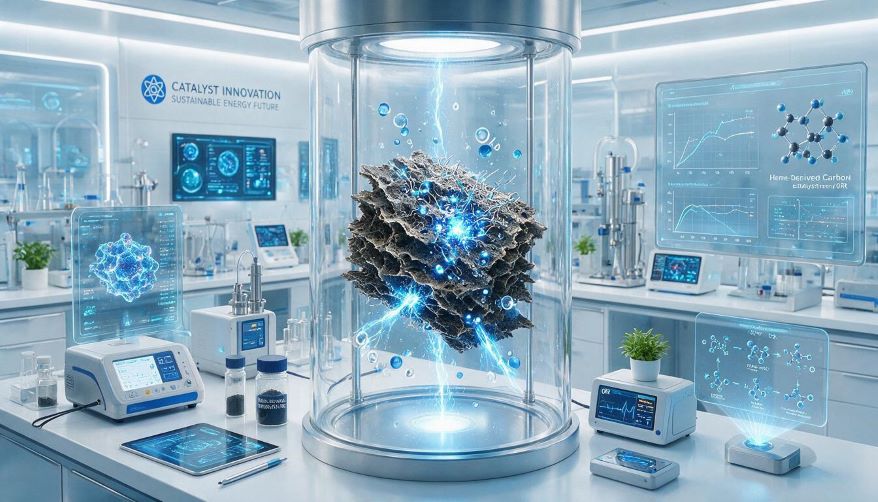
Imagine if the secret to clean energy was hidden in the same molecule that lets our blood carry oxygen. That’s heme—the iron-rich part of haemoglobin. Scientists have figured out how to turn heme into a super-efficient carbon electrocatalyst, perfect for powering fuel cells and making hydrogen. While the world looking for cheaper, greener alternatives to platinum, this breakthrough of heme-derived carbon electrocatalyst offers a sustainable, affordable solution. Thus, It’s a great example of how biology and materials science can work together to tackle some of our biggest energy problems.
ENTECH STEM Magazine has included this research in its list of Top 10 STEM Discoveries and Innovations of June 2026.
Key Takeaways: Heme-Derived Carbon Electrocatalyst
- Heme-derived carbon electrocatalysts are produces by pyrolysing heme from blood, creating iron-nitrogen-carbon active sites.
- They offer a sustainable, low-cost alternative to platinum for fuel cells and hydrogen production.
- Key applications include energy storage, water purification, biosensors, and ammonia synthesis.
- Major advantages are low cost, high stability, and environmental friendliness.
- Current challenges include performance in acidic conditions, scalability, consistency, and long-term durability.
- Future trends involve AI optimization, secondary metal doping, and integration with bioelectrochemical systems.
- This approach exemplifies the potential of biology-inspired design to address critical energy and environmental challenges.
What Is a Heme-Derived Carbon Electrocatalyst?
Let’s break this down. Heme is a special molecule in blood that helps carry oxygen. At the centre is an iron atom, wrapped in a ring-shaped structure called a porphyrin. When scientists heat heme in a controlls way—a process called pyrolysis—the organic parts turn into carbon.
The end result is a heme-based carbon electrocatalyst. It does the same job as platinum—speeding up reactions at electrodes—but it’s way cheaper and comes from renewable sources.
Why This Discovery Matters: Background and Importance
Most electrocatalysts use precious metals like platinum and palladium, which are not only pricey and rare but also tough on the environment to mine. Scientists have been searching for metal-free or cheaper alternatives for years, but making those usually means using complicated and sometimes toxic chemicals.
This new method solves both problems. First, heme is easy to get—it’s found in blood waste from slaughterhouses or can even be made biologically. Second, making the catalyst is straightforward. Thus, Just heat the heme, and you get a super-porous carbon material with iron and nitrogen atoms spread throughout, working like the active centers in natural enzymes. That means the process is cheap, simple, and eco-friendly.
How a Heme-Derived Carbon Electrocatalyst Works: A Step-by-Step Explanation
Step 1: Get the heme. It’s usually obtain from animal blood (e.g., from slaughterhouses) or produces by microbes through fermentation. This part is pretty simple and uses common industry techniques.
Step 2: Heat it up! The heme is put in a furnace and brought to high temperatures—between 600°C and 1000°C. While it cooks, the carbon parts form a network that’s both conductive and full of tiny holes.
Step 3: Make the magic spots. As things heat up, iron and nitrogen atoms team up to form special sites (called Fe-Nₓ) that do the real work—breaking up oxygen molecules really well.
Step 4: Fine-tune the heat. The temperature and how long you cook the heme matter a lot. Too cool, and the material won’t conduct electricity well. Too hot, and the iron clumps up and stops working. The trick is to find the sweet spot where the material is both porous and packed with active sites.
Step 5: Put it to the test. Scientists add the new material to an electrode and see how it performs in real fuel cells. Turns out, it works just as well as platinum when it comes to the main reaction in fuel cells—and it lasts even longer in some tests.
Real-World Applications Across Industries
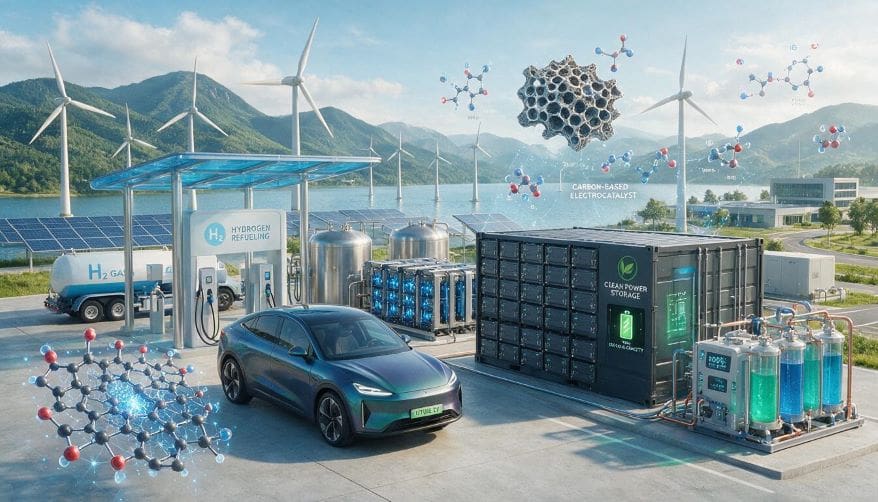
- Energy (Fuel Cells): These catalysts (heme-derived carbon electrocatalyst) are ideal for proton-exchange membrane fuel cells. They convert hydrogen and oxygen into electricity without emitting carbon dioxide, offering a clean power source for vehicles and stationary generators.
- Environmental Remediation: The same catalyst can degrade organic pollutants in wastewater. Thus, when used in a bioelectrochemical system, it breaks down dyes, pharmaceuticals, and pesticides efficiently.
- Healthcare (Biosensors): Because the catalyst is biocompatible, it can be integrated into glucose sensors or oxygen monitors. Its high sensitivity enables real-time detection in blood or tissue.
- Engineering (Hydrogen Production): The catalyst also promotes the hydrogen evolution reaction (HER). This makes it useful for water splitting to produce green hydrogen, a key fuel for the future.
- Education and Research: This material serves as an effective teaching tool for electrochemistry, biomass valorization, and sustainable chemistry. It illustrates the potential of biology-inspired design in addressing engineering challenges.
- Agriculture (Nitrogen Fixation): Preliminary studies indicate that these catalysts can reduce nitrogen to ammonia under mild conditions, potentially providing an alternative to the energy-intensive Haber-Bosch process.
Benefits of Heme-Derived Carbon Electrocatalysts
Low Cost: Derived from abundant biomass (blood waste), significantly cheaper than platinum ($30/g vs. $50,000/kg).
High Activity: Fe-Nₓ active sites provide ORR activity matching or exceeding commercial Pt/C catalysts in alkaline environments.
Exceptional Stability: The carbon matrix protects the iron sites from leaching, leading to stable performance over thousands of cycles.
Environmental Sustainability: Uses waste materials and avoids toxic solvents or rare metals, aligning with green chemistry principles.
Scalable Synthesis: Simple pyrolysis requires no complex equipment, making industrial scale-up feasible.
Versatility: Effective for multiple reactions beyond ORR, including HER, pollutant degradation, and biosensing.
Future Scope: Emerging Trends and Opportunities
Doping with Secondary Metals: Adding trace amounts of copper or cobalt alongside iron has been shown to enhance activity further, leveraging synergistic effects between metals.
Machine Learning for Optimization: Researchers are using AI to predict the optimal pyrolysis temperature and gas environment, accelerating the discovery of high-performance variants.
Roll-to-Roll Manufacturing: Efforts are underway to produce these catalysts on flexible substrates, enabling large-scale production for wearable energy devices.
Integrated Bioelectrochemical Systems: Combining heme-derived catalysts with microbial fuel cells could directly convert organic waste into electricity, offering a dual benefit of waste treatment and power generation.
Electrochemical Carbon Capture: New studies suggest these catalysts can help convert CO₂ into useful chemicals (e.g., carbon monoxide or methane), addressing climate change directly.
Frequently Asked Questions
Q1: How is a heme-derived carbon electrocatalyst different from commercial platinum catalysts?
It is made from biological waste (heme from blood) instead of rare, expensive metals. While its activity in alkaline media matches platinum, it is cheaper and more sustainable. However, it performs less well in acidic conditions.
Q2: Can this catalyst be used in cars and buses?
Yes, but currently primarily in alkaline fuel cells. For proton-exchange membrane fuel cells (the most common car type), further optimization is need to match platinum’s performance in acidic environments.
Q3: Is it safe to handle this catalyst?
Yes. After pyrolysis, the material is a stable, inert carbon solid. It does not contain infectious agents because the heating process sterilizes and carbonizes the biological source material.
Q4: How does the cost compare to other non-precious catalysts?
It is competitive with iron-nitrogen-carbon catalysts made from synthetic precursors. However, because heme is naturally abundant and requires fewer synthetic steps, the overall production cost is often lower.
Reference
Li, J., Sun, Q., Zhang, T., Ma, J., Li, D., & Xing, S. (2026). Design, Synthesis, and Performance of Heme-Derived Carbon Towards Electrocatalytic Oxygen Reduction Reaction. Chemistry, 8(6), 83. https://doi.org/10.3390/chemistry8060083
- Author
- Latest Posts

I am an inspirational writer and emerging science blogger with a deep-rooted passion for understanding and sharing the wonders of the world around us. My journey began with a Bachelor of Science in Chemistry from AKI’s Poona College of Arts, Commerce and Science, where I developed not only a strong foundation in scientific principles but also a mindset that values curiosity, observation, and critical thinking. Studying chemistry has taught me to approach problems with logic, to look beyond the obvious, and to see patterns where others might only see complexity. These experiences have shaped the way I perceive life and influence the way I express my thoughts, both scientifically and creatively.
I have always believed that knowledge is only as powerful as the way it is shared. This belief has guided me to create content that bridges the gap between science and everyday life. I aim to simplify complex scientific ideas so they become approachable, relatable, and engaging for everyone—whether someone has a formal background in science or is simply curious about the world. Science, in my view, is not confined to textbooks and laboratories; it is a way of thinking, understanding, and connecting with the world around us. By making science accessible, I hope to inspire curiosity, ignite learning, and encourage people to see the beauty and relevance of scientific discovery in their daily lives.
Alongside my love for science, I am deeply passionate about motivational writing. I believe words carry the power to transform perspectives, encourage self-reflection, and inspire action. By combining analytical thinking with creativity, I create content that is intellectually stimulating yet emotionally resonant. Whether I am breaking down a chemical concept, exploring a scientific phenomenon, or crafting motivational narratives, my goal is to communicate ideas in a way that is clear, meaningful, and impactful.
Through my work, I strive to empower my readers – not just by helping them understand the science around them, but by inspiring them to grow, learn, and realize their full potential. Every article, post, or story I write reflects my commitment to turning knowledge into inspiration. I want to spark curiosity, encourage self-improvement, and show that learning and personal growth are deeply connected. For me, writing is not just a craft; it is a way to touch minds, connect hearts, and make ideas come alive in a way that truly resonates.