Photon Bunching Interference Enhances Quantum Information Processing Applications
Photon Bunching Interference Reveals Recurring Quantum Light Distributions

Scientists create special light patterns called quantum frequency combs. These combs produce photons that act in strange ways. Photons sometimes exhibit photon-bunching interference. This creates an effect called asymmetric photon bunching. The scientists can see repeating patterns in how the photons interfere with each other. These patterns shift and change over time. The team also looks at how the photons spread out. They observe that the distributions are not random. They follow specific rules set by the frequency comb. By studying these patterns, scientists learn more about how light behaves at the quantum level. This helps them build better tools for quantum computers and communication.
ENTECH STEM Magazine has included this research in its list of Top 10 STEM Discoveries and Innovations of June 2026.
Key Takeaways
- To start, scientists build special light tools called quantum frequency combs. These tools create many colors of light at once.
- In addition, the light from these combs creates ring patterns. The rings show how the light waves interfere with each other. Some rings are bright. Some are dim.
- On top of that, the photons bunch together in uneven ways. This is called asymmetric photon bunching. It happens over and over again.
- As a result, the scientists observe recurring interference patterns of photon bunching. These patterns keep coming back.
- More importantly, the light also makes specific distributions. The photons spread out in a nonrandom pattern—the frequency comb controls where the photons go.
- Finally, this work helps scientists better understand quantum light. It also leads to better tools for quantum computers and secure communication.
Photon Bunching Interference
First of all, scientists use a special tool called a quantum frequency comb. This tool creates many different colors of light at once. As a result, the photons from this light act in strange ways. For instance, the photons bunch together unevenly. This is called asymmetric photon bunching. In other words, more photons show up at some times than at others.
Additionally, this bunching creates recurring patterns. These are called recurring interferences. Over time, the scientists see the same patterns recur. Furthermore, the photons also spread out in specific ways. These distributions are not random.
Asymmetric Quantum Interference
Scientists use a tool called a quantum frequency comb. This tool shoots out many colors of light at once. As a result, the light particles, called photons, behave in unusual ways. For example, they create what scientists call asymmetric quantum interference. This means the light waves do not cancel out evenly. Instead, some waves become stronger while others become weaker. This creates an unbalanced pattern. In addition, the photons bunch together unevenly. This is called asymmetric photon bunching. It happens over and over again.
Furthermore, the interference patterns keep coming back. They repeat in a regular cycle. Finally, the photons spread out into specific distributions. A frequency comb controls where each photon goes. In conclusion, by studying these asymmetric patterns, scientists gain a deeper understanding of quantum light. This knowledge helps them design more powerful quantum computers and more secure communication networks.
Optical Fiber Distribution
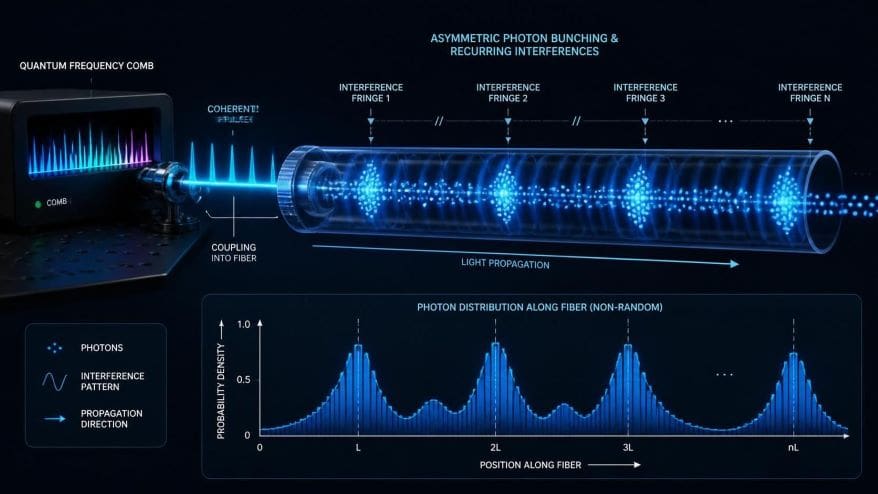
Scientists, while studying photon bunching interference, send light from a quantum frequency comb through an optical fiber. An optical fiber is a thin glass wire that carries light. As the light travels through the fiber, something interesting happens. The photons, or light particles, bunch together unevenly. This is called asymmetric photon bunching. As a result, the light does not spread out evenly inside the fiber. Instead, it creates repeating patterns. These are called recurring interferences. In addition, the photons spread out into specific distributions along the fiber. The distribution of the photons is not random—the fiber and the frequency comb work together to control where the photons go. Furthermore, the way the photons bunch and spread affects how well the fiber can send information. In conclusion, understanding these patterns helps scientists build better optical fibers.
Photon Interference Visibility
- First, scientists use a quantum frequency comb to generate light. This comb produces many colors of light at once.
- As a result, the light particles, called photons, create interference patterns. Interference happens when light waves mix.
- Next, the scientists look at something called photon interference visibility. Visibility tells us how clear the interference pattern is.
- In addition, the photons bunch together unevenly. This is called asymmetric photon bunching. It makes the interference pattern less clear.
- For example, when photons bunch together, the pattern becomes blurry. So the visibility goes down.
- On the other hand, when photons spread out more evenly, the pattern is sharper. So the visibility goes up.
- Furthermore, the interference patterns keep coming back. These are called recurring interferences. They repeat over and over again.
Quantum Information Processing
Scientists use a tool called a “quantum frequency comb” to process information. This comb shoots out many colors of light at once. Each color carries a tiny piece of data called a quantum bit, or qubit. As a result, the combs create strange light patterns. For example, the photons bunch together unevenly. This is called asymmetric photon bunching. In addition, the photons create recurring patterns. These are called recurring interferences. These patterns help scientists encode and read information.
Time-Bin Photon Recurrences
Scientists use a quantum frequency comb to create light pulses. These pulses happen at very specific times. Each pulse is a time bin, or a small time slot, for a photon. As a result, the photons show a behavior called time-bin photon recurrences. In other words, the same time slots keep appearing again and again. This happens because of asymmetric photon bunching. The photons do not spread out evenly across time. Instead, they bunch together in some time slots more than others. For example, certain time bins receive many photons, while others receive very few.
Frequently Asked Questions
What are quantum frequency combs?
Quantum frequency combs are light tools. They produce many colors of light. The colors are evenly spaced apart. These combs create repeating patterns of light interference. The patterns keep coming back over time. Scientists use these patterns to encode and process data. This makes quantum information work faster and better. The study indicates that these combs also create a special effect. Photons bunch together in ways that keep repeating.
What is asymmetric photon bunching?
Scientists study how paired photons interact. Normally, these pairs interfere with each other in a balanced way. However, sometimes they do not. This is called asymmetric photon bunching. It happens when the photons interfere unevenly around a central point. To see this effect, the researchers used a special tool. They used Hong–Ou–Mandel (HOM) interference. This tool helps scientists observe how two photons interact.
How were the photons distributed?
The researchers sent a quantum frequency comb through a long optical fiber. The fiber was 21 kilometers long. That is about 13 miles. In addition, the team did not need any special tools to adjust the light as it traveled. This is called dispersion compensation. They let the light travel without any correction. As a result, they still saw photon bunching recurrences. The photons kept bunching together again and again. The effect did not go away.
Reference
Chang, K.-C., Cheng, X., Chen, Y., & Wong, C. W. (2026). Asymmetric photon bunching, recurring interferences, and distributions via quantum frequency combs. New Journal of Physics, 28(6), 064507. https://doi.org/10.1088/1367-2630/ae6f45
- Author
- Latest Posts

I completed my Master of Science from the University of Allahabad in 2017 with a strong academic background in life sciences and chemistry. My specialization included Molecular Biology, Microbiology, Genetics, Plant Breeding, Phycology, Paleobotany, and Bioinformatics, along with Organic Chemistry, Inorganic Chemistry, and Physical Chemistry. This multidisciplinary training provided me with a comprehensive understanding of biological systems and analytical scientific approaches.
After completing my postgraduate studies, I gained valuable professional experience in both the education and social development sectors. I worked at A.M. Oxford Public School, where I was actively involved in guiding students toward academic excellence. In this role, I focused on creating an engaging learning environment, encouraging critical thinking, and nurturing students’ curiosity for scientific learning. My experience as an educator strengthened my communication, mentoring, and classroom management skills.
In addition to my teaching experience, I worked with Jeevan Jagriti Foundation, where I contributed to community-based initiatives aimed at improving educational access and awareness among underprivileged sections of society. Through this work, I participated in programs designed to support social development and promote the value of education in marginalized communities.
These professional experiences helped me develop strong interpersonal, leadership, and organizational skills while reinforcing my commitment to education and community service.