Targeted protein degradation destroys harmful proteins using the cell’s ubiquitin-proteasome system.
Targeted Protein Degradation: Revolutionary Cancer Treatment Innovation
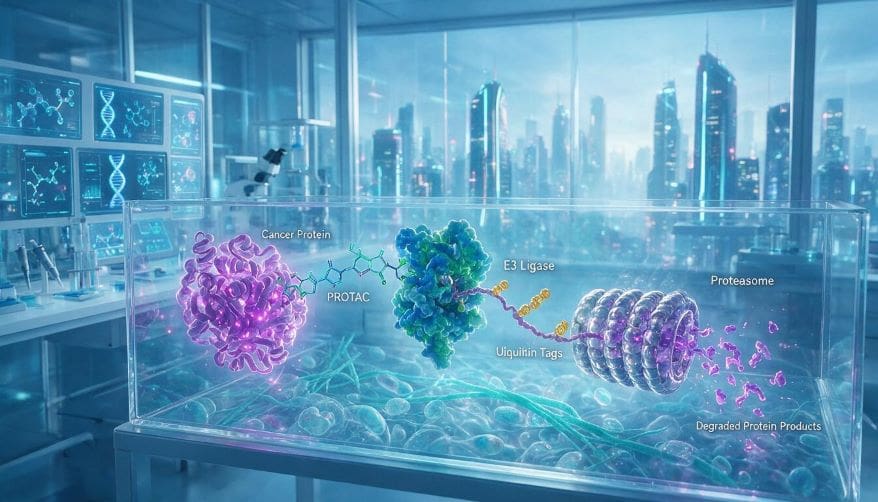
Traditional drugs function by inhibiting a protein’s activity, analogous to a key stuck in a lock. However, numerous disease-associated proteins cannot be effectively block by such inhibitors. Targeted protein degradation presents a transformative alternative: rather than merely inhibiting the protein, it facilitates its complete destruction. This strategy harnesses the cell’s intrinsic disposal mechanisms to eliminate pathogenic proteins, thereby enabling therapeutic interventions for diseases previously deemed “undruggable,” such as various cancers and neurodegenerative disorders.
ENTECH STEM Magazine has included this research in its list of Top 10 STEM Discoveries and Innovations of June 2026.
Key Takeaways
- Targeted protein degradation destroys harmful proteins using the cell’s ubiquitin-proteasome system.
- PROTACs are bifunctional molecules that bridge a target protein to an E3 ligase, triggering degradation.
- Thus, This approach addresses “undruggable” targets like KRAS and tau that resist traditional drugs.
- Applications span cancer, neurodegeneration, infectious disease, and immunology.
- Additionally, Benefits include catalytic activity, low-dose potency as well as ability to overcome drug resistance.
- Challenges involve oral bioavailability, limited E3 ligase options, and tissue delivery.
- However, Future innovations include multimodal degraders and AI-driven design.
What Is Targeted Protein Degradation?
Understanding this innovation requires an examination of cellular protein quality control mechanisms. Cells utilize the ubiquitin-proteasome system, which however tags obsolete or damaged proteins with ubiquitin, a small regulatory protein.
Targeted protein degradation (TPD) leverages this system through the use of engineered molecules known as PROTACs (proteolysis-targeting chimeras). These bifunctional molecules simultaneously bind to a target protein and an E3 ubiquitin ligase, thereby facilitating the ubiquitination and subsequent degradation of the target protein.
How Targeted Protein Degradation Works: A Step-by-Step Explanation
- The PROTAC Binds: The degrader molecule has two “arms.” One arm grabs the target protein (e.g., a cancer-causing mutant protein). The other arm grabs an E3 ligase, which is a protein that adds ubiquitin tags.
- A Bridge Forms: The PROTAC creates a temporary bridge between the target and the ligase. This brings them close together.
- Ubiquitin Tagging: The E3 ligase attaches a chain of these molecules to the target protein. This acts like a “kill me” signal.
- Recognition and Destruction: The proteasome—the cell’s protein shredder—recognizes the ubiquitin chain. It unfolds the target protein and breaks it into small peptides.
- Recycling: The PROTAC is releases intact after the target is destroy. It can then find another copy of the target and repeat the process. Additionally, this catalytic cycle makes TPD extremely efficient.
Real-World Applications
Targeted protein degradation demonstrates broad application
Healthcare (Cancer Treatment): TPD can destroy oncoproteins like KRAS (G12C), which is notoriously difficult to drug with traditional inhibitors. However, Clinical trials are already underway for PROTACs targeting breast and prostate cancers.
Neurology (Neurodegeneration): Additionally, Misfolded proteins like tau in Alzheimer’s or huntingtin in Huntington’s disease can be selectively degraded, potentially slowing disease progression.
Infectious Disease: PROTACs can target viral proteins, such as those from SARS-CoV-2 or HIV, even when the virus mutates around traditional drugs.
Immunology: Degrading inflammatory signaling proteins (e.g., STAT3) offers a new way to treat autoimmune conditions like rheumatoid arthritis.
Research Tools: Finally, TPD enables the rapid and selective removal of specific proteins from cells.
Benefits of Targeted Protein Degradation
- Targets the “Undruggable”: Can eliminate proteins that lack active sites for traditional inhibitors.
- Catalytic Action: One drug molecule degrades many target copies, enabling low-dose efficacy.
- Overcomes Resistance: Cancers often mutate to evade inhibitors. TPD can still degrade mutant forms.
- Higher Selectivity: Modern degraders are design to minimize off-target effects.
- Durable Response: Once the protein is gone, its effects eliminate until the cell makes new copies.
Challenges and Limitations
- Oral Bioavailability: PROTACs are large molecules (usually >800 Da), making them difficult to formulate for oral administration.
- E3 Ligase Availability: Only a few E3 ligases are uses in current TPD design. However, Expanding this toolkit is crucial.
- Resistance Mechanisms: Cells can evolve resistance by mutating the PROTAC binding site or downregulating the E3 ligase.
- Tissue Distribution: Reaching tissues like the brain is challenging due to the blood-brain barrier.
Future Scope

- Dual-Target Degraders: Molecules that degrade two different disease proteins simultaneously.
- Light-Activated PROTACs: Degraders that only work when exposed to light, allowing precise spatial control.
- Oral Formulations: New chemistry to improve the drug-like properties of large degrader molecules.
- Machine Learning Design: AI to predict optimal linker length and binding orientation for more potent degraders.
Frequently Asked Questions
Q1: What is the difference between a PROTAC and a traditional drug?
A traditional inhibitor binds and blocks a protein’s active site. A PROTAC recruits the degradation machinery to destroy the entire protein. TPD is catalytic, meaning one degrader can destroy many targets.
Q2: Are there any FDA-approved targeted protein degradation drugs?
As of now, no TPD drugs are FDA-approved, but several are in clinical trials (e.g., for cancer). Early results show promise, and experts expect approvals within the next few years.
Q3: Can targeted protein degradation be use for viral infections?
Yes. PROTACs can degrade viral proteins like the SARS-CoV-2 spike protein or HIV integrase. This approach may overcome viral mutations that cause drug resistance.
Q4: Is targeted protein degradation safe for normal cells?
Ideally, yes. Degraders are designed to only target disease associated proteins. However, off target degradation can occur. Ongoing research focuses on safety to minimize side effects.
Reference
Marques, AS.M.C., Bauer, L.G., Nguyen, TA. et al. Targeted Protein Degradation of NUDT5 Dissociates Catalytic Inhibition from Protein Loss in Response. Nat Commun (2026). https://doi.org/10.1038/s41467-026-74489-9
- Author
- Latest Posts

I am an inspirational writer and emerging science blogger with a deep-rooted passion for understanding and sharing the wonders of the world around us. My journey began with a Bachelor of Science in Chemistry from AKI’s Poona College of Arts, Commerce and Science, where I developed not only a strong foundation in scientific principles but also a mindset that values curiosity, observation, and critical thinking. Studying chemistry has taught me to approach problems with logic, to look beyond the obvious, and to see patterns where others might only see complexity. These experiences have shaped the way I perceive life and influence the way I express my thoughts, both scientifically and creatively.
I have always believed that knowledge is only as powerful as the way it is shared. This belief has guided me to create content that bridges the gap between science and everyday life. I aim to simplify complex scientific ideas so they become approachable, relatable, and engaging for everyone—whether someone has a formal background in science or is simply curious about the world. Science, in my view, is not confined to textbooks and laboratories; it is a way of thinking, understanding, and connecting with the world around us. By making science accessible, I hope to inspire curiosity, ignite learning, and encourage people to see the beauty and relevance of scientific discovery in their daily lives.
Alongside my love for science, I am deeply passionate about motivational writing. I believe words carry the power to transform perspectives, encourage self-reflection, and inspire action. By combining analytical thinking with creativity, I create content that is intellectually stimulating yet emotionally resonant. Whether I am breaking down a chemical concept, exploring a scientific phenomenon, or crafting motivational narratives, my goal is to communicate ideas in a way that is clear, meaningful, and impactful.
Through my work, I strive to empower my readers – not just by helping them understand the science around them, but by inspiring them to grow, learn, and realize their full potential. Every article, post, or story I write reflects my commitment to turning knowledge into inspiration. I want to spark curiosity, encourage self-improvement, and show that learning and personal growth are deeply connected. For me, writing is not just a craft; it is a way to touch minds, connect hearts, and make ideas come alive in a way that truly resonates.