Featured in ENTECH Magazine’s STEM Discoveries & Innovations, June 2026
Spectral Algorithms in Higher-Order Fourier Analysis: A Breakthrough for the Future of STEM
Estimated reading time: 6 minutes
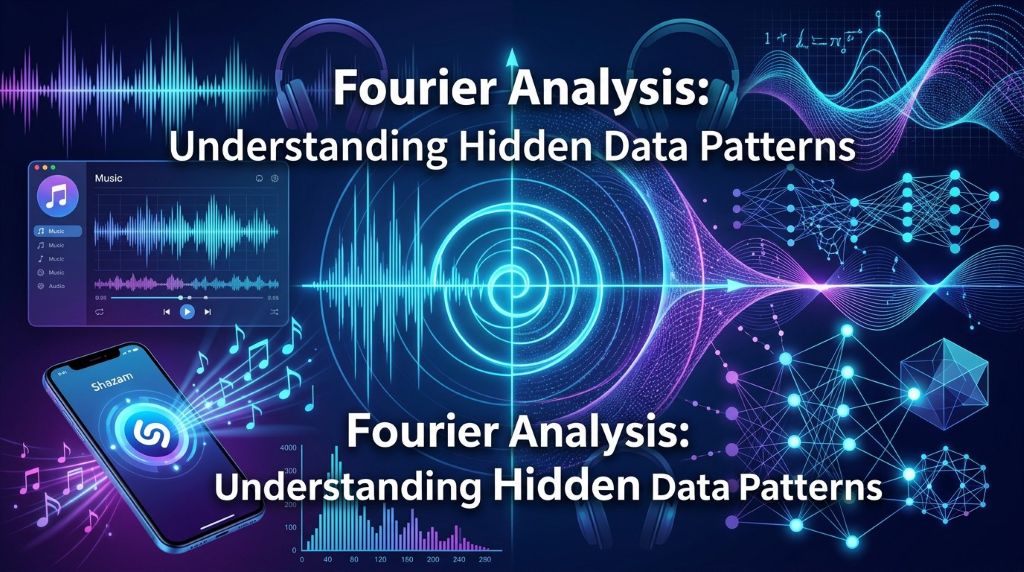
Have you ever thought about how your favorite music app can recognize a song almost instantly? In addition, have you considered how noise-canceling headphones seem to magically block out the world around you? The math behind these everyday marvels is called Fourier analysis. Pretty cool, right? Well, here’s something even cooler: mathematicians have recently found a way to take this concept to a whole new level using higher-order Fourier analysis. As a result, they are uncovering hidden patterns in data that no one could see before.
Why Should You Care About Spectral Algorithms and Fourier Analysis?
This breakthrough comes from the work of Pablo Candela, Diego González-Sánchez, and Balázs Szegedy. Specifically, they have made significant advances in what is known as higher-order Fourier analysis. Their research isn’t just theoretical—it’s a total game-changer for areas like artificial intelligence, cryptography, and data science. If you’re a high school student wondering how math impacts the world, this discovery is like a backstage pass to the future of STEM. Moreover, it offers a unique glimpse into upcoming advancements.
What Is Fourier Analysis? (And How Does It Show Up in Real Life?)
Let’s start with the basics. Imagine you’re sipping a smoothie. It tastes amazing, but can you tell exactly which fruits are in it? Fourier analysis is like having a superpower that lets you break down that smoothie into its individual ingredients—strawberries, bananas, maybe even a hint of mango. In the world of math and science, Fourier analysis helps us decompose complex signals (like music, images, or even weather patterns) into simple, repeating waves called frequencies.
Think about how Shazam identifies a song: it listens to a snippet, breaks it down into its musical notes (frequencies), and matches it to a database. Or consider how JPEG images are compressed—Fourier analysis helps keep the important details while tossing out the noise, saving space on your phone. This is why “Fourier analysis for high school” is such a hot topic: it’s everywhere, from your playlist to your Instagram feed.
But here’s the catch: classical Fourier analysis is great for simple, repeating patterns. What if the pattern is more like a secret code, hidden deep within the data? That’s where the story gets really interesting
Digging Deeper: Higher-Order Fourier Analysis and Gowers Norms Explained
Now, let’s level up. Imagine you’re a detective, not just looking for the main flavors in your smoothie, but searching for subtle hints—like a dash of cinnamon or a swirl of chocolate. Higher-order Fourier analysis is the detective’s toolkit for finding these hidden patterns, the ones that classical methods miss.
Here’s where Gowers norms come in. Think of them as “randomness detectors.” If you have a playlist and want to know if there’s a secret pattern in how the songs are arranged, the Gowers norm can tell you. A high Gowers norm means there’s a hidden structure; a low one means it’s just random noise. This is why “Gowers norms simple explanation” is trending among students and teachers alike.
But how do you actually find these patterns? That’s where the new research shines. The authors proved something called the Spectral Regularity Theorem and the Spectral Inverse Theorem. In simple terms, these theorems show that any complex dataset can be split into two parts: the structured, meaningful patterns (like the secret recipe in your smoothie) and the random noise. This is a huge leap forward, making it possible to uncover secrets in data that were previously out of reach.
Spectral Algorithms: The Prism That Reveals Hidden Rainbows in Data
Let’s bring in another analogy: a prism. When you shine white light through a prism, it splits into a rainbow of colors. Spectral algorithms do the same for data—they break down complex information into its basic components, making hidden patterns visible.
The research introduces a practical tool called the Quadratic Fourier Analysis Algorithm. Imagine you have a messy dataset—maybe it’s a series of financial transactions, genetic sequences, or even encrypted messages. This algorithm builds a special matrix from your data. Subsequently, it applies a “denoising” process, similar to cleaning a foggy window, and then uses spectral decomposition to identify the most important patterns. Spectral decomposition is just a fancy way of saying: “Let’s find the main directions in which the data varies,” much like how principal component analysis works in statistics.
What’s truly exciting is that these algorithms are efficient and easy to implement. You don’t need to be a math genius—they use standard tools like the Fast Fourier transform (FFT) and basic linear algebra. This means that even high school students can start experimenting with these ideas, making “spectral algorithms explained” a must-read topic for anyone interested in STEM.
Real-Life Applications: From AI and Data Science to Cryptography and Beyond
So, why does all this matter? The answer lies in the incredible range of applications. In AI and machine learning, these spectral algorithms help computers recognize patterns in massive datasets. For example, they enable smarter recommendation systems or more accurate medical diagnoses. In data science, they’re used for cleaning up noisy data. This process is also essential for predicting missing values, which is crucial for everything from climate modeling to genomics.
Cryptographers use complex mathematical techniques, such as higher-order Fourier analysis and spectral decomposition, to uncover hidden weaknesses in security systems. These methods are essential for spotting subtle vulnerabilities that might otherwise go unnoticed.
At the same time, these techniques play a key role in signal processing. For example, they’re what make noise-canceling headphones work so effectively. By analyzing and canceling out unwanted background noise, these headphones allow you to enjoy clear, uninterrupted music. As a result, even in loud places like a busy café, your listening experience remains unaffected.
Here’s a quick table to show just how far-reaching these discoveries are:
| Field | How Spectral Algorithms Help |
|---|---|
| AI & Machine Learning | Better pattern recognition, smarter predictions |
| Data Science | Denoising, missing data prediction |
| Cryptography | Finding hidden flaws, strengthening security |
| Genomics | Detecting complex DNA patterns |
| Signal Processing | Enhanced noise reduction, clearer communications |
The bottom line? These new algorithms are like giving scientists and engineers a super-powered microscope for data. Moreover, they can reveal secrets hidden deep within the numbers.
Why This Discovery Is a Game-Changer for the Future of STEM
This isn’t just another math breakthrough—it’s a bridge between deep theory and real-world impact. Before this research, higher-order Fourier analysis was mostly a playground for advanced mathematicians. Now, thanks to these spectral algorithms, anyone with curiosity and a laptop can start exploring the hidden structures in data.
For high school students, this means the doors to cutting-edge STEM fields are wide open. Whether you dream of building the next AI, cracking codes, or making sense of the world’s data, understanding these concepts gives you a head start. The tools are accessible, the applications are endless, and the future is yours to shape.
Ready to Join the Next Wave of STEM Innovators?
If you’ve ever wondered how math can change the world, this is your moment. Dive into the world of spectral algorithms and higher-order Fourier analysis. Experiment with data, ask big questions, and don’t be afraid to explore the unknown. The discoveries you make today could power the technologies of tomorrow.
Stay curious, keep exploring, and remember: the next big STEM breakthrough could start with you!
Reference
Candela, P., González-Sánchez, D., & Szegedy, B. (2026). Spectral algorithms in higher-order Fourier analysis. Forum of Mathematics Sigma, 14. https://doi.org/10.1017/fms.2026.10238
- Author
- Latest Posts

Charudatta Pathak was a student at St. Aloysius High School in Bhusawal, established in 1874, making it one of India’s oldest convent institutions. He earned his bachelor’s degree in mechanical engineering from SSVPS College of Engineering, Dhule in 1995, demonstrating exceptional academic achievement. Thereafter, he launched his career as a CNC programmer in a toolroom. He has utilized FANUC, Deckel, Maho, and Mikron controllers to operate 2-axis and 3-axis machines for the fabrication of jigs, fixtures, dies, and molds. He commenced his career as an academic in 1996, when he assumed the role of lecturer at SSVPS College of Engineering, Dhule. Additionally, he earned his post-graduate degree in CAD/CAM from L. D. College of Engineering, Ahmedabad, in 2000, and then acquired a Ph.D. from COEP in 2011 while concurrently engaged in teaching. Until 2023, he occupied many academic roles, including lecturer, assistant professor, professor, dean, principal, director, and vice chancellor at both public and private universities throughout India. From 2008 to 2010, he served as the project lead in the CAE department of a European multinational firm. During his 28-year professional tenure, he identified a need for dependable books targeted at students in grades 8 to 12, particularly for nascent career planning. He founded ENTECH Digital Magazine, a free monthly publication available on entechonline.com and magzter.com. Teens with a strong interest in Science, Technology, Engineering, and Mathematics (STEM) who aspire to pursue careers in these fields may find ENTECH Digital Magazine beneficial.