We use soap every day and it is in fact a little bit of scientific magic in bar form. The secret of how soap cleans lies in its tiny, invisible molecules. Each molecule of soap has two sides: one side is attracted to water and the other to oil and grease. That is why soap can do something that water alone cannot—remove dirt and oil. Water on its own is unable to remove greasy substances because oil and water don’t mix. Soap, on the other hand, acts as a bridge: one end of the molecule attaches to the grease while the other end remains attached to the water. This cooperation allows soap to lift dirt off your skin or clothes so that you can rinse it away.
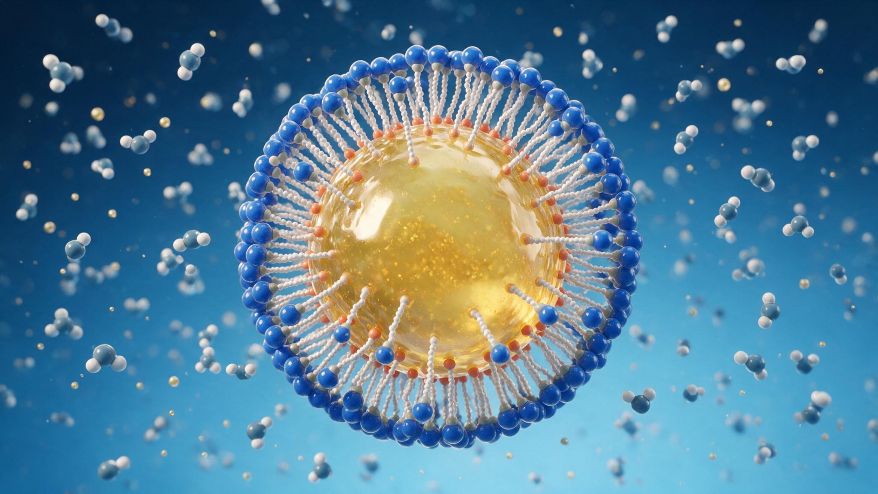
Soap molecules join together to make tiny bubbles called micelles that trap dirt and oil. When you rinse with water, these micelles carry everything away. That’s the basic science behind why soap cleans so well. Even though you can’t see the chemistry, it’s happening every time you wash. This guide will explain the whole process step by step in simple terms. You might even surprise your friends or your chemistry class with what you learn!
Key Takeaways
Each soap molecule has one part that is attracted to water and another part that is attracted to oil.
Soap is able to clean because it contains small spheres called micelles.
Grease and dirt get trapped inside soap micelles.
For example, soap’s cleaning effect can be seen on the skin, on dishes, and on clothes.
Soap also dissolves the oily outer layers of a large number of germs.
Warm water and rubbing help soap work more quickly.
In the end, the dirt which the soap has taken away is removed by rinsing.
The Chemistry of Soap
People have been making and using soap for thousands of years. Long ago, they found that boiling animal fats with wood ashes creates soap. The ashes add something called alkali, which helps start a reaction called saponification. This reaction turns fat and alkali into soap and a bit of glycerin. The type of fat you use changes the soap you get. For example, coconut fat makes a hard, bubbly bar, while olive oil gives you a gentle, softer soap. Even buffalo milk can be turned into soap, as a recent study showed. Sometimes, people add plant extracts to make soap even more special. So, soap starts with simple ingredients, but there’s an ancient and clever reaction in every bar. The way soap works today still relies on this same science. Next, let’s look at how the shape of soap molecules gives them their cleaning power.
Soap is made from fats and oils, which scientists call triglycerides. Plants and animals store energy in this form. Each triglyceride is like a bundle—glycerol holding onto three fatty acids. When you mix in a strong base like breaks the bundle apart. One part becomes soap, and the other becomes glycerin. This is the process of saponification. Each soap molecule has a negative charge at one end, which helps it grab water. The long tail, made of carbon, loves to grab onto oils and grease.
Think of each soap molecule as a little bridge. Because it has one end that loves water and another that loves oil, it can connect the two. That’s why soap is so good at cleaning away grease, sweat, and dirt. Soap is made of similar stuff as fats, so it bonds easily with greasy stains. In a way, soap turns the ‘enemy’—oily dirt—into something water can wash away.
A Molecule with Two Personalities
If you could see a soap molecule up close, you’d notice that one end has a small charge, and water is attracted to this charged ‘head.’ The other end is a long, oily ‘tail’ that avoids water. Scientists call this design amphiphilic. Nature uses the same trick, since the fats in our own cells are built this way. The ‘head’ likes water, while the ‘tail’ prefers oil or grease. When you use soap, the tail goes into the grease and the head stays in the water. Together, they break down the barrier between oil and water.
At the same time, the oily parts come together and squeeze the grease into small droplets, which then float in the water and form an emulsion. Because of the presence of soap, oil and water are finally able to mix together. Each time you see bubbles and lather, it is the chemistry at work. Now let’s examine how this process works step by step.
How Soap Cleans in Steps
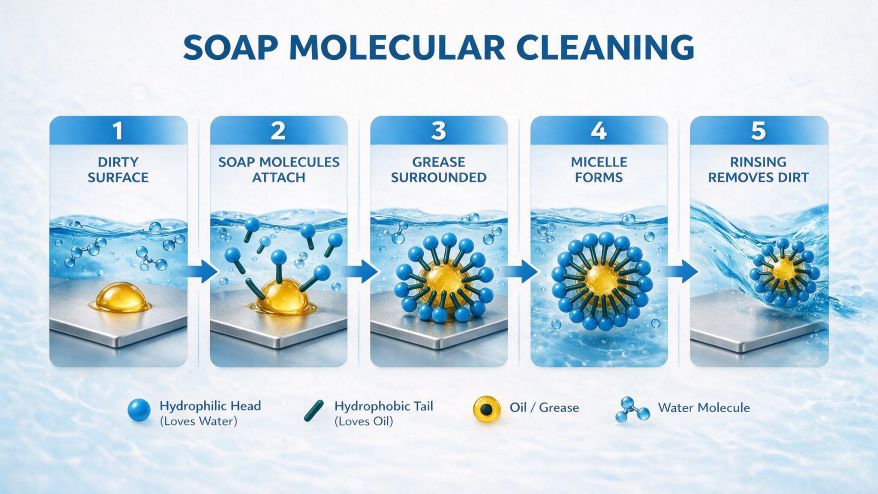
Fig.1: Step by Step- How Soap Cleans
The entire process involves three steps. In the first step, the ends of the soap molecules penetrate the grease and surround each oil droplet. Then the charged parts face outwards into the water. Because of the negative charges, they repel one another slightly and thus prevent the droplets from rejoining. In the third step, the water carries the small droplets away. Each of these groups is known as a micelle, which is similar to a hollow soap ball with the oil hidden inside.
Since the water only comes into contact with the outer shell, the grease is able to pass safely down the drain. This method is the way in which soap removes dirt, and the same chemical principle applies to all surfaces. Friction helps to speed up the formation of the micelles, so you should scrub for twenty seconds altogether. Your hands will appreciate it. This scientific principle is employed in all detergents, although soap was the first to do so.
The Rinsing Stage
At the rinsing stage, the micelles float off, taking with them the oil and the dead germs that had become trapped. The surface is then left clean, with no grease remaining. The rinsing is completed using plain water. A small amount of soap molecules may still remain and this can form a film which dries and becomes sticky. In the case of hard water, a grey scum can develop since the soap reacts with the calcium and magnesium ions to produce flakes that adhere to the tubs and to the fabrics.
This is the reason why soapsuds sometimes leave a ring. Modern detergents have solved this problem as their molecules do not react with the ions in hard water. Yet soap is still a natural classic. The chemistry of soap shows us the fundamental rules which all cleaning agents obey. The micelle structure changes the way we understand dirt, making oily dirt compatible with water. It is this simple concept that underlies all home cleaning.
The Cleaning Action of Soap
Soap is effective against a variety of types of dirt. Although body oil, food grease, and dust are different, soap is able to deal with all of them. Its cleaning process always begins with the tails. These tails dissolve into any oily substance. For instance, skin sebum is one such oily substance. It combines with sweat and dead skin cells. This sticky mixture then catches bacteria. The soap removes the entire combination. As a result, washing every day keeps the pores able to breathe. This is something that athletes need to do after each workout. Cooks are exposed to oil splashes every day. Mechanics come into contact with grease right up to their elbows. In all these situations, the same chemistry is at work.
The soap sticks to the tail portion while the water attaches to the head, which results in a simple and complete rinse. Although soap is mild when it comes to most surfaces it is powerful in dealing with dirt. This combination is the reason it is so widely used as a cleaning agent. All kitchens and laboratories make use of it. In the following sections soap will be seen in practice, with two everyday tasks serving as examples.
How Soap Cleans Oil and Grease
Picture a dirty frying pan with a thin layer of oil on it, so that water simply runs off. Soap brings about a rapid change. When a drop of soap is added to warm water, the tails dive straight into the oil film, lift up the edges and break the layer apart. The oil pieces are then surrounded and caught by micelles. Rubbing the pan with a sponge makes the process go faster, and scouring exposes more oil to the soap. The fresh soap continues to pick up more grease. Eventually, the pan becomes smooth and clean. This process is known as emulsification.
Soap cleaning works by breaking up oil into tiny water droplets, so it is able to remove grease without the need for vigorous scrubbing. Dish soap contains more powerful surfactants, while laundry soap is formulated to deal with fats that are safe for fabrics. In the same way, engine grease can also be dealt with by soapy water. This process is a true example of molecular cooperation. The pan is now shiny and has no oily film on it, all because of a small amount of fatty acid salts. Finally, it is clear that chemistry actually takes place in your sink.
How Soap Cleans Dishes and Clothes
Dishes contain a variety of food residues, including proteins, starches and fats. Soap is most effective at removing the fatty substances. Warm water helps to soften the food that has stuck to the dishes. First, soaking loosens the dried-on debris, after which soap encircles each food particle and micelles take the particles into the rinse water. When the cutlery is dried it comes out completely clean. Clothes pose a greater difficulty because the fabric fibres catch sweat and body oils, something that is clearly seen in the stains on the collars. The soap molecules act between the fibres and gently loosen the dirt that is embedded in them. The washing machine also provides a tumbling action.
This action removes dust from the weave; rinsing then gets all the remaining material away. To sum up, using soap cleans fabrics every day. Sporting equipment once again has a fresh smell, towels once again feel soft, and the colours remain bright even after a number of washes. That is the reason why soap has stayed so popular. A single family of molecules carries out all these tasks. Consequently, chemistry becomes, in the end, a science when it comes to laundry. The next part is the germ-fighting aspect of soap.
How Soap Cleans Away Germs
Fig. 2: Chemistry Of Soap
Germs cover our hands all day long. Many microbes carry oily outer coats. In fact, viruses often wrap themselves in lipid membranes. Soap attacks those fatty membranes directly. Soap tails, therefore, wedge into the membrane layer. They pry the germ coat apart. The microbe then falls apart completely. As a result, this mechanism stops many viruses cold. Fatty acid salts do this job very well. A 2026 study compared several anionic surfactants. Scientists tested soap salts and synthetic types. Soap-type molecules, moreover, damaged virus membranes fast. So, the chemistry of soap doubles as defense. It cleans dirt and destroys germs together. That is how soap cleans skin so well. Handwashing, therefore, remains a proven health tool. Twenty seconds of lather matters enormously. This simple habit prevents many infections. Clean hands protect the whole family. Soap turns washing into protection. Finally, good technique makes every wash count.
A Handwashing Routine That Works
Handwashing using soap keeps lives saved every day. A review from 2026 demonstrated its true value. The authors looked at the costs and the health benefits. Promoting the use of soap was found to be highly cost-effective. Even in poor communities there were great benefits obtained. Therefore, the practice should receive careful consideration. Observe these five simple steps every time.
Take some clean running water and wet your hands.
Afterwards, Apply enough soap to cover both hands.
Eventually, Scrub every part for twenty seconds.
Rinse away all soap and loose germs.
Finally, Dry your hands with a clean towel.
Five steps take less than one minute. Clean water rinses germs off the surface. Soap loosens the oily grip first. Friction between hands adds the force. Nails and thumbs need extra attention. Those spots hide the most microbes. A quick routine keeps everyone safer. Parents can teach kids this habit. Schools see fewer sick days as a result. Research shows repeated handwashing pays off. Soap cleaning beats plain water every time. Make this routine automatic at home. Your future self will stay healthier. This small act carries huge power. In conclusion, soap is a true health ally.
Some germs survive without an oily coat. Soap still washes them away physically. Running water removes loose microbes too. Yet soap and water beat sanitizer alone. A 2025 study tested soap versus bleach. Researchers cleaned surfaces carrying the virus. Soap and water removed contamination well. Bleach offered extra disinfection power. Soap remains kinder to skin and air. Use sanitizer when water is missing. Prefer soap whenever a sink exists. Soap handles dirt, grease, and germs. One product solves three problems. That is real everyday chemistry. Science explains why we wash. Now the last section answers common questions. These answers will round out your knowledge.
Frequently Asked Questions
Because soap is more effective at removing oil than water is.
Soap tails dissolve into the oil. Soap heads grab water. Micelles carry the oil away. Water by itself cannot do this job.
Can hand sanitizer take the place of soap and water?
Soap and water get rid of more germs; sanitizer is useful when there is no sink, and soap also removes dirt and grease whereas sanitizer leaves the dirt behind.
Does hot water help soap clean better?
Yes, warm water acts on the fats first since heat accelerates the majority of chemical reactions and very hot water can cause your skin to dry out so lukewarm water is best when washing your hands.
Can soap harm healthy skin?
Soap has the effect of removing the natural oils from the skin. If you wash your skin frequently then you should use a milder soap. A moisturizer aids in restoring the barrier. Using a mild soap helps to protect the skin’s biome.
la Gatta, B., Dilucia, F., Liberatore, M. T., Rutigliano, M., Di Luccia, A., Albenzio, M., & Caroprese, M. (2026). Buffalo milk: Alternative use for soap preparation enriched with vegetables. Molecules, 31(4), 734. https://doi.org/10.3390/molecules31040734
Ross, I., Bath, D., Wells, J., Dreibelbis, R., Ejemot-Nwadiaro, R., Esteves Mills, J., Greco, G., Pitt, C., & Cumming, O. (2026). Cost-effectiveness and benefit-cost analyses of promoting handwashing with soap: A systematic review. PLoS Medicine, 23(4), e1004982. https://doi.org/10.1371/journal.pmed.1004982
Udoh, E. E., Udoh, U. A., Egwuenu, A., Esu, E. B., Eteng, A., Ovat, F. E., Okomo, U., Oduwole, O., Okebe, J., & Meremikwu, M. (2025). Soap and water cleaning versus bleach-based cleaners for eliminating SARS-CoV-2 infection. Journal of Public Health in Africa, 16(2). https://doi.org/10.4102/jphia.v16i2.612
Yamamoto, A., Iseki, Y., Elsayed, A. M. A., Kawahara, T., Akiba, I., Akita, T., Tanaka, J., Sakaguchi, T., & Higashiura, A. (2026). Differential mechanisms of SARS-CoV-2 inactivation by anionic surfactants: A comparative study of fatty acid salts and synthetic surfactants. Scientific Reports, 16(1). https://doi.org/10.1038/s41598-026-36858-8
I am an inspirational writer and emerging science blogger with a deep-rooted passion for understanding and sharing the wonders of the world around us. My journey began with a Bachelor of Science in Chemistry from AKI’s Poona College of Arts, Commerce and Science, where I developed not only a strong foundation in scientific principles but also a mindset that values curiosity, observation, and critical thinking. Studying chemistry has taught me to approach problems with logic, to look beyond the obvious, and to see patterns where others might only see complexity. These experiences have shaped the way I perceive life and influence the way I express my thoughts, both scientifically and creatively.
I have always believed that knowledge is only as powerful as the way it is shared. This belief has guided me to create content that bridges the gap between science and everyday life. I aim to simplify complex scientific ideas so they become approachable, relatable, and engaging for everyone—whether someone has a formal background in science or is simply curious about the world. Science, in my view, is not confined to textbooks and laboratories; it is a way of thinking, understanding, and connecting with the world around us. By making science accessible, I hope to inspire curiosity, ignite learning, and encourage people to see the beauty and relevance of scientific discovery in their daily lives.
Alongside my love for science, I am deeply passionate about motivational writing. I believe words carry the power to transform perspectives, encourage self-reflection, and inspire action. By combining analytical thinking with creativity, I create content that is intellectually stimulating yet emotionally resonant. Whether I am breaking down a chemical concept, exploring a scientific phenomenon, or crafting motivational narratives, my goal is to communicate ideas in a way that is clear, meaningful, and impactful.
Through my work, I strive to empower my readers - not just by helping them understand the science around them, but by inspiring them to grow, learn, and realize their full potential. Every article, post, or story I write reflects my commitment to turning knowledge into inspiration. I want to spark curiosity, encourage self-improvement, and show that learning and personal growth are deeply connected. For me, writing is not just a craft; it is a way to touch minds, connect hearts, and make ideas come alive in a way that truly resonates.
I am an inspirational writer and emerging science blogger with a deep-rooted passion for understanding and sharing the wonders of the world around us. My journey began with a Bachelor of Science in Chemistry from AKI’s Poona College of Arts, Commerce and Science, where I developed not only a strong foundation in scientific principles but also a mindset that values curiosity, observation, and critical thinking. Studying chemistry has taught me to approach problems with logic, to look beyond the obvious, and to see patterns where others might only see complexity. These experiences have shaped the way I perceive life and influence the way I express my thoughts, both scientifically and creatively.
I have always believed that knowledge is only as powerful as the way it is shared. This belief has guided me to create content that bridges the gap between science and everyday life. I aim to simplify complex scientific ideas so they become approachable, relatable, and engaging for everyone—whether someone has a formal background in science or is simply curious about the world. Science, in my view, is not confined to textbooks and laboratories; it is a way of thinking, understanding, and connecting with the world around us. By making science accessible, I hope to inspire curiosity, ignite learning, and encourage people to see the beauty and relevance of scientific discovery in their daily lives.
Alongside my love for science, I am deeply passionate about motivational writing. I believe words carry the power to transform perspectives, encourage self-reflection, and inspire action. By combining analytical thinking with creativity, I create content that is intellectually stimulating yet emotionally resonant. Whether I am breaking down a chemical concept, exploring a scientific phenomenon, or crafting motivational narratives, my goal is to communicate ideas in a way that is clear, meaningful, and impactful.
Through my work, I strive to empower my readers – not just by helping them understand the science around them, but by inspiring them to grow, learn, and realize their full potential. Every article, post, or story I write reflects my commitment to turning knowledge into inspiration. I want to spark curiosity, encourage self-improvement, and show that learning and personal growth are deeply connected. For me, writing is not just a craft; it is a way to touch minds, connect hearts, and make ideas come alive in a way that truly resonates.