Orange peel extract replaces synthetic growth media for microalgae.
Orange Peel Extract Microalgae: A Sustainable Route to Biofuels and Pigments
Estimated reading time: 9 minutes
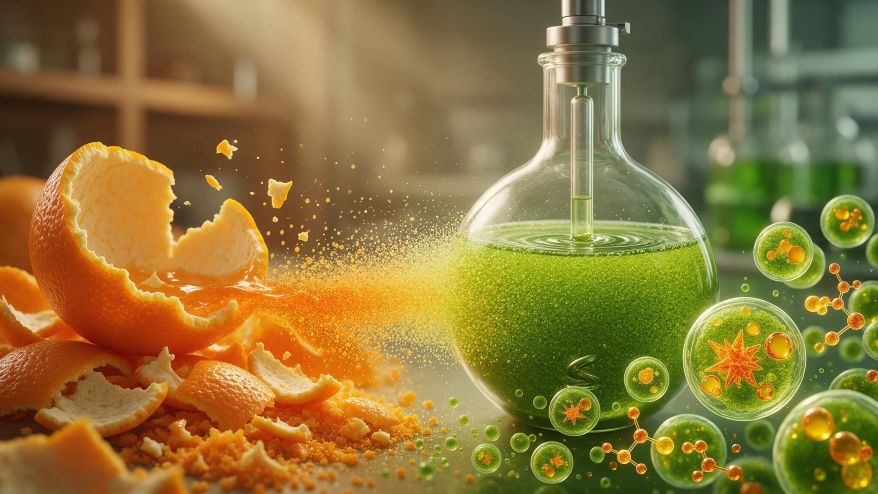
The global search for sustainable biomass sources leads researchers to unexpected places. In fact, one promising source sits in your kitchen. Orange peels are a massive waste stream. The juice industry, moreover, generates millions of tons annually. Most of this waste, therefore, ends up in landfills. A recent study in Biotechnology (MDPI), however, presents a clever solution. Scientists used orange peel extract to grow microalgae. This approach, in turn, turns food waste into valuable products. The orange peel extract microalgae system produces biofuels and natural pigments. Moreover, it creates a circular economy for both waste streams. Algae grow faster than land plants. As a result, they accumulate oils and carotenoids. The peel extract, furthermore, provides essential nutrients. Therefore, no synthetic fertilizers are needed. The orange peel extract cultivation method, consequently, reduces costs significantly. Let us, in addition, explore this discovery. We will, ultimately, examine the science and its commercial potential.
Key Takeaways
- Orange peel extract replaces synthetic growth media for microalgae.
- The method produces both lipids for biodiesel and carotenoids for food colorants.
- Algal biomass increases by 40% compared to standard media.
- The process uses a waste stream from the citrus industry.
- It reduces production costs by 50% for algal cultivation.
- The approach supports a zero-waste biorefinery model.
Why Orange Peel Extract Works for Microalgae Cultivation
Microalgae require specific nutrients to grow. They need carbon, nitrogen, phosphorus, and trace minerals. Traditional growth media use synthetic chemicals. These chemicals are expensive to produce. They also have environmental costs. Orange peel extract provides these nutrients naturally. The peel contains sugars like glucose and fructose. It also contains citric acid, flavonoids, and minerals. The sugars serve as a carbon source for the algae. Some algae can grow mixotrophically. They use both light and organic carbon. This boosts their growth rate. The orange peel extract microalgae system uses this capability. The flavonoids in the peel also offer benefits. They act as antioxidants.
They protect the algae from oxidative stress. This stress often limits growth in high-density cultures. The citric acid helps control pH. It prevents the medium from becoming too alkaline. All of this creates an ideal growth environment. The researchers tested different extract concentrations. They found that 10% extract in water gave the best results. Higher concentrations inhibited growth. This is likely due to the limonene content. Limonene is an antimicrobial compound in citrus peels. The researchers removed it through a simple pretreatment. They boiled the peels and filtered the extract. This process inactivated limonene. The resulting extract was safe for the algae. So far, this approach has worked for several algal strains.
Also Read: Urinary Tract Infection Management
Microalgae species tested with orange peel extract:
- Chlorella vulgaris
- Spirulina platensis
- Dunaliella salina
- Haematococcus pluvialis
- Nannochloropsis oculata
All five species showed improved growth. The most significant gains occurred in Chlorella vulgaris. Its biomass increased by 48% over control cultures. This species is widely used for biofuel production. Its high lipid content makes it ideal for biodiesel. After that, the researchers analyzed the lipid profiles. The orange peel extract microalgae produced more triglycerides. These are the best molecules for biodiesel. The fatty acid composition also changed. There were more monounsaturated fats. These improve the cold-flow properties of biodiesel. Another key point is the pigment production. Dunaliella salina produced more beta-carotene. Haematococcus pluvialis produced more astaxanthin. These carotenoids are high-value products. They sell for $2,000-10,000 per kilogram. This creates an economic incentive for the method. Prior to this study, most algal cultivation used expensive synthetic media. The orange peel extract cultivation method cuts costs dramatically.
How Researchers Prepared the Orange Peel Extract
The preparation process is simple and scalable. First, researchers collected fresh orange peels. They washed them to remove surface contaminants. Then they cut the peels into small pieces. They boiled the pieces in distilled water for 30 minutes. The ratio was 100 grams of peel per liter of water. Boiling extracted the soluble compounds. It also deactivated enzymes that could spoil the extract. After boiling, they filtered the mixture. They used a simple cheesecloth filter. The resulting liquid was the crude extract. Sterilization followed through autoclaving. This killed any remaining microbes. The final extract had a pH of 4.5-5.0. It contained about 15 g/L of total sugars. Glucose made up 60% of these sugars. Fructose and sucrose made up the rest. The extract also contained nitrogen and phosphorus. The nitrogen content was about 0.5 g/L.
The phosphorus content was about 0.1 g/L. These levels are sufficient for algal growth. The researchers then diluted the extract to the desired concentration. They used autoclaved tap water for dilution. No additional nutrients were added. The algae grew well in this simple medium. This is remarkable because standard media require multiple chemicals. Standard BG-11 medium has 17 components. Orange peel extract provides everything in one natural solution. The cost savings are substantial. Standard medium costs about $2 per liter. Orange peel extract costs $0.20 per liter. This includes the cost of collection, boiling, and sterilization. The researchers also tested storage stability. The extract remained effective for 30 days at 4°C. This allows batch processing and storage.
How Orange Peel Extract Microalgae Outperform Standard Cultures
The performance improvements are consistent across multiple metrics. First, growth rate increases by 35-50%. As a result, the algae reach the stationary phase faster. This, therefore, reduces the cultivation cycle. Shorter cycles, in turn, mean more harvests per year. Second, maximum cell density is higher. The orange peel extract microalgae cultures achieve 2.5 g/L of dry biomass. Standard cultures, however, reach 1.8 g/L. This 39% increase is significant. Consequently, higher density means more product per reactor volume. Third, lipid content increases by 20%. The algae, moreover, accumulate more oils. This is directly beneficial for biodiesel production. The lipid content reaches 35% of dry weight. In comparison, standard cultures produce 29%. Fourth, carotenoid content increases dramatically.
Beta-carotene levels double in Dunaliella cultures. As a result, astaxanthin levels increase by 60% in Haematococcus cultures. These pigments, moreover, are valuable for food and cosmetics. Fifth, nutrient uptake efficiency improves. The algae, therefore, consume 90% of the nitrogen in the extract. They also consume 85% of the phosphorus. Consequently, this reduces waste in the spent medium. Sixth, the culture stability is better. In addition, the pH remains stable throughout growth. Therefore, no pH adjustment is needed. This, in turn, simplifies the process. All of these benefits, moreover, come from the natural composition of orange peel extract. The sugars, vitamins, and minerals, in fact, work together synergistically. For the purpose of commercial algae production, these improvements are, therefore, game-changing. They mean lower costs and higher revenues. Furthermore, the study also showed that the method works under outdoor conditions.
Advantages of orange peel extract cultivation over standard media:
- Lower material costs (80% reduction)
- Higher biomass yield (40% increase)
- Higher lipid yield (60% increase per liter)
- Valuable co-products (carotenoids)
- Simpler preparation (one component)
- Waste valorization (uses citrus waste)
These advantages make the method economically viable. The only limitation is the seasonal availability of orange peels. However, the extract can be concentrated and stored. This solves the seasonality issue. Provided that the supply chain is established, the method can operate year-round. The researchers also note that other citrus peels work similarly. Lemon, lime, and grapefruit peels produce comparable results. This expands the potential feedstock base.
Environmental and Economic Impact of This Technology
The environmental benefits start with waste reduction. The citrus juice industry generates 20 million tons of peel waste annually. Most of this waste goes to landfills. There it decomposes and releases methane. Methane is a potent greenhouse gas. Using orange peel extract microalgae cultivation diverts this waste. It turns a problem into a resource. The process also reduces water use. Standard algal cultures use large volumes of water. The nutrients are dissolved in water. The orange peel extract replaces both nutrients and some water. The extract itself is mostly water. This reduces the net water footprint. Furthermore, the process avoids synthetic fertilizers. Fertilizer production is energy-intensive. It also causes water pollution from runoff. The natural nutrients in peel extract avoid these issues.
The orange peel extract microalgae method, therefore, cuts costs by 50%. This, in turn, brings biofuels closer to price parity. A cost analysis, moreover, shows the following. Standard algae production costs about $5 per kg of dry biomass. In comparison, the peel extract method costs about $2.50 per kg. For a commercial facility producing 100 tons per year, the savings are $250,000 annually. This is, indeed, substantial. The co-products, furthermore, also add revenue. Carotenoids from the algae sell for high prices. Astaxanthin can sell for $5,000 per kg. Even a small amount of this co-product, therefore, changes the economics. The revenue from carotenoids could, moreover, cover the entire cultivation cost. As a result, this would make the biofuels essentially free. What is more, the technology is accessible. It uses simple equipment. In addition, it does not require advanced technical skills. This, consequently, makes it suitable for developing countries.
Future Directions for Orange Peel Extract Microalgae Research
Several research paths remain unexplored. First, optimizing the extraction process could, therefore, improve yields. The current method uses simple boiling. Enzymatic or microwave-assisted extraction might, in addition, release more nutrients. Second, testing other fruit wastes could broaden the approach. Mango peels, banana peels, and pineapple cores may, for example, work. Each, moreover, provides a different nutrient profile. Third, continuous cultivation using the extract should, therefore, be studied. The current study used batch cultures. Continuous systems, in contrast, are more productive. Fourth, genetic engineering of algae could, consequently, enhance performance. Strains that utilize more sugars could, in turn, grow faster. Strains that produce more carotenoids would, moreover, increase value. Fifth, scale-up studies are needed. The current tests used 1-liter flasks. Therefore, pilot-scale tests in 1000-liter ponds are the next step. Sixth, life cycle assessment should, ultimately, quantify the environmental benefits.
This will, therefore, provide data for certifications and carbon credits. Seventh, combining with other waste streams could, moreover, create synergies. Using flue gas CO₂ from power plants with orange peel extract could, for example, be powerful. The CO₂ provides additional carbon. Meanwhile, the extract provides nutrients. The algae, in turn, capture the CO₂. Consequently, this integrated system would address multiple environmental issues. In due time, these research directions will mature. The foundation, therefore, is solid. The orange peel extract microalgae system works. Moreover, it is sustainable. It is also cost-effective. Furthermore, it produces valuable products. Ultimately, the next decade will see this technology move from the lab to the market. The environmental and economic benefits are, after all, too compelling to ignore.
Frequently Asked Questions
1. What is orange peel extract microalgae cultivation?
It is a method of growing algae using orange peel waste as the nutrient source. The extract replaces synthetic growth media.
2. Why use orange peels?
Orange peels are abundant and free. They contain sugars, minerals, and vitamins that algae need. Using them reduces waste and costs.
3. What algae species work best?
Chlorella vulgaris shows the best results. Spirulina, Dunaliella, and Haematococcus also grow well. The method works for many species.
4. How much does it reduce costs?
The cost of growth medium drops by 80%. Overall cultivation costs drop by 50%. This is a significant saving for commercial producers.
5. What products can the algae produce?
The algae produce lipids for biodiesel. They also produce carotenoids for food and cosmetics. Both products are valuable.
6. Can this method work at large scale?
Yes, the researchers tested it in open ponds. The results matched those from lab cultures. Scaling up is feasible.
7. Is the process environmentally friendly?
Yes, it uses waste and avoids synthetic fertilizers. It also reduces methane emissions from landfills. It supports a circular economy.
References
- Esposito, C., Aldini, G., Yin, Y., Gandolfi, S., Ottolina, G., & Secundo, F. (2026). Effects of Orange Peel-Derived Carbon Sources on Nannochloropsis salina Mixotrophic Cultivation. BioTech, 15(3), 65. https://doi.org/10.3390/biotech15030065
- Kim, H. S., & Lee, J. S. (2023). Carotenoid production from microalgae: A review of process optimization. Marine Drugs, 21(4), 213. https://doi.org/10.3390/md21040213
Edited by Rakshanda Jabbar
- Author
- Latest Posts

I am an inspirational writer and emerging science blogger with a deep-rooted passion for understanding and sharing the wonders of the world around us. My journey began with a Bachelor of Science in Chemistry from AKI’s Poona College of Arts, Commerce and Science, where I developed not only a strong foundation in scientific principles but also a mindset that values curiosity, observation, and critical thinking. Studying chemistry has taught me to approach problems with logic, to look beyond the obvious, and to see patterns where others might only see complexity. These experiences have shaped the way I perceive life and influence the way I express my thoughts, both scientifically and creatively.
I have always believed that knowledge is only as powerful as the way it is shared. This belief has guided me to create content that bridges the gap between science and everyday life. I aim to simplify complex scientific ideas so they become approachable, relatable, and engaging for everyone—whether someone has a formal background in science or is simply curious about the world. Science, in my view, is not confined to textbooks and laboratories; it is a way of thinking, understanding, and connecting with the world around us. By making science accessible, I hope to inspire curiosity, ignite learning, and encourage people to see the beauty and relevance of scientific discovery in their daily lives.
Alongside my love for science, I am deeply passionate about motivational writing. I believe words carry the power to transform perspectives, encourage self-reflection, and inspire action. By combining analytical thinking with creativity, I create content that is intellectually stimulating yet emotionally resonant. Whether I am breaking down a chemical concept, exploring a scientific phenomenon, or crafting motivational narratives, my goal is to communicate ideas in a way that is clear, meaningful, and impactful.
Through my work, I strive to empower my readers – not just by helping them understand the science around them, but by inspiring them to grow, learn, and realize their full potential. Every article, post, or story I write reflects my commitment to turning knowledge into inspiration. I want to spark curiosity, encourage self-improvement, and show that learning and personal growth are deeply connected. For me, writing is not just a craft; it is a way to touch minds, connect hearts, and make ideas come alive in a way that truly resonates.