Explore structure-based drug discovery focusing on phospholipase A1 to combat Pseudomonas aeruginosa infections effectively.
Structure-Based Discovery of Novel PlaF Inhibitors Against Pseudomonas
Estimated reading time: 1 minute
Pseudomonas aeruginosa is a major bacterial pathogen worldwide. It can cause serious infections in vulnerable patients. Many strains also resist multiple antibiotics. Therefore, researchers need new strategies beyond conventional antibacterial drugs. One promising approach targets bacterial virulence rather than survival alone. Phospholipase A1, known as PlaF, has emerged as an interesting target. This membrane-associated enzyme influences phospholipid metabolism and bacterial virulence. Recent research combined computational tools with laboratory experiments to identify potential inhibitors. The structure-based discovery of phospholipase A1 (PlaF) inhibitors demonstrates how modern drug research combines structural biology, molecular docking, simulations, and experimental validation. Such integrated approaches may support future treatments against difficult P. aeruginosa infections.
ENTECH STEM Magazine has included this research in its list of Top 10 STEM Discoveries and Innovations of August 2026.
Key Takeaways: Structure-based drug discovery
- PlaF is a membrane-associated phospholipase in P. aeruginosa.
- PlaF contributes to bacterial membrane lipid remodelling.
- Structural data enable rational inhibitor discovery.
- Molecular docking predicts possible protein–ligand interactions.
- Molecular dynamics examines binding stability over time.
- Experimental testing strengthens computational findings.
- Tunnel geometry may influence successful PlaF binding.
- PlaF inhibitors remain early-stage research candidates.
Why Pseudomonas aeruginosa Needs New Therapeutic Targets
Pseudomonas aeruginosa is a type of bacteria that can cause infections. These infections may affect the lungs, wounds, urinary tract, or blood. The risk is higher for people in hospitals and those with weak immune systems. Structure-based drug discovery may help scientists find new treatments.
Treating Pseudomonas aeruginosa can be hard because it often resists antibiotics. The bacterium has several defenses. These include drug pumps, a strong outer layer, and biofilms. As a result, common antibiotics may not work well. Scientists are studying new treatments. One option is anti-virulence therapy. It weakens the features that help bacteria cause disease instead of killing the bacteria directly. PlaF may be a useful target for this approach. Studying its structure can support structure-based drug discovery. It may also help researchers design better treatments. Research on medicines such as SGLT2 inhibitors shows why it is important to understand how drugs work.
Understanding PlaF as a Drug Target
PlaF is a phospholipase A1 enzyme found in P. aeruginosa. It helps break down glycerophospholipids. These fats are important parts of bacterial cell membranes. Bacterial membranes must adapt to changes in the environment. Lipid remodeling helps keep them working properly. Therefore, enzymes that control lipids may affect bacterial behaviour.
Studies link PlaF to virulence, or the ability to cause disease. Bacteria without PlaF showed fewer disease-causing traits. For this reason, PlaF is being studied as a possible drug target. Researchers have also identified PlaF’s three-dimensional structure. This supports structure-based drug discovery. Scientists can study its pockets, tunnels, and active sites to design possible inhibitors.
PlaF Structure and Function
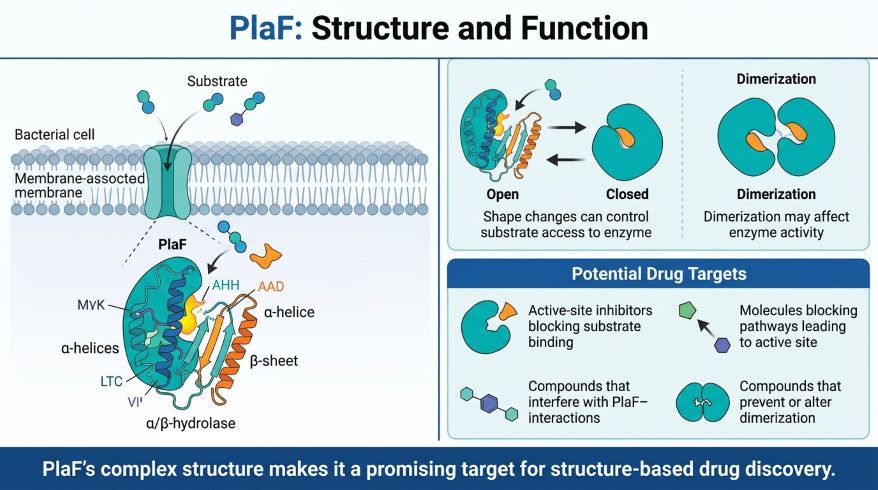
PlaF has an α/β-hydrolase structure. Its active site contains key amino acids. These amino acids help the enzyme work. PlaF also interacts with bacterial cell membranes. Studies show that its activity may change when its shape changes. Two PlaF units can also join together. This process is called dimerisation. It may affect how the enzyme works. These shape changes may control how easily substrates reach the active site. Therefore, PlaF offers several possible drug targets.
Scientists can target the active site. They can also block the pathways leading to it. PlaF’s complex structure makes it an interesting target. However, effective inhibitors require careful design. Structure-based drug discovery can help researchers develop potential treatments.
Structure-Based Discovery of Phospholipase A1 (PlaF) Inhibitors
This approach uses a protein’s shape to find possible drug compounds. Researchers first study the protein’s structure. They then look for compounds that may bind to it.
Researchers use several methods to find phospholipase A1 (PlaF) inhibitors. These include structure-based drug design and computer screening. Using different methods improves the results and reduces reliance on a single prediction tool.
Molecular Docking
Molecular docking predicts where a small molecule may bind to a target protein. Computer programs place each molecule in possible binding sites. They then estimate how strongly it may bind. For PlaF, tunnel-like regions may be important. These tunnels may guide substrates to the enzyme’s active sites. During docking, researchers study several types of interactions. Hydrogen bonds can help the molecule bind to the protein. Hydrophobic interactions may also make the bond stronger.
However, a high docking score does not prove that a compound will work. A molecule may look promising on a computer but fail in laboratory tests. Docking is therefore a useful step in drug discovery and design. Laboratory experiments are still needed.
Free-Energy Calculations
Free-energy calculations can provide more information after docking. Methods such as MM/GBSA estimate how strongly a compound may bind to a protein. Researchers can use these results to compare selected compounds. The results may also improve compound ranking beyond docking scores.
However, computer-based values are only predictions. They cannot replace laboratory tests. Structure-based drug discovery should therefore combine energy calculations with biological experiments. This approach improves drug design and supports more reliable decisions.
Molecular Dynamics and Tunnel Analysis
Proteins are flexible. They are always moving under normal conditions. A fixed docking model cannot show all these changes. Molecular dynamics simulations help solve this problem. They track how atoms move over time. This allows scientists to study protein flexibility. They can also see whether a ligand stays in place.
Recent PlaF research used these simulations to study selected protein–ligand pairs. This method shows how the molecules move and interact. It supports drug discovery and improves drug design.
Why Tunnel Geometry Matters
PlaF has tunnels that guide substrates to its active site. A potential inhibitor must fit these tunnels well. Its shape is very important. Strong chemical bonds alone may not be enough. For example, a large molecule may form many bonds but not fit well inside a tunnel. A smaller molecule may fit better and work more effectively.
This finding offers an important lesson for drug discovery. A good fit matters more than having many interactions. Careful shape matching is also important for drug design.
Mutational Analysis
Researchers can also study amino acid changes with computer models. These changes may alter a tunnel’s shape or chemical features. Mutation studies help identify important amino acids. Some changes may weaken ligand binding, while others may have little effect. This information can guide future drug improvement. For example, scientists may design compounds that still work when the protein changes. However, laboratory tests must confirm these predictions. Computer studies provide useful ideas, not final proof. Together, they support structure-based drug discovery and help guide structure-based drug design.
Experimental Validation of PlaF Inhibitors
Computer-based drug discovery needs laboratory testing. Computer models can predict how a drug might work. However, living systems are more complex. Laboratory tests are therefore essential. These tests show whether a compound stops bacteria from growing. Several compounds in PlaF studies showed promising results. Some also had strong computer-based results.
However, stopping bacterial growth does not prove that a compound blocks PlaF. The compound may affect another bacterial protein. Tests that measure PlaF activity directly are still needed.
Important Next Steps
Future research should include several experimental approaches:
- Direct PlaF enzyme inhibition assays
- Dose-response experiments
- Bacterial lipidomic analysis
- Mammalian cell safety studies
- Antibiotic combination testing
- Resistance development studies
- Animal infection models
For example, drug research often needs several testing stages. ENTECH Magazine’s coverage of diabetes drug research also highlights the need to understand how a drug works before concluding.
Future Potential of PlaF Inhibitor Research
The search for phospholipase A1 (PlaF) inhibitors is an important area of research. It combines computer studies with laboratory tests. PlaF may be a useful target for anti-virulence drugs. Its structure is known, which can guide drug design. The enzyme also helps bacteria maintain their cell membranes. However, several challenges remain. A drug must enter the bacterial cell. It must reach PlaF in the right amount. It must also be safe and mainly affect PlaF.
Drug resistance is another concern. Bacteria may change when exposed to drugs. Future studies should examine how this resistance develops. Combination treatment may also help. A PlaF inhibitor could be used with common antibiotics. Researchers must test this idea in the laboratory. Overall, using several methods can improve early drug research. Molecular docking can find possible drug candidates. Molecular dynamics can test their stability. Laboratory tests can show whether they work.
Conclusion: Structure-based drug discovery
The search for phospholipase A1 (PlaF) inhibitors is an exciting area of antibiotic research. Scientists use protein structures, molecular docking, energy studies, and molecular dynamics. Lab tests then show whether these computer-based results are correct. Using several methods can increase confidence in promising drug candidates. PlaF is interesting because it helps control fats in bacterial cell membranes. Its tunnels may also help scientists design drugs that target PlaF.
Frequently Asked Questions: Structure-based drug discovery
What is PlaF?
PlaF is an enzyme linked to the cell membrane of Pseudomonas aeruginosa. It helps the bacteria break down and manage phospholipids, which are important parts of the cell membrane.
Why is PlaF considered a drug target?
PlaF helps bacteria change and maintain their cell membranes. It may also help them cause disease. Blocking PlaF could weaken these harmful processes.
What is structure-based drug discovery?
Structure-based drug discovery uses the three-dimensional shape of proteins. Scientists look for molecules that can attach to specific parts of a target protein.
Can molecular docking prove that a compound works?
No. Docking only predicts how molecules might interact. Lab tests are needed to confirm whether they work and affect the intended target.
Are PlaF inhibitors currently approved medicines?
No. PlaF inhibitors are still experimental treatments. Researchers need more laboratory tests to confirm their effects, safety, proper dosage, and usefulness in clinical studies before they can be used widely.
Reference: Structure-based drug discovery
Vemula, D., Gulipalli, K. C., Bodige, S., Seelam, N., & Bhandari, V. (2026). Structure-based discovery of phospholipase A1 (PlaF) inhibitors in Pseudomonas aeruginosa using integrated in silico and experimental approaches. Discover Chemistry, 3, 457. https://doi.org/10.1007/s44371-026-00802-6
This article was written by Ramya Dobbala and reviewed for editorial accuracy by our editorial team. It has not yet undergone independent review by a professional.
Edited by Rakshanda Jabbar
- Author
- Latest Posts

Ramya Dobbala is a pharmacist and science communicator dedicated to bridging the gap between complex pharmaceutical research and public understanding. A 2024 B.Pharmacy graduate, Ramya has a strong foundational background in formulation science, having spearheaded research into the evaluation and formulation of anti-acne creams. Her work focused on optimizing topical delivery systems to enhance treatment efficacy and skin health.
Transitioning from the laboratory to the forefront of scientific discourse, she now leverages her technical expertise to translate intricate healthcare concepts into accessible, engaging content. As an author and communicator, Ramya is passionate about empowering audiences with evidence-based insights, particularly in the realms of dermatology and pharmaceutical innovation.