Explore the physics and engineering behind modern access control, contactless smart cards, cloud security, and biometric door systems.
How Modern Access Control Works: The Science and Engineering Behind Smart Doors
Estimated reading time: 8 minutes
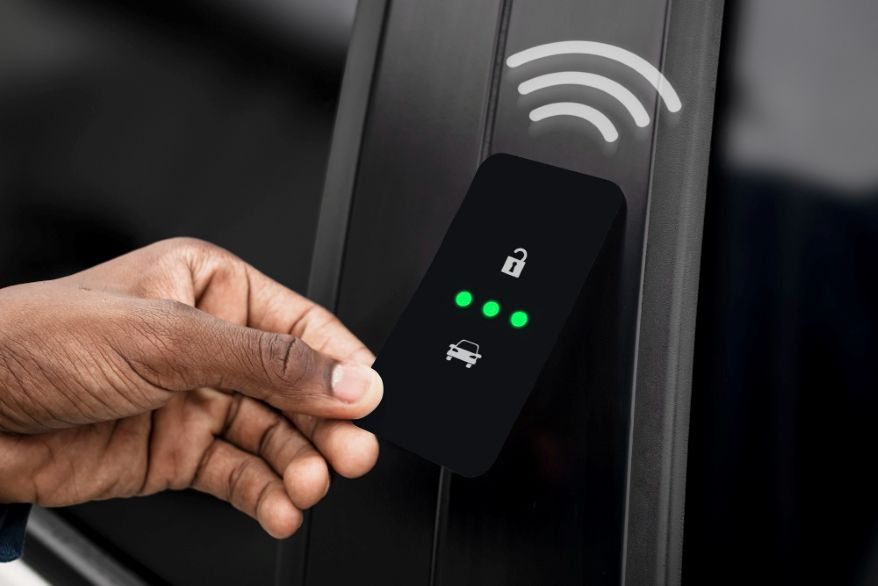
Every day, millions of people tap a card, scan a phone, or press a finger against a reader to walk into a school, office, hospital, or laboratory. The door clicks open in less than a second, and most of us never think about the access control behind it.
Yet that simple moment combines physics, electrical engineering, computer science, and also cryptography. A small plastic card has to power itself without a battery. A reader has to verify it is genuine. A controller has to decide whether the person holding it is allowed in, and a lock has to respond safely even if the power fails.
In this article, we will open up the system piece by piece. You will learn how modern electronic access control works, the science that makes contactless cards possible, and how these systems use the same identity principles that protect your online accounts.
From Metal Keys to Digital Credentials
For centuries, physical security relied on mechanical keys. A key works through a simple principle: a row of pins inside the lock must be lifted to exactly the right heights before the cylinder can turn. The pattern cut into the key is the “password.”
Mechanical keys have serious weaknesses, though. They can be copied at a hardware store. If one is lost, every lock it opens must be changed. And a key cannot tell anyone who used it, or when.
Modern electronic access control solves these problems by replacing the physical pattern with digital information. Instead of cutting a new key, an administrator can grant or remove access with a few clicks. Every entry is recorded, creating an audit trail that shows who opened which door and at what time. Permissions can also change automatically, for example, allowing students into a science lab only during class hours.
This shift turned the door from a purely mechanical device into a node on a computer network.
The Building Blocks of an Access Control System
Although systems vary, nearly all electronic access control setups share four core components.
1. The credential. This is what a person presents to prove their identity. It might be a plastic card, a key fob, a smartphone app, a PIN, or a biometric trait such as a fingerprint.
2. The reader. Mounted beside the door, the reader collects information from the credential. Card readers use radio waves, keypads record entered digits, and biometric readers use optical or capacitive sensors.
3. The controller. This is the “brain” of the system. The controller receives data from the reader, compares it against a list of approved users and rules, and decides whether to unlock the door. Many controllers can continue working on their own if the network connection drops.
4. The locking hardware. Common options include electric strikes, which release the latch side of a door frame, and electromagnetic locks, which hold a door shut using a powerful electromagnet bonded to a steel plate.
Engineers must also choose how a lock behaves during a power outage. A fail-safe lock unlocks when power is lost, which helps people exit during emergencies such as fires. A fail-secure lock stays locked without power, which protects sensitive rooms like server areas. Building codes and safety regulations usually decide which option is required for each door.
Communication between readers and controllers matters too. Older systems often used a protocol called Wiegand, which sends data without encryption and can be intercepted. Newer systems use standards like OSDP (Open Supervised Device Protocol), which encrypts communication and alerts administrators if a reader is tampered with.
The Physics of Contactless Credentials
One of the most fascinating parts of access control is the contactless card. Most of these cards contain no battery at all. So how do they work?
The answer is electromagnetic induction, the same principle Michael Faraday discovered in 1831. The reader contains a coil of wire that produces an oscillating magnetic field. When a card with its own small antenna coil enters this field, the changing magnetic field induces an electric current in the card’s coil. That current powers a tiny chip just long enough for it to send back its data.
The card “talks” back by subtly changing how much energy it draws from the field, a technique called load modulation. The reader detects these tiny changes and decodes them into digital information.
Access cards generally fall into two frequency groups:
- 125 kHz proximity cards are the older technology. They usually transmit a fixed ID number without encryption, which makes them relatively easy to copy with inexpensive equipment.
- 13.56 MHz smart cards use a higher frequency and contain a microprocessor that can perform cryptographic operations. Many use strong encryption standards such as AES, making cloning much harder.
Smartphones have added another layer. Mobile credentials typically use NFC (Near Field Communication), which also runs at 13.56 MHz and works only within a few centimeters, or Bluetooth Low Energy, which operates at 2.4 GHz and can work from slightly farther away. Because phones already have screen locks, fingerprint sensors, and secure storage chips, they can provide stronger protection than a plastic card that anyone could pick up.
From Local Servers to the Cloud
Traditional access control systems stored all their data on a server located inside the building. Updating permissions often meant someone had to be on site, and organizations with several locations needed separate systems for each one.
Cloud computing has changed this model. In a cloud-based system, the controllers at each door connect securely to a central platform hosted on the internet. Administrators can manage doors across many buildings from a web browser, and updates such as revoking a lost card take effect almost instantly.
The Acre platform is a good example of this approach. Acre platform solutions combine cloud-based access control, visitor management, and mobile credentials, allowing organizations such as universities, hospitals, and corporate campuses to manage security across multiple sites from one place.
Moving to the cloud also brings engineering challenges. Systems must keep working during internet outages, so controllers usually store a local copy of permissions. Data must be encrypted while traveling across networks and while stored on servers. Engineers also design these platforms to scale, meaning they can handle thousands of doors and millions of access events without slowing down.
Authentication and Authorization at the Door
If you have studied cybersecurity, you may recognize two important terms: authentication and authorization. Access control systems use both, just in a physical setting.
- Authentication answers the question, “Who are you?” When you present a card or scan your fingerprint, the system checks that the credential is genuine and belongs to a known person. Secure smart cards perform a challenge-response exchange, where the reader sends a random number and the card proves it holds the correct secret key without ever revealing the key itself.
- Authorization answers a different question: “What are you allowed to do?” Even after the system knows who you are, it must check whether your role permits entry to that specific door at that specific time. A student might be authenticated successfully but still denied entry to a staff room.
These ideas mirror the digital authentication and authorization protocols that protect websites and government services. In fact, many modern access control systems connect directly to the same identity providers used for online logins, using standards such as SAML and OpenID Connect. This means a single digital identity can control access to both a company’s software and its physical buildings.
Security experts call this approach multi-factor authentication when it requires more than one type of proof. A high-security laboratory might require a smart card (something you have), a PIN (something you know), and a fingerprint (something you are) before the door opens.
Biometrics and the Future of Access Control
Biometric systems identify people using unique physical characteristics. Fingerprint readers measure the pattern of ridges on your skin, often using capacitive sensors that detect tiny differences in electrical charge. Facial recognition systems use cameras and machine learning models to map the distances between facial features.
Importantly, well-designed systems do not store actual images of fingerprints or faces. Instead, they convert these features into mathematical templates, which are much harder to misuse if stolen.
Looking ahead, engineers are working on several exciting developments:
- Touchless entry using facial recognition or long-range Bluetooth, which became more popular after the COVID-19 pandemic.
- AI-based anomaly detection that spots unusual behavior, such as one card being used at two distant buildings within minutes.
- Integration with smart buildings, where access data helps control lighting, heating, and ventilation based on how many people are actually present.
Each of these innovations raises important questions about privacy and ethics, which is why responsible design matters just as much as technical skill.
Why This Field Matters for Future Engineers
Access control sits at the meeting point of many STEM disciplines. Electrical engineers design readers, antennas, and power systems. Computer scientists build the software, databases, and cloud infrastructure. Cybersecurity specialists develop encryption and test systems for weaknesses. Mechanical engineers create locks that are durable and safe.
For students interested in a career that combines hardware, software, and real-world impact, physical security technology offers a surprisingly rich path.
How Modern Access Control Works: Conclusion
The next time you tap a card to open a door, remember what is happening in that split second. A magnetic field powers a tiny chip, encrypted data travels to a controller, identity and permissions are checked, and a carefully engineered lock responds.
Electronic access control shows how scientific principles discovered nearly two centuries ago now combine with modern computing to keep people and places safe. It is a reminder that some of the most impressive technology is the kind we barely notice.
Edited by Juveriya Khan
Note: The article includes external links to third-party services; readers should independently evaluate any referenced platforms before engaging.
- Author
- Latest Posts

Deven Nandapurkar is a Software Engineer, Project Lead; working at the strategic intersection of software engineering, productivity science, and emerging technologies. Driven by a core philosophy of “building things worth building,” he leads cross-functional teams and drives end-to-end technical strategy—from early-stage conceptualization through production-grade deployment.
A Computer Engineering graduate from Pune University, Deven brings a sharp systems-thinking approach to technical leadership, honed by years of managing high-stakes engineering projects and leading teams to top placements in national and international hackathons, including the NASA Space Apps Challenge and the Peerlist GenAI Hackathon.
Deven explores how human cognition and emerging technology converge. He regularly writes about cognitive performance optimization, attention management, AI integration, and the evolving dynamics of the modern workforce – offering actionable frameworks for professionals seeking to maximize their productivity and thrive alongside intelligent systems.