Induction cooktops heat the pot directly, not the glass surface.
Induction Cooktops: Cooking Without a Flame
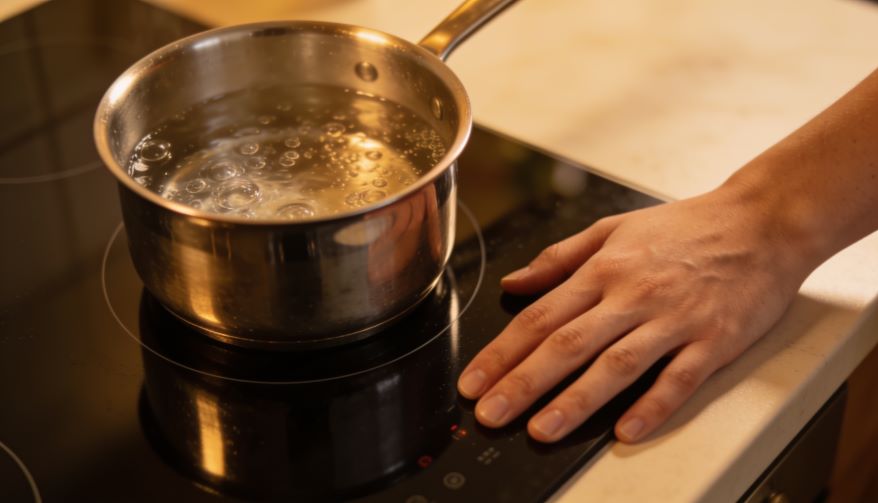
Picture this scene. As an illustration, you place your palm on a cooktop. At this instant, it feels cool, not hot. At the same time, water in a pot starts boiling. This seems odd at first glance. After all, no visible flame is burning anywhere. In fact, the answer lies in physics, not magic. To explain this, we turn to Faraday’s Law.
Key Takeaways
- Induction cooktops heat the pot directly, not the glass surface.
- The science behind this trick is Faraday’s Law of induction.
- A changing magnetic field creates eddy currents inside the metal pot.
- Electrical resistance turns those currents into heat, instantly and safely.
- Induction cooking wastes far less energy than gas or electric coils.
Faraday’s Law in Induction cooktops
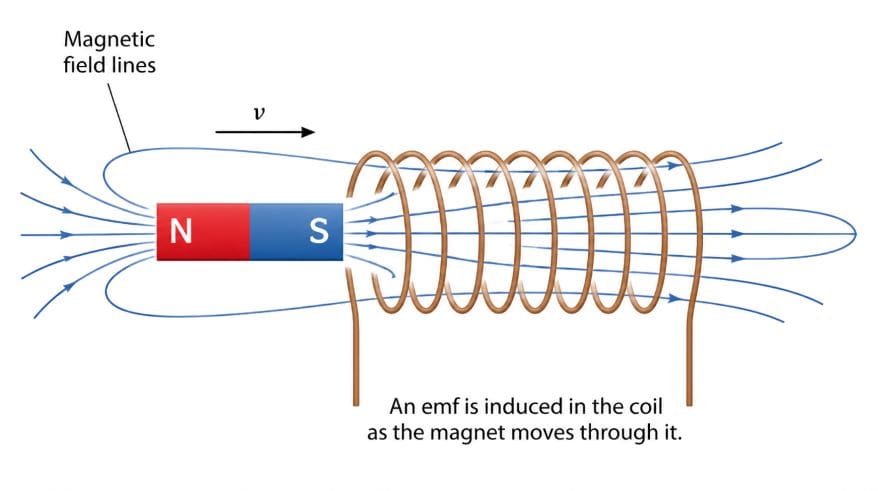
As a matter of fact, Michael Faraday discovered this in 1831. A changing magnetic field can push electric charges into motion. To put it another way, this push is an induced current. As a result, you need no direct contact to create electricity. You only need a field that keeps changing. With this in mind, induction cooktops use coils, not flames.
What Happens Under The Glass
At the present time, a copper coil sits below the ceramic. Electric current flows through this coil at high speed. So far, nothing touches the pot above it. As a result, the coil produces a rapidly oscillating magnetic field. This field passes straight through the glass with ease. In fact, it does not heat the glass at all. Provided that your pot is magnetic, the story changes.
Eddy Currents Do The Real Work: Induction cooktops
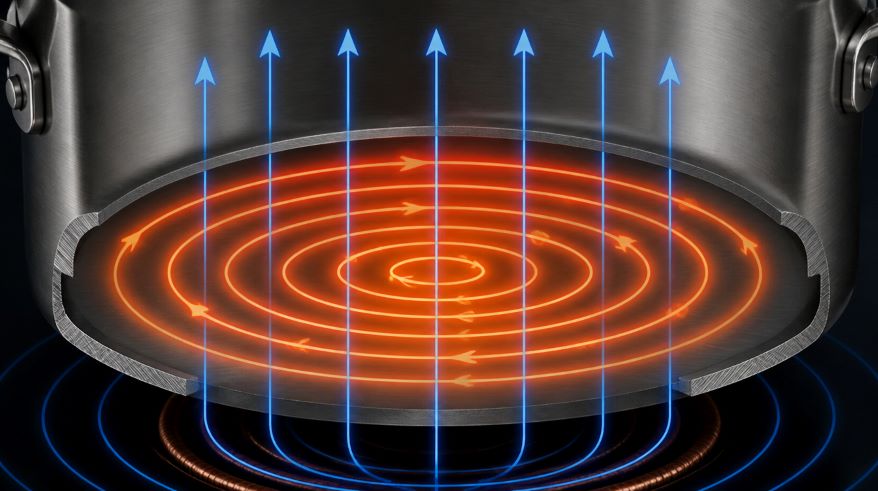
The magnetic field reaches the metal base of your pot. In similar fashion to a wave, it disturbs the metal. To illustrate, this disturbance forms small circular currents inside it. Scientists call these loops eddy currents. These currents try to flow freely through the metal. However, metal always resists the flow of electricity. As a result, this resistance turns electricity directly into heat. To put it differently, the pot becomes its own heater.
Why The Glass Stays Cool
Glass and ceramic are not good electrical conductors. So, magnetic fields pass through them with ease. In contrast, no eddy currents form inside the glass. As a result, the surface stays cool by itself. After that, it only warms from touching a hot pot. Take the case of an empty cooktop with no pot. At this time, it stays close to room temperature.
At this point, one more detail matters: speed. To be sure, coils oscillate at roughly 27 kilohertz . This is far above what human ears can hear. At this rate, the magnetic field flips direction thousands of times per second. So long as current alternates, the induced field keeps flipping too. To sum up, this rapid flipping generates intense heat.
Energy Effeciency
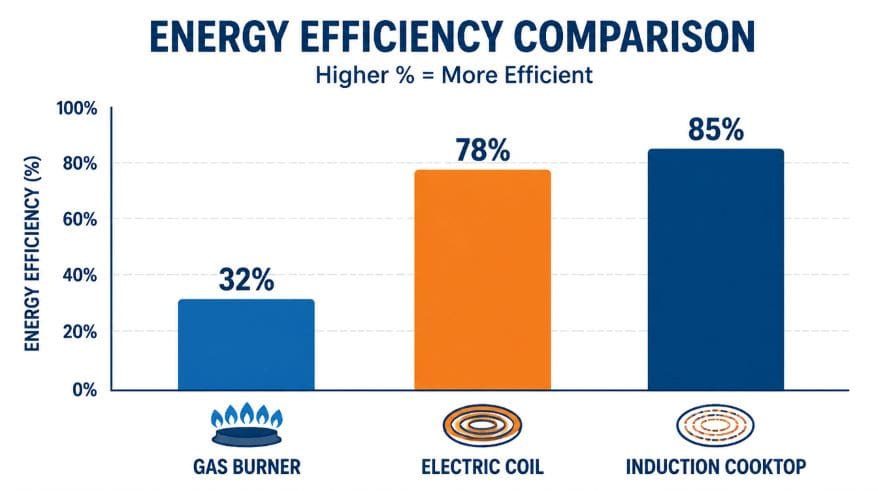
In light of rising energy costs, this efficiency matters greatly. As can be seen, ENERGY STAR tested all three stove types (U.S. Environmental Protection Agency, 2022). Gas burners transfer only about 32% of their energy to food. By comparison, electric coils reach 75 to 80% efficiency. At last, induction cooktops reach roughly 85% efficiency, the highest score (U.S. Environmental Protection Agency, 2022).
| Cooktop Type | Energy Efficiency |
|---|---|
| Gas burner | ~32% |
| Electric coil | 75–80% |
| Induction cooktop | ~85% |
Quick Benefits: Induction cooktops
- Faster cooking: heat forms directly inside the pot.
- Safer surface: the cooktop stays cool to touch.
- Less wasted heat: energy goes into food, not air.
- Instant control: heating stops the moment you lift the pot.
One Catch: Magnetic Cookware Only
As I have noted, induction needs ferromagnetic cookware, such as cast iron. Stainless steel pans also work well on these cooktops. By contrast, copper and aluminum pans will not heat at all. To test this, hold a magnet against the pan base. Provided that the magnet sticks firmly, the pan will work.
All Things Considered: Induction cooktops
Induction cooktops feel almost magical at first glance. In reality, they simply apply Faraday’s Law of induction. With this in mind, a changing field creates eddy currents inside your pot. After that, resistance turns those currents into useful heat. The glass stays cool because it cannot host these currents. To sum up, this is electromagnetism working quietly in your kitchen.
Also Read: Self Darkening Sunglasses: Real-Time Chemistry Experiment On Face
References
- Kinsler, P. (2020). Faraday’s Law and Magnetic Induction: Cause and Effect, Experiment and Theory. Physics, 2(2), 150-163. https://doi.org/10.3390/physics2020009
- Romero-Arismendi, N. O., Olivares-Galvan, J. C., Escarela-Perez, R., Hernandez-Avila, J. L., Jimenez-Mondragon, V. M., & Gonzalez-Montañez, F. (2024). Multidisciplinary Review of Induction Stove Technology: Technological Advances, Societal Impacts, and Challenges for Its Widespread Use. Technologies, 12(10), 206. https://doi.org/10.3390/technologies12100206
- Author
- Latest Posts

I am an inspirational writer and emerging science blogger with a deep-rooted passion for understanding and sharing the wonders of the world around us. My journey began with a Bachelor of Science in Chemistry from AKI’s Poona College of Arts, Commerce and Science, where I developed not only a strong foundation in scientific principles but also a mindset that values curiosity, observation, and critical thinking. Studying chemistry has taught me to approach problems with logic, to look beyond the obvious, and to see patterns where others might only see complexity. These experiences have shaped the way I perceive life and influence the way I express my thoughts, both scientifically and creatively.
I have always believed that knowledge is only as powerful as the way it is shared. This belief has guided me to create content that bridges the gap between science and everyday life. I aim to simplify complex scientific ideas so they become approachable, relatable, and engaging for everyone—whether someone has a formal background in science or is simply curious about the world. Science, in my view, is not confined to textbooks and laboratories; it is a way of thinking, understanding, and connecting with the world around us. By making science accessible, I hope to inspire curiosity, ignite learning, and encourage people to see the beauty and relevance of scientific discovery in their daily lives.
Alongside my love for science, I am deeply passionate about motivational writing. I believe words carry the power to transform perspectives, encourage self-reflection, and inspire action. By combining analytical thinking with creativity, I create content that is intellectually stimulating yet emotionally resonant. Whether I am breaking down a chemical concept, exploring a scientific phenomenon, or crafting motivational narratives, my goal is to communicate ideas in a way that is clear, meaningful, and impactful.
Through my work, I strive to empower my readers – not just by helping them understand the science around them, but by inspiring them to grow, learn, and realize their full potential. Every article, post, or story I write reflects my commitment to turning knowledge into inspiration. I want to spark curiosity, encourage self-improvement, and show that learning and personal growth are deeply connected. For me, writing is not just a craft; it is a way to touch minds, connect hearts, and make ideas come alive in a way that truly resonates.


