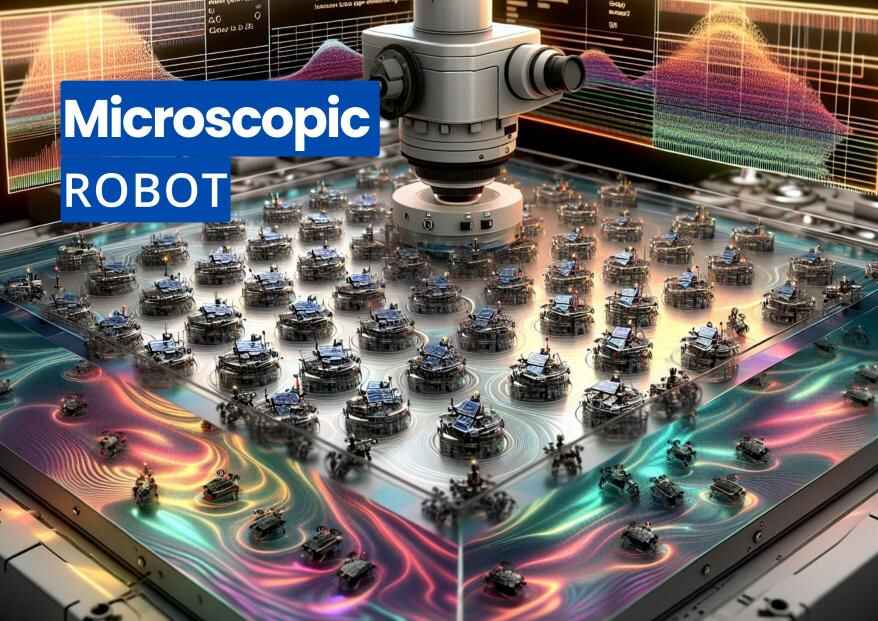
Each microscopic robot measures about 200 by 300 by 50 micrometers. This size is smaller than a grain of salt, making it nearly invisible without special tools. Even so, these robots run on light energy…
Microscopic Robots Swim, Think, and Work Independently Using Light Power
Estimated reading time: 3 minutes
Scientists have created a microscopic robot that can move, sense, and operate independently. These tiny machines are powered by light and can swim through liquids much like living cells. This breakthrough marks a major step in robotics and medical technology. Teens interested in science and innovation will find the microscopic robot especially fascinating.
The Size and Power of the Microscopic Robot
Each microscopic robot measures about 200 by 300 by 50 micrometers. This size is smaller than a grain of salt, making it nearly invisible without special tools. Even so, these robots run on light energy from LEDs, allowing continuous swimming for months.
Notably, this is the first time scientists have created a fully programmable microscopic robot at this scale. Each robot contains a tiny onboard computer that helps it think and respond independently. As a result, they do not need wires or external controls, which separates them from earlier micro-scale devices.
The Challenge of Working at Microscopic Scales
However, building a microscopic robot is extremely difficult because physics behaves differently at tiny sizes. Gravity becomes less important, while surface forces like water drag become much stronger.
“Pushing water at this scale feels like pushing through tar,” says Marc Miskin from the University of Pennsylvania.
Because of this, traditional robotic parts such as arms or legs fail when miniaturized. Therefore, researchers needed a completely new movement strategy.
A New Way to Swim Without Moving Parts
An Innovative Propulsion System
To solve this problem, the team designed a new propulsion method for the microscopic robot using electrical fields. Instead of pushing water directly, the robot moves charged particles in the liquid. This motion gently pulls surrounding water along.
As a result, the microscopic robot swims smoothly without fragile moving parts. In addition, it can easily change direction and cooperate with other robots, similar to fish swimming together. Impressively, each robot can reach speeds of up to one body length per second.
Sensors That Help the Robot Sense Its World
Beyond movement, every microscopic robot includes sensors that accurately measure temperature. This allows the robot to move toward warmer areas or report detailed cell health data. Consequently, this ability could support future medical research at the single-cell level.
The Amazing Brain Behind the Microscopic Robot
A Computer Smaller Than You Can Imagine
The tiny computers inside each microscopic robot were developed by David Blaauw’s team at the University of Michigan. Their major achievement was creating the world’s smallest computer powered entirely by ultra-low energy solar panels.
In fact, the microscopic robot uses over 100,000 times less power than a smartwatch, making long-term operation possible.
Communication Through Robot “Dance” Signals
It is only important to collect sensing data if it can be shared. In order to accomplish this, the researchers instructed each small robot to relay temperature data by means of subtle movements that they referred to as “wiggles” or dances.
In the natural world, honeybees dance in a manner that is similar to this communication mechanism. Researchers utilize microscopes and cameras to decipher these movements. Due to the fact that each minuscule robot has its own unique ID-based answers, it is possible to program each robot separately by pulses of light.
Due to the configuration of this system, a large number of microscopic robots are able to collaborate as a unified team. Consequently, this paves the way for new opportunities for collaborative work in the fields of medicine, biology, and environmental monitoring.
Additionally, to stay updated with the latest developments in STEM research, visit ENTECH Online. Basically, this is our digital magazine for science, technology, engineering, and mathematics. Further, at ENTECH Online, you’ll find a wealth of information.
Reference
- Hanson, L. C., Reinhardt, W. H., Shrager, S., Sivakumar, T., & Miskin, M. Z. (2025). Electrokinetic propulsion for electronically integrated microscopic robots. Proceedings of the National Academy of Sciences, 122(29), e2500526122. https://doi.org/10.1073/pnas.2500526122
- Author
- Latest Posts

I’m a web developer and science writer with a Master’s degree in Computer Applications (MCA) from Pune University.
I work in tech, building websites and staying updated with the latest developments. I also love writing about physics, chemistry, technology, robotics, mathematics, and breakthrough innovations. My passion is breaking down complex scientific topics into simple, easy-to-understand stories.
My goal is to help everyone stay informed about the exciting changes happening in science and technology. I believe understanding science shouldn’t be complicated—it should be accessible to all.