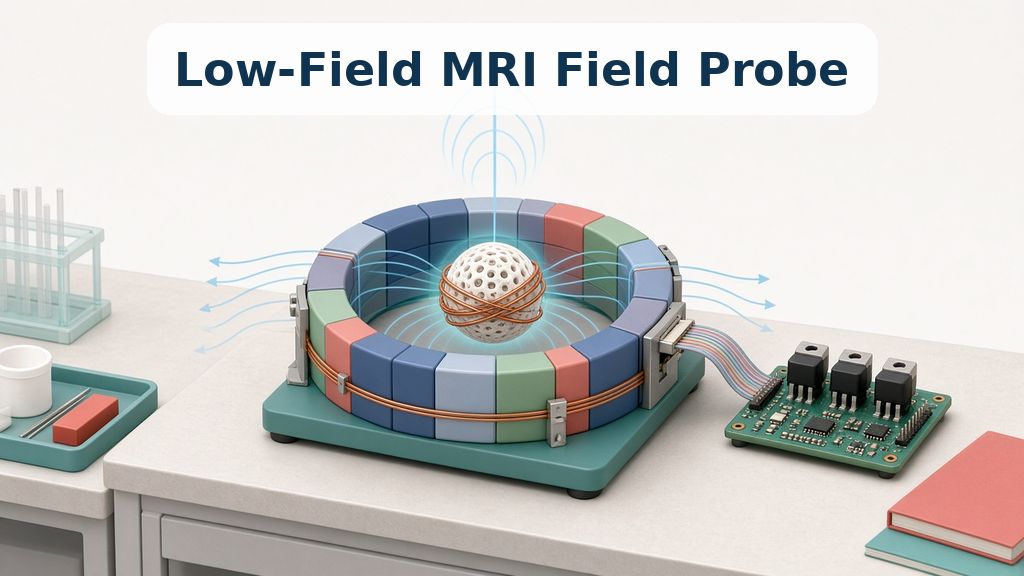
A phone’s compass app works because a tiny chip senses Earth’s magnetic field. Hospital MRI scanners also depend on magnetic fields, but they need far greater precision. Now, engineers have built a low-field MRI field probe that reads such fields cheaply. The device targets small, affordable scanners that use weak magnets instead of costly superconducting ones. Pavel Povolni and Kai Buckenmaier led the study in Tübingen, Germany. Their home base is the Max Planck Institute for Biological Cybernetics. Partners came from the Universities of Stuttgart and Tübingen and Graz University of Technology. A hospital team in Peru also contributed. Together, they published the work in Communications Engineering, a Nature Portfolio journal. Its DOI is 10.1038/s44172-026-00815-0. In addition, the team shared every circuit board and code file online. As a result, other builders can copy the probe and adapt it.
Challenges and Motivation Behind the Low-Field MRI Field Probe
Magnetic resonance imaging, or MRI, helps doctors find cancer, heart disease and brain disorders. Yet many regions still lack scanners. For example, West Africa has about 84 MRI scanners for over 370 million people. In other words, that equals roughly 0.22 scanners per million residents, the paper notes. By comparison, Japan has more than 230 times as many per person. Standard hospital scanners use superconducting magnets of 1.5 tesla or more. Because of this, they need cryogenic cooling, so buying and running them costs a lot. Low-field MRI offers a cheaper option, often near 50 millitesla. Such systems use permanent magnets or simple electromagnets. In fact, local workshops in Uganda have built some. To learn how magnets and radiation serve medicine, read about medical physics fundamentals. Even so, weaker magnets bring a new headache. Their fields drift with temperature and current changes, which blurs images unless someone tracks them.
Why Simple Magnetic Sensors Fall Short
Builders usually check magnets with Hall sensors, chips much like a phone compass. These magnetic detection chips cost little and read out fast as well as easily. However, they lack the accuracy that MRI magnets demand. For this reason, a better tool listens to hydrogen atoms in water instead. In a magnetic field, each hydrogen nucleus wobbles at a set frequency. As a result, that rate tracks field strength like a precise ruler. Large hospital scanners already use such nuclear magnetic resonance, or NMR, probes. Unfortunately, NMR signals shrink sharply in weak fields. Signal strength falls with the square of the field. At 50 millitesla, only about 280 parts per million of a 3-tesla signal remains. On top of that, standard probes must roughly know the field before tuning to it. For drifting low-field magnets, both problems get in the way at the same time.
The Science Explained: How the Low-Field MRI Field Probe Works
To begin with, the team borrowed a trick from older geophysics instruments. First, a small coil wraps around 1.2 milliliters of water inside a 3D-printed sphere. Next, a strong current through that coil builds a temporary magnetic field. This pre-polarization step lines up far more hydrogen nuclei than the weak scanner field could. Then the current shuts off almost instantly, in under about a microsecond. Because the switch happens so fast, the nuclei cannot follow the change smoothly.
Instead, they start spinning freely around the scanner’s own field. In turn, they produce a faint radio signal. A second coil picks up that signal. Software then reads the spin frequency and converts it into field strength. In other words, the probe needs no prior guess about the field. Earlier versions of this non-adiabatic trick, in contrast, worked only near Earth’s weak field. This probe, by comparison, works in fields up to about 1,000 times stronger.
Fig. 1: How the Field Probe Works
A Transistor Pushed Past Its Limit
That fast shutoff posed the hardest engineering problem. The current must drop to zero in under about one microsecond. In order to do so, the team wired three silicon carbide transistors side by side. Each part costs about 10 euros and carries a 1.7-kilovolt rating. During shutoff, the voltage climbs past 2 kilovolts. Normally that would push a transistor into damaging avalanche breakdown. Here, however, the team triggered that breakdown on purpose so that energy drains fast. According to the authors, this marks the first use of controlled avalanche breakdown for sensing. A 10,000-cycle aging test caused no measurable damage. The stored coil energy also stays under 25 millijoules. That roughly equals a static shock from a doorknob. An ESP32 microcontroller reads the onboard Hall sensor. Meanwhile, a public GitHub repository holds all design files. Moreover, inexpensive oscilloscopes can check the switch-off pulse, so labs need no costly gear.
Key Findings From Two Real Scanners
The study tested the probe inside two different low-field MRI systems. To begin with, an electromagnet system ran at 1, 3 and 5 millitesla. These ultra-low fields challenge any NMR sensor, because the signal becomes extremely weak. Even so, the probe captured clear NMR spectra at all three settings. At 1 millitesla, in particular, the team also added a short radio pulse. Overall, signals grew clearly stronger as the pre-polarizing field increased in strength. Simulations suggest the probe beats normal radio-pulse excitation below about 26 millitesla. The team did not measure fields between 5 and 45 millitesla, however. For that range, they rely on simulations. Coil heating stayed modest, with temperatures rising 4 kelvin or less. Each front end, though, needs retuning for each new field strength. Electronically adjustable capacitors could automate that step in future versions, the authors suggest.
Testing the Low-Field MRI Field Probe at 45 mT
Next, the team moved to an unshimmed 45-millitesla Halbach magnet, built from permanent magnet blocks. The probe then mapped the field at many points inside the magnet’s bore. There, it measured the field to within about 0.1 percent. The magnet’s built-in Hall sensor, by comparison, managed only 2.5 percent. In plain terms, that precision suits a first round of magnet shimming, or fine adjustment. Repeated readings also exposed strong drift, reaching hundreds of hertz in frequency. In fact, this drift was likely high enough to prevent imaging without active correction. Fortunately, the probe’s own output could feed a controller that cancels the drift. Not every shot worked, though, because of random avalanche timing. Delays ranged from about 2 to 26 microseconds, and some shots gave no signal. For these reasons, the authors call the 45-millitesla results a proof of principle.
Fig. 2: Key Takeaways From the Probe Study
Expert Commentary and Quotes
No press release covers this specific probe yet. However, the Max Planck Institute for Biological Cybernetics described the team’s wider goal in 2024. That institute news story announced a project to build a cost-efficient low-field scanner. Project leader Pavel Povolni, the probe paper’s first author, explained the mission. His goal, he said, is to help design “efficient and cost-effective MRI scanners.” Engineers could then adapt them “to meet the needs of countries in the Global South.” Even so, that statement concerns the broader scanner program, not this sensor alone. Still, it shows why a cheap, open field sensor matters. After all, low-cost scanners need affordable tools for testing and tuning magnets. Without such tools, local builders cannot easily check field quality, especially in remote clinics. The new probe aims to fill that gap with parts most electronics labs can source.
Implications: Business, Careers and Future Research
For startups, open hardware lowers the barrier to building affordable scanners. Groups building scanners can copy the low-field MRI field probe to check magnets. Benchtop NMR magnet makers could also use it for routine quality checks. In addition, the probe can calibrate cheaper Hall or magnetoresistive sensors on site. Future versions may use 3.3-kilovolt transistors for faster switch-offs and stronger fields. Researchers also plan smaller samples and copper sulfate-doped water for faster repeat readings. Fluorinated samples, for example, offer another useful option. Over time, probe feedback could stabilize magnets automatically. As a result, low-cost MRI could serve more clinics in low-resource regions. Earlier diagnosis, in turn, could lower treatment costs and keep workers healthy. Local workshops might even assemble scanners and probes themselves, creating skilled jobs. Of course, real clinical use still requires imaging trials, safety reviews and regulatory approval.
Careers Built Around the Low-Field MRI Field Probe
This project blends physics, electronics and coding, so it points to several careers. For instance, MRI hardware engineers design magnets, coils and sensors. Power electronics engineers, by contrast, handle high-voltage switches like the avalanche transistors. Embedded systems engineers write the C code that runs microcontrollers. Meanwhile, biomedical engineers connect devices to real clinical needs. You can explore more options among these biomedical engineering careers. Teens interested in this field can start with physics and calculus. Electrical and electronic engineering degrees teach circuits, signals and power devices. Biomedical engineering adds anatomy, imaging and device safety. Physics programs, in turn, cover magnetic resonance in depth. Computer engineering, for its part, builds skills in embedded C and signal processing. Students can also practice with open projects, such as this probe’s shared circuit boards. Building, testing and fixing hardware teaches lessons that textbooks alone cannot.
Conclusion: Cheaper Field Checks for Accessible MRI
Low-field MRI promises scanners that more hospitals can afford. However, weak magnets drift, and cheap sensors cannot track them precisely. This low-field MRI field probe tackles that gap with clever, inexpensive electronics. It switches off a polarizing field in under about a microsecond using avalanche-driven transistors. As a result, it read fields from 1 to 45 millitesla without knowing them first. At 45 millitesla, it beat the built-in Hall sensor by a wide margin. Still, the tests covered only 1, 3, 5 and about 45 millitesla. Some shots also failed, and imaging will need active drift correction as well as shimming. Next, the team hopes to automate tuning and boost signal strength. In the long run, probe feedback could keep magnets steady. For students, the open-access paper shows how electronics can widen access to medicine. Smart engineering, shared openly, can help bring MRI to patients who lack it today.
Editorial note
Many hospitals in sub-Saharan Africa and other low-income regions have few or no MRI scanners, and low-field scanners built from permanent magnets are one way to close that gap. We are running this story because the team built a tool scanner builders need: a probe that measures an unknown magnet's field with about 0.1% accuracy, whereas the built-in Hall sensor was up to 2.5% off. All circuit boards, CAD files, and code are free on GitHub. Caveats: the authors call the 45 mT results a proof of principle, and some pulses gave no signal. Takeaway: open hardware lets students and small labs help with global health problems.
Reviewer's comment
The probe is tested in two real scanner types, an electromagnet system and an unshimmed Halbach magnet, and the paper is open about failures, explaining why some pulses gave no detectable signal. The brief reports the accuracy, switching, and transistor-lifetime figures accurately and correctly calls the 10,000-cycle figure an estimate. One phrase overstated the coverage: "worked from 1 mT to 45 mT" suggests the whole range was measured, but the authors tested only 1, 3, and 5 mT and about 45 mT, and say intermediate fields were not investigated. Readers should also know the field drift in the test magnet was large enough that the authors think it would likely prevent imaging without active correction. Fix applied: the tested fields are now listed exactly.
Mahi Shitut is a Science Communicator at ENTECH STEM Magazine, with a BSc in Physics from Fergusson College, Pune, and an ongoing MSc in Mathematics at the Indian Institute of Science Education and Research (IISER), Kolkata. Her areas of interest include theoretical physics, pure mathematics, astronomy, space science, set theory, asymptotic series, and science education. She completed the National Initiative in Undergraduate Science (NIUS) Physics Programme at the Homi Bhabha Centre for Science Education, TIFR, Mumbai, where she carried out a 1.5-year research project at the UM-DAE Centre for Excellence in Basic Sciences. She was also a top scorer in the Madhava Mathematics Competition and was selected for the Madhava Nurture Camp at IIT Bombay, and she attended the IWM Winter School for Young Women in Mathematics.
Mahi specializes in explaining advanced physics and mathematics in simple, clear, and easy-to-understand language for teenagers and school students. Drawing on everyday examples and practical analogies, she helps readers make sense of ideas like infinity, space missions, telescopes, and how the universe works, without losing scientific accuracy. Her skill comes from hands-on experience. She has explained models of Chandrayaan-3 to more than 3,000 visitors at IUCAA’s National Science Day open day, volunteered at SPPU’s National Space Day celebrations, presented at Fergusson College’s Astro Club Poster Exhibitions, and delivered undergraduate lectures on countability and uncountability, the infinite hotel paradox, and asymptotic series through the Synectics Math Club. With earlier experience in editorial work and content strategy, including editing a newsletter and writing for digital audiences, she aims through ENTECH STEM Magazine to bridge the gap between advanced science and public understanding, making physics and mathematics engaging, accessible, and relevant for young minds.