Explore the role of optical adhesive in the iPhone Fold. Learn how this smart glue enhances screen clarity and flexibility.
How Apple’s ‘Smart Glue’ Makes the iPhone Fold a Game-Changer in Tech!
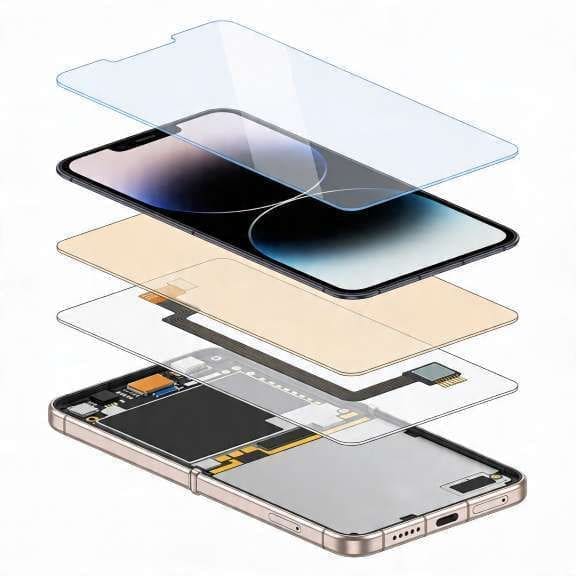
The iPhone Fold is about to change how we see smartphones. At the heart of this innovation is a tiny layer called optical adhesive. Above all, this “smart glue” keeps the foldable screen both clear and flexible. As a matter of fact, understanding this technology opens doors to exciting careers in science and engineering. In this article, we will cover how optical adhesive in iPhone Fold works. Why it matters and how you can be part of this future.
Key Takeaways
- Optical adhesive is the “smart glue” that makes the iPhone Fold possible.
- It keeps the screen clear and strong, even after millions of folds.
- Apple uses advanced OCA to fight creases and micro-cracks.
- The OCA market is booming, with billions in future value.
- Studying Physics and Chemistry in high school can lead to cool tech careers.
What Is Optical Adhesive and Why Does It Matter?
The Role of OCA in Foldable Displays
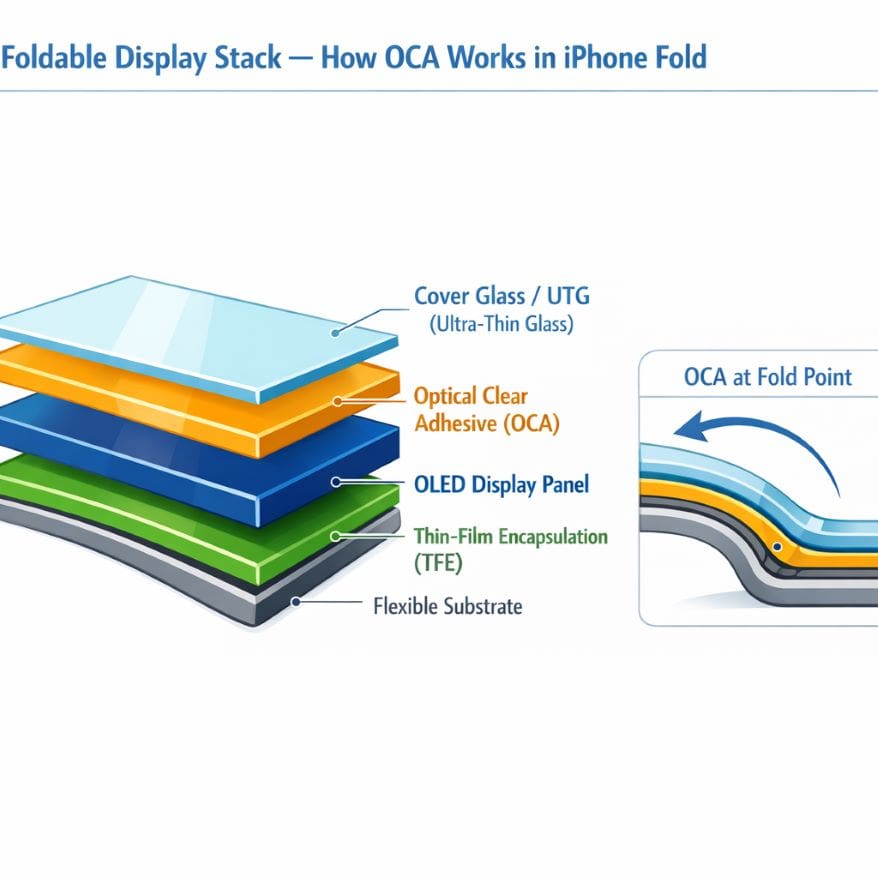
Optical adhesive, or OCA, is a special glue for screens. It bonds the layers in foldable devices like the iPhone Fold. In this case, OCA keeps the display clear and strong. At the same time, it allows the screen to bend without breaking. To illustrate, think of OCA as the invisible force holding your phone together.
How OCA Actually Works ?
OCA is not just sticky. It is hyper elastic and viscoelastic. That means it can stretch and bounce back. It also absorbs shocks. To explain, when you fold your phone, OCA stretches. It does not tear. After that, it returns to its original shape. In effect, OCA also fills tiny cracks. This keeps the screen smooth. As can be seen, this is why your phone survives millions of bends. Furthermore, it is durable.
Optical Adhesive in iPhone Fold — Apple’s Big Move
Apple’s Crease-Free Goal
Apple wants the iPhone Fold to have a seamless screen. To that end, they use ultra-thin glass (UTG). They also use advanced OCA. The OCA reduces bending stress. It also repairs micro-cracks during use. At this point, Apple aims for a crease depth of less than 0.15 mm. In similar fashion, the fold angle will be under 2.5 degrees. With this intention, the screen will look almost flat. This remains true even after many folds. Therefore, the display remains pristine.
Key Players Making the OCA for iPhone Fold
Several companies lead the OCA industry. 3M, Nitto Denko, and LG Chem are top names. They create high-quality and durable adhesives for foldable screens. In like manner, Henkel and Samsung SDI also supply OCA for advanced devices. Specifically, they target ultra-thin glass compatibility. To enumerate, here are the main players and their focus:
Table 1: Top OCA manufacturers for foldable screens.
| Company | Focus |
| 3M Company | Advanced OCA for foldable smartphones, high durability |
| Nitto Denko Corporation | Ultra-thin OCA films for flexible OLED |
| LG Chem | High-transparency adhesive films for OLED |
| Henkel AG & Co. KGaA | High-performance OCA solutions, facility expansions |
| Samsung SDI | Display materials and OCA for foldable OLED panels |
Market Data — How Big Is This Industry?
The OCA market is growing fast. In fact, it is expected to reach US$4.12 billion by 2033. Foldable OLED shipments could hit 124.6 million units by 2032. To point out, the display adhesive market is valued at USD 768 million in 2025. As a result, more companies are investing in this technology.
Table 2: Foldable Display and OCA Market Growth
| Metric | Value |
| OCA Market Forecast | US $ 4 billion by 2034 |
| Display Adhesive Market (2025) | USD 768 million |
| Foldable OLED Shipments (2032) | 124.6 million units |
| Optical Film Market (2024) | USD 12.8 billion |
| Optical Film Market (2032) | USD 21.4 billion |
OLED Encapsulation — The Shield Behind the Screen
What Is Thin-Film Encapsulation (TFE)?
OLED screens are sensitive to moisture and oxygen. Thin-Film Encapsulation (TFE) protects the display from these threats. TFE uses layers of organic and inorganic materials. In essence, this shield keeps the screen working longer. At the present time, TFE is a must for foldable and wearable devices.
Why Moisture and Oxygen Are the Enemy
Moisture and oxygen can damage OLED displays quickly. To put it another way, they cause the screen to fade or fail. TFE blocks these elements. It also stops heat and mechanical stress. In detail, engineers test TFE. They use Water Vapor Transmission Rate (WVTR) and durability tests. Furthermore, this protection is vital for flexible electronics. With this in mind, a good TFE means a longer-lasting phone.
Your Future in This Field — Careers and Education
Core K-12 Subjects to Study Right Now
To work with optical adhesive in iPhone Fold, start with the right subjects. Physics, Chemistry, and Mathematics are essential. Computer Science and Engineering electives also help. To sum up, these subjects build your foundation for future tech careers.
Table 3: Core K-12 Subjects for a Career in This Field
| Subject | Relevance |
| Physics | Optics, electronics, mechanical properties |
| Chemistry | Material composition, adhesives, chemical processes |
| Mathematics | Modelling, analysis, engineering calculations |
| Computer Science | Programming, simulation, automation |
| Engineering/Tech Electives | Hands-on design, prototyping, circuit skills |
Career Paths in Optical Adhesive
There are many jobs in this field. You can be a Display Engineer. You can also be a Materials Scientist or Process Engineer. Salaries are strong. This is especially true for engineers. In either case, you can work in research, design, or manufacturing. Thus, pursuing a career in this niche offers long-term stability.
Top 5 Steps to Get into This Field
- Focus on Physics, Chemistry, and Math in high school.
- Join STEM clubs or engineering electives for hands-on experience.
- Explore online courses in electronics and materials science.
- Apply for internships programs in tech companies.
- Pursue a university degree in engineering or materials science.
Closing Remarks on Optical Adhesive
All in all, optical adhesive in iPhone Fold is a game-changer for smartphones. It keeps screens clear and strong, even after millions of folds. As I have noted, this technology is opening new doors in engineering and science. If you are curious about tech, start with Physics and Chemistry. With this purpose in mind, you can help build the next generation of devices. In conclusion, the future of foldable phones and your career could start today.
Frequently asked Questions about Optical Adhesive in iPhone Fold
What exactly is an optical adhesive?
An optical adhesive is a transparent, flexible glue. Specifically, it bonds layers inside a foldable screen. It must remain clear even after thousands of folds. Thus, it must remain clear even after thousands of folds.
What is the difference between an OCA and a PSA?
An OCA (Optically Clear Adhesive) is cured by light and forms a firm, transparent bond. In contrast, a PSA (Pressure-Sensitive Adhesive) sticks on contact without curing. Consequently, Both types are used in flexible displays depending on the layer requirements.
Is this field growing?
Absolutely. Foldable displays are leading the market today. Their complex design requires better and more functional optical adhesives. As a result, the global market for these glues is growing at a fast pace. In fact, this growth shows how much people want durable, flexible screens.
References
Zhang, Y., Wang, S., Dong, F., Sun, Y., Sheng, C., Ma, K., Tian, Z., Qian, Z., Wong, C., & Liu, S. (2022). Mechanical behavior and constitutive model characterization of optically clear adhesive in flexible devices. Micromachines, 13(2), 301. https://doi.org/10.3390/mi13020301Kim, J., Park, S., Kim, T. Y.,
HardwareZone. (2026, April 15). Apple’s rumoured foldable iPhone could use OCA tech for a crease-free display. https://www.hardwarezone.com.sg/mobile/smartphones/apple-foldable-iphone-oca-tech-for-crease-less-look
- Author
- Latest Posts

I am a digitally-adept IT graduate driven by an insatiable curiosity for scientific discovery and systemic progress. Captivated by how transformative breakthroughs like artificial intelligence, blockchain, complex DBMS and autonomous systems are redefining our global landscape. I am proficient in programming languages like Python and SQL. Alongside, I excel at synthesizing intricate technical data and high-level research into precise, compelling narratives. I have a keen interest in new mobile technologies and innovations. My mission is to bridge the gap between complex engineering and practical understanding for aspiring students, inquisitive enthusiasts, and tech leads alike. I specialize in deploying machine learning solutions using industry-leading libraries—including TensorFlow, PyTorch, and Scikit-learn. My academic foundation in engineering has been a pivotal contributor, instilling in me the analytical rigor and disciplined mindset necessary to navigate and decode today’s most disruptive technological innovations. By distilling theories into visionary insights, I aim to catalyse intellectual growth and pioneering spirit, encouraging every reader to navigate the revolutionary advancements currently building our collective future.