Learn about Custom Contact Pins and how they connect unique electronic components. Essential know-how for aspiring engineers.
Custom Contact Pins in Electronics: How Engineers Design Connections for Specific Applications
Estimated reading time: 6 minutes
Most electronic assemblies start with standard components. Resistors, capacitors, connectors, and contact pins are produced in common specifications because it makes them affordable, widely available, and easy to integrate into standard designs. But there is a category of application where standard components simply do not fit the requirement. The geometry is unusual, the operating environment is extreme, the current rating falls outside normal ranges, or the mating interface belongs to a proprietary system. In these cases, engineers turn to custom contact pins.
Understanding how custom contact pins are designed and manufactured is useful for engineering students working across electronics, mechanical engineering, and product development. It connects material science, tolerance engineering, and manufacturing process selection in a practical context.
What Contact Pins Do
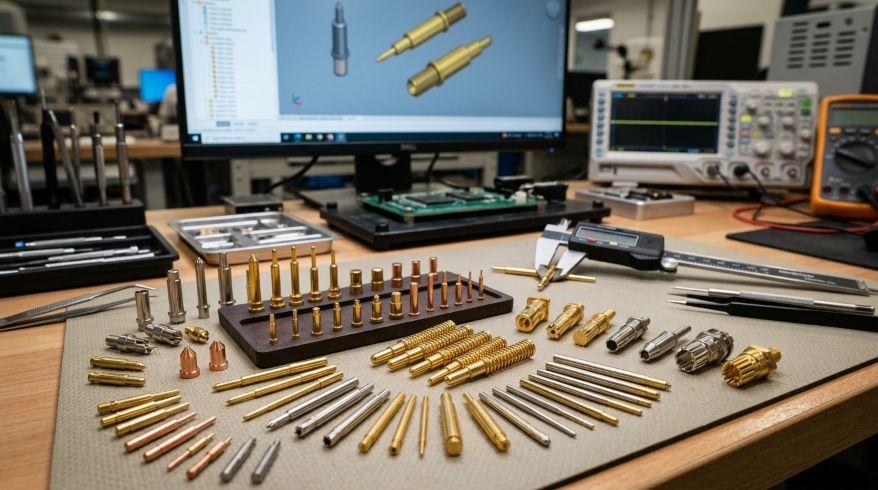
A contact pin is a conductive element that forms an electrical connection between two surfaces or components. In a spring-loaded configuration, sometimes called a pogo pin, the pin includes a plunger, a barrel, and a spring. The spring maintains consistent contact pressure across a range of compression distances, which allows the pin to compensate for surface variation, misalignment, or repeated connection cycles without losing electrical continuity.
Contact pins appear in PCB test fixtures, battery charging interfaces, wearable devices, medical instruments, and industrial control systems. The basic operating principle is consistent across these applications, but the specific dimensions, materials, spring force, current rating, and surface finish vary considerably depending on what the pin needs to do.
Why Standard Pins Are Not Always Sufficient
Standard pogo pins are produced in common pitch sizes, typically 0.9mm, 1.0mm, 1.27mm, and 2.54mm, and in standard barrel diameters and lengths. For many applications, these work well. For others, the constraints of the design push outside what standard catalogue parts can offer.
A medical device might need a pin with a very specific stroke length to fit within a sealed housing. A high-current charging application might require a larger contact area and lower resistance than standard pins provide. A consumer electronics product with an unusually tight PCB layout might need a non-standard pitch. A connector intended for outdoor industrial equipment might require a specific plating material to resist corrosion in a harsh environment.
In each of these cases, the engineer has a choice: redesign the product around available standard components, or source Pogo Pins customized to the specific requirement. When the design constraint is fixed, custom manufacture is often the more practical path.
The Custom Design Process
Custom contact pin design typically starts with a detailed specification. The engineer defines the required dimensions, including barrel diameter, overall length, plunger travel, and pitch if the pin is part of a multi-pin connector. Current rating, contact resistance, operating temperature range, and the number of mating cycles the pin must survive are all part of the specification.
Material selection follows from these requirements. Brass is commonly used for pin barrels because it machines well and offers reasonable conductivity. Stainless steel is used where strength or corrosion resistance is a priority. The plunger tip geometry matters too. A flat tip, a pointed tip, a crown tip, and a rounded tip each make contact with a mating surface differently, and the right choice depends on whether the mating surface is a flat pad, a recessed socket, or an uneven substrate.
Surface plating is applied over the base material to improve conductivity and resist oxidation. Gold plating is standard for low-resistance, high-reliability applications. We use Nickel as an undercoat and sometimes as the final surface for cost-sensitive applications. The plating thickness is specified in micrometres and affects both performance and cost.
Manufacturing Tolerances in Contact Pin Production
Contact pins are small components produced to tight tolerances. A pin with a barrel diameter of 1mm might be specified with a dimensional tolerance of plus or minus 0.01mm. Achieving this consistently across a production run requires CNC turning equipment with precise tooling control and regular in-process measurement.
Spring performance is another area where tolerance matters. The spring force determines how much contact pressure the pin applies at a given compression, which affects both electrical contact reliability and the mechanical load placed on the mating surface. Workers make springs to meet set weight limits and check them for errors.
For engineering students studying manufacturing systems, contact pin production is a good example of how tight tolerances, material properties, and surface treatments combine to determine whether a small component performs as intended across its service life.
Testing and Validation
We validate custom contact pins before approving them for production use. Electrical testing checks contact resistance at specified compression levels. Mechanical testing measures spring force across the plunger travel range. Life cycle testing compresses and extends the pin through the specified number of mating cycles, after which the pin is re-measured to confirm it still meets the contact resistance and dimensional specifications.
For applications in medical devices or aerospace, additional environmental testing covers temperature cycling, humidity exposure, and vibration resistance. These tests confirm that the pin will perform in the actual operating environment, not just in a controlled laboratory setting.
Where Custom Contact Pins Are Used
The application range for custom contact pins is certainly broad.
- In consumer electronics, they are used in proprietary charging connectors and docking interfaces.
- In medical devices, they appear in diagnostic equipment, implantable device programmers, and patient monitoring systems.
- In industrial automation, they are used in test fixtures, modular control systems, and sensor interfaces. In automotive electronics, they appear in battery management systems, module testing equipment, and charging infrastructure.
What these applications share is a specific connection requirement that a standard catalogue pin does not fully address. The ability to specify a pin to exact dimensions, materials, and performance parameters is what makes custom manufacture relevant across such a wide range of engineering fields.
A Practical Lesson in Engineering Constraints
One of the skills that separates experienced engineers from students still developing their practice is knowing when to design around standard components and when to specify something custom. Standard components are cheaper, faster to source, and easier to replace. Custom components solve problems that standard parts cannot, but they require more upfront engineering work and longer lead times. Contact pins sit at this boundary in an instructive way. The underlying technology is well understood, the manufacturing processes are established, and also the performance variables are clearly defined. Working through a contact pin specification teaches engineers to translate a functional requirement into a set of measurable parameters, which is a skill that transfers across almost every area of hardware development.
Additionally, to stay updated with the latest developments in STEM research, visit ENTECH Online. Basically, this is our digital magazine for science, technology, engineering, and mathematics. Further, at ENTECH Online, you’ll find a wealth of information.
- Author
- Latest Posts

Charudatta Pathak was a student at St. Aloysius High School in Bhusawal, established in 1874, making it one of India’s oldest convent institutions. He earned his bachelor’s degree in mechanical engineering from SSVPS College of Engineering, Dhule in 1995, demonstrating exceptional academic achievement. Thereafter, he launched his career as a CNC programmer in a toolroom. He has utilized FANUC, Deckel, Maho, and Mikron controllers to operate 2-axis and 3-axis machines for the fabrication of jigs, fixtures, dies, and molds. He commenced his career as an academic in 1996, when he assumed the role of lecturer at SSVPS College of Engineering, Dhule. Additionally, he earned his post-graduate degree in CAD/CAM from L. D. College of Engineering, Ahmedabad, in 2000, and then acquired a Ph.D. from COEP in 2011 while concurrently engaged in teaching. Until 2023, he occupied many academic roles, including lecturer, assistant professor, professor, dean, principal, director, and vice chancellor at both public and private universities throughout India. From 2008 to 2010, he served as the project lead in the CAE department of a European multinational firm. During his 28-year professional tenure, he identified a need for dependable books targeted at students in grades 8 to 12, particularly for nascent career planning. He founded ENTECH Digital Magazine, a free monthly publication available on entechonline.com and magzter.com. Teens with a strong interest in Science, Technology, Engineering, and Mathematics (STEM) who aspire to pursue careers in these fields may find ENTECH Digital Magazine beneficial.