Naloxone nasal spray has been sold without a prescription in the US since 2023. A national study found more than a third of pharmacies had none available the same day.
A person stops breathing in a shop doorway. Someone standing nearby carries naloxone, and uses it. In short, that scene is the argument for selling the antidote without a prescription. The United States has now approved three such nasal sprays. The most recent of them arrived in June 2026. Throughout, this article describes regulation in the United States. Readers elsewhere should follow their own country’s rules and emergency number. So the policy question has now moved on. It is no longer whether people may buy the spray. It is whether they can actually get hold of it. For instance, one national study contacted 1,108 pharmacies nationwide. More than a third had none available the same day.
That gap is the part deserving a pharmacy student’s attention. By contrast, regulatory approval is a national event, decided once and reported widely. Availability is local, and it gets settled inside each individual store instead. Stock, shelf position and price decide it between them. A pharmacist changes those three things, and a regulator does not. Counter staff decide whether the box sits openly on a shelf. They also decide how a person asking for it is treated. Yet none of that appears anywhere in an approval letter. All of it decides whether somebody leaves holding the medicine. The rest of this article follows that distinction closely. It is the difference between a policy and its delivery.
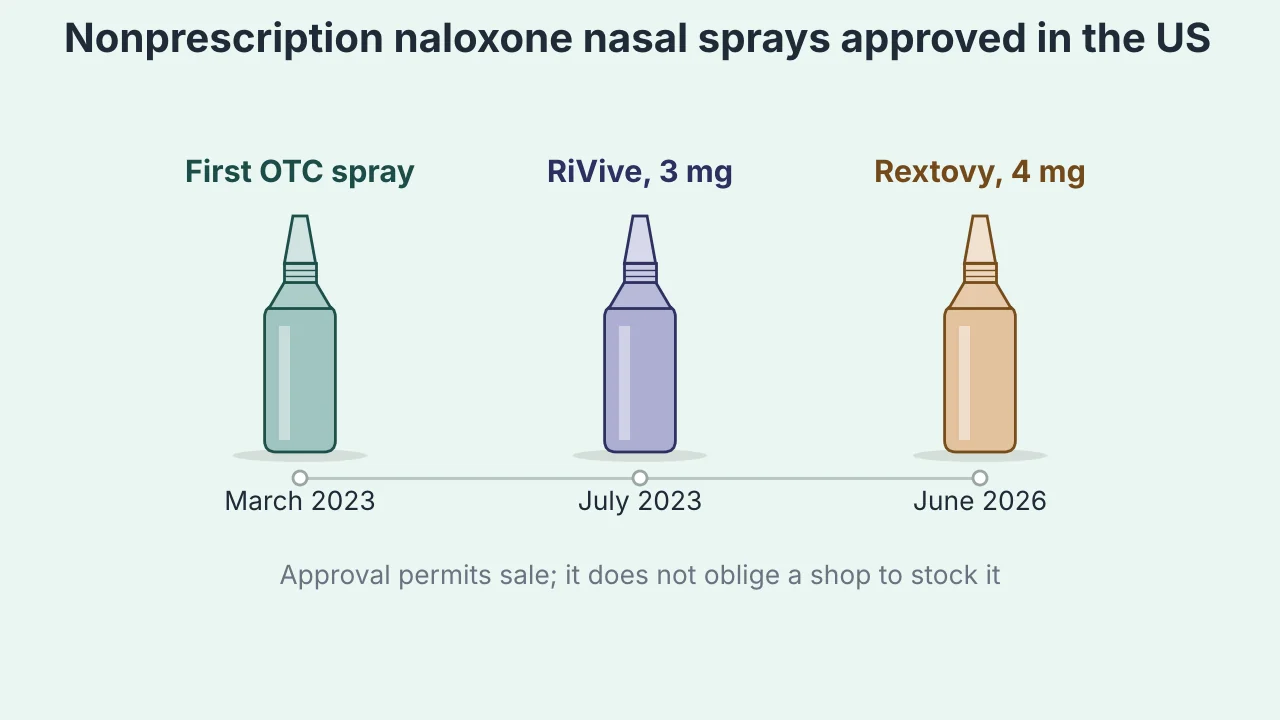
Three dates between them carry the whole story. In March 2023 the Food and Drug Administration approved the first nonprescription naloxone nasal spray. Then a first generic nonprescription version followed in July 2023. Later that month the agency approved RiVive, a 3 milligram spray. That nonprescription approval went to Harm Reduction Therapeutics. Then on 16 June 2026 the agency approved Rextovy, at 4 milligrams. The agency granted that approval to Amphastar Pharmaceuticals. The FDA says consumers may buy Rextovy directly, without any prescription at all. It names pharmacies, convenience stores and online sellers as places to do so. In each case the approval widened the range of products a shop could stock. None of them obliged a shop to stock anything.
Two details in those announcements matter more than the dates. On RiVive, the agency said timing and price rested with the manufacturer. Approval is permission to sell rather than any promise to supply the product. It also sets no ceiling at all on what the product will finally cost. On Rextovy, the packaging carries pictorial directions in five steps. Notably, one of those steps is calling emergency services after the first dose. That instruction is printed on the box for a reason. In other words, reversal is not the end of the episode. Naloxone buys time for professional care to arrive. It does not replace that care, and the label says so.
* Fig. 1 follows the approval dates stated in the FDA announcements.
Fig. 1: Three OTC approvals, 2023 to 2026
How naloxone nasal spray works
Opioids slow a person’s breathing by acting at particular receptors in the brain. Naloxone, in turn, competes for those same receptors and displaces the opioid. As a result, breathing can return within minutes once the opioid is pushed aside. Naloxone blocks the receptor rather than stimulating it. So it does nothing at all in a body holding no opioid. The FDA puts the practical consequence plainly enough. The product is safe to use, it says, even when opioid involvement is uncertain. That single sentence removes the hardest judgment from an already frightening moment. After all, a bystander does not have to be right about what the person took. Acting on a suspicion is the intended use, not a misuse.
The other side of this belongs in every counseling conversation. Displacing an opioid can bring on withdrawal in someone dependent on it. The FDA’s RiVive announcement lists what that withdrawal can look like. It names body aches, diarrhea, a fast heart rate, fever and sweating. It also names sneezing, a runny nose, goose bumps and yawning. Likewise, nausea, vomiting, nervousness and restlessness appear on the same list. The Rextovy announcement adds what somebody regaining consciousness after a reversal may feel. They may shake, sweat, feel sick, or feel angry. Somebody expecting none of this may think the medicine has misfired. Saying it beforehand costs nothing, and it prevents that particular mistake entirely.
Legal access is not the same as real access
For this question, the best current evidence is a 2026 secret shopper study. It appeared in JAMA Network Open in July 2026. Researchers contacted a stratified random sample of 1,108 retail pharmacies. The sample ran across the United States, from January to April 2024. It drew on the seven largest chains plus an eighth mixed group. An estimated 61.40 percent reported same-day naloxone without a prescription. By contrast, an estimated 38.60 percent reported none. Among those without it, staff were about as likely to suggest another pharmacy as nothing at all. Nonprescription status had been in force for roughly a year by then. So this is what a full year of legal access actually produced.
Two further findings sharpen the picture considerably. Placement varied from shop to shop. Naloxone sat at the pharmacy counter in an estimated 58.14 percent of cases. Self-service aisles accounted for 31.74 percent, and front checkouts for 8.99 percent. Above all, a medicine behind a counter has to be asked for by name. That is not the same transaction as lifting it off a shelf. Cost varied too, averaging 52.07 dollars out of pocket across the sample. The authors also found markedly lower availability at independent pharmacies. They found the same in neighborhoods with fewer White residents. Access still depends on which shop a person happens to reach.
* Fig. 2 uses the availability and placement estimates reported by Eldridge et al. (2026).
Fig. 2: Same-day availability and in-store placement
What naloxone means at the pharmacy counter
Every number in that study records a decision somebody made in a shop. Whether to carry the product at all is a stocking decision taken locally. Whether it goes on an open shelf is a placement decision. Signage is a third decision, down to whether a notice appears at all. So is the question of which languages that sign uses. A pharmacist sits close to all of these. So does a pharmacy student on placement. Nobody sitting inside a regulatory agency comes anywhere near these three decisions. The approval was won back in 2023. That 38.60 percent is still being decided, store by store, every day.
The counseling side is equally concrete. Someone buying naloxone may be buying it for a person they love. They may have no wish to explain that at a counter. Treating the purchase as unremarkable is the most useful thing on offer. The points genuinely worth making are few, and all of them are short. What the device looks like, and how the box opens. That emergency services are called after the first dose. That the person may wake frightened or unwell. Where to find local treatment services afterwards. Our article on the risks and realities of opioid pain relief covers that last point.
Where the overdose numbers stand
The context has shifted sharply, and in a hopeful direction. Provisional federal data cover rolling twelve-month windows. The window ending June 2026 gives a predicted 65,724 drug overdose deaths. A year earlier, the same window gave 74,120. The series peaked at 112,418 for the twelve months ending August 2023. So the current level sits roughly 42 percent below that peak. It is also the lowest figure since December 2016. In practice, these counts appear with about a four-month reporting lag. The June 2026 window was 99.5 percent complete at the moment the data were drawn. Earlier months in the same series are still being revised. A figure read today may not match the same figure next spring.
Two cautions belong with those numbers. The first caution is a matter of plain arithmetic. Each figure covers a moving twelve-month window, not a calendar year. Counts quoted from different months are therefore not interchangeable. An article has to say which window it means. The second caution is causal, and it matters more. Wider naloxone access is one explanation offered for the decline. Besides that, expanded treatment and changes in the drug supply are others. The data show the fall but do not apportion it. So anyone crediting naloxone alone has gone past what the evidence supports.
* Fig. 3 plots the predicted counts in the NCHS provisional overdose dataset.
Fig. 3: US overdose deaths, 12-month windows
What a pharmacy student should take from this
Two habits, and both outlast this one medicine. To begin with, separate permission from provision. A drug can be legal and still absent from the shelf somebody reaches. Only the second kind of fact tells you whether anyone was helped. The second habit is to read a hopeful statistic for its silences. Deaths are falling, and nobody can yet say with any confidence how much of that is naloxone. Both habits will serve for the next regulatory change too. The harder question will again be what actually reaches a shelf. Asking it early is what separates a professional from a spectator. Our coverage of the FDA’s shift away from animal testing traces the same gap. So does our piece on nasal nanodrops for brain tumors.
References
US Food and Drug Administration. (2026). FDA broadens access to over-the-counter naloxone nasal spray for opioid overdose. FDA News Release, June 16. fda.gov press announcement
US Food and Drug Administration. (2023). FDA approves second over-the-counter naloxone nasal spray product. FDA News Release, July 28. fda.gov press announcement
Eldridge, L. A., Kline, D., Fields, K., Lewis, B., McMillian, J., Graves, R. L., & Egan, K. L. (2026). Availability of naloxone in retail pharmacies following introduction of over-the-counter status. JAMA Network Open, 9, e2623617. https://doi.org/10.1001/jamanetworkopen.2026.23617
This article follows one medicine from the moment it became legal to buy without a prescription to the moment somebody actually finds it on a shelf. It sets the regulatory timeline beside what a national survey of pharmacies found about stock, price and where the box is kept. Readers who want the underlying studies and the federal announcements will find them listed under References.
Editorial note
Naloxone reverses an opioid overdose, and how easily an ordinary person can obtain it is a practical question for anyone training in pharmacy. This piece separates what regulators have permitted from what the evidence says reaches the public, and it keeps the two apart throughout. The papers and pages under References hold the full methods and measurements. Readers are encouraged to consult them and to check each claim for themselves. ENTECH accepts no responsibility for statements made here or in those sources. This article is offered for information and education only, and it is not professional advice.
Ramya Dobbala is a pharmacist and science communicator dedicated to bridging the gap between complex pharmaceutical research and public understanding. A 2024 B.Pharmacy graduate, Ramya has a strong foundational background in formulation science, having spearheaded research into the evaluation and formulation of anti-acne creams. Her work focused on optimizing topical delivery systems to enhance treatment efficacy and skin health.
Transitioning from the laboratory to the forefront of scientific discourse, she now leverages her technical expertise to translate intricate healthcare concepts into accessible, engaging content. As an author and communicator, Ramya is passionate about empowering audiences with evidence-based insights, particularly in the realms of dermatology and pharmaceutical innovation.