In essence, doctors now personalize your treatment plan. At this point, risk scores drive most decisions.
New Cholesterol Guidelines 2026: What Doctors Won’t Tell You Upfront!

At the present time, heart disease still kills millions worldwide. The new cholesterol guidelines 2026 shift how doctors treat you. In fact, these rules focus on your personal risk. At first, the changes may seem small. In reality, they affect nearly every adult. To explain, treatment now depends on more than numbers. Above all, your lifestyle and values matter more today. As a matter of fact, shared choices now guide your care. In short, this update could protect your heart for years. Let’s break down what changed and why.
Introduction
The new cholesterol guidelines 2026 arrived with major updates. In essence, doctors now personalize your treatment plan. At this point, risk scores drive most decisions. To point out, lifestyle changes come before medication. What’s more, special groups get tailored advice. In sum, these rules aim to save more lives. Let’s look closely at each key change.
Key Takeaways
- Doctors now use personalized risk categories for everyone.
- Lifestyle changes remain the first step always.
- Statin therapy depends on your risk level.
- Special groups get customized treatment plans.
- Shared decisions now guide your care directly.
At any rate, these points show real-world impact. To enumerate, we cover each in detail below. In short, knowledge helps you protect your health.
What Changed in the New Cholesterol Guidelines 2026?
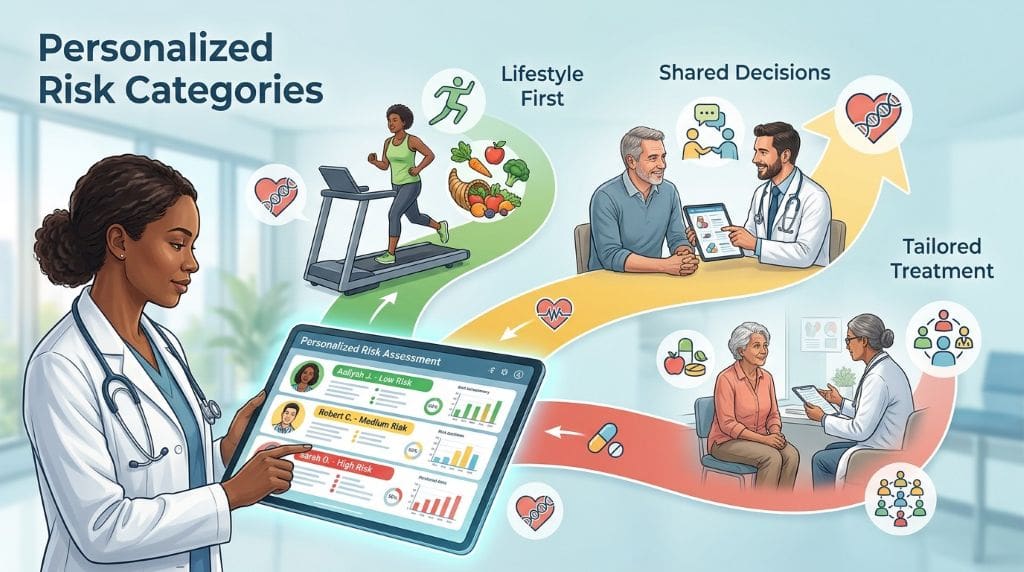
The new cholesterol guidelines 2026 update several key areas. To explain, doctors now assess risk more precisely.
Personalized Risk Assessment
Doctors now group patients by 10-year risk. In detail, four categories guide treatment choices.
- Low risk: Under 5% in ten years.
- Borderline risk: 5% to under 7.5%.
- Intermediate risk: 7.5% to under 20%.
- High risk: 20% or greater.
To point out, risk scores now drive most plans. In effect, your full profile matters most.
Risk-Enhancing Factors
Doctors look beyond simple cholesterol numbers now. In like manner, they weigh extra health factors.
- Family history of early heart disease.
- Chronic kidney disease raises your risk.
- Metabolic syndrome affects blood sugar and fat.
- Inflammatory conditions like lupus count too.
With this in mind, doctors see your whole picture. As a result, treatment fits your true needs.
Coronary Artery Calcium Scoring
A CT scan checks calcium in heart arteries. To illustrate, this helps when risk stays unclear. A high score means earlier treatment may help. In contrast, a zero score may delay drugs. To that end, this test guides tough decisions. In short, it prevents over- and under-treatment.
All things considered, these changes improve accuracy. To list, personalization now shapes every plan. In sum, doctors treat the person, not just numbers. Let’s explore lifestyle steps next.
Lifestyle Changes the New Cholesterol Guidelines 2026 Recommend
The new cholesterol guidelines stress lifestyle first. In essence, healthy habits protect your heart daily.
Heart-Healthy Eating
Food choices strongly affect your cholesterol levels. To explain, better meals lower your heart risk.
- Eat more vegetables and fresh fruits daily.
- Choose whole grains over refined carbs.
- Pick lean proteins like fish and beans.
- Cut back on saturated and trans fats.
To illustrate, small diet swaps add up fast. In fact, they lower bad cholesterol steadily.
Staying Active
Regular movement supports your heart health greatly. At the same time, it lowers bad cholesterol. Aim for 150 minutes of moderate activity weekly. Walking, cycling, and swimming all count well. In like manner, strength training helps your body. To put it another way, motion is medicine. In short, consistency matters more than intensity.
Managing Your Weight
A healthy weight improves your cholesterol numbers. In fact, even small loss brings big gains. Combine better food with regular exercise daily. As a result, your heart risk drops steadily. For more tips, read our guide on common diseases and treatments. To that end, prevention starts with daily habits.
For the most part, lifestyle changes come before drugs. To sum up, healthy habits form the foundation. In light of this, everyone should start here first. Let’s cover medication rules now.
New Medication Rules and Treatment Targets
The new cholesterol guidelines 2026 set clearer drug rules. With attention to risk, doctors choose the right therapy.
Statin Therapy Basics
Statins remain the main cholesterol-lowering drug. To repeat, they prevent heart attacks and strokes.
- High-intensity statins suit high-risk patients.
- These aim to cut LDL-C by half.
- Moderate statins fit intermediate-risk adults.
In detail, statins offer proven protection. As has been noted, they save countless lives.
Very High-Risk Patients
Some patients need extra medication beyond statins. To explain, added drugs push cholesterol lower. Ezetimibe works well with statin therapy. In addition, PCSK9 inhibitors help stubborn cases. With this intention, doctors combine treatments carefully. In effect, teamwork between drugs improves results.
Diabetes and Cholesterol
Adults with diabetes face higher heart risk. In fact, most aged 40 to 75 need statins. To that end, moderate statins suit many patients. In contrast, high-risk cases need stronger doses. As a result, statins protect diabetic hearts well. Learn more in our post on supplements and health effects.
At last, medication supports lifestyle changes together. To put it differently, drugs work best with habits. In sum, both approaches protect your heart. Let’s see who these rules cover.
Who Do the New Cholesterol Guidelines 2026 Cover?
The new cholesterol guidelines cover many groups. In detail, each population gets tailored advice.
Older Adults
Doctors weigh age and health together. To explain, life expectancy shapes treatment plans. Preferences and other illnesses matter greatly. In like manner, shared choices guide care. With this in mind, older people get personalized treatment. As a result, care fits individual needs.
Children and Teens
Early checks catch inherited cholesterol problems. To point out, familial cases need quick action. Kids with high levels start treatment early. In fact, prevention works best when young. To that end, screening protects future hearts. In short, early care prevents later disease.
People With Kidney Disease
Chronic kidney disease raises heart risk sharply. In fact, statins usually help these patients. To repeat, kidney and heart problems link closely. As a result, doctors prescribe statins often here. With this purpose in mind, treatment protects both organs. In sum, kidney patients need close monitoring.
All things considered, the guidelines reach everyone. To list, they cover kids through older people. In conclusion, personalized care benefits all groups. Let’s answer common questions now.
Frequently Asked Questions about New Cholesterol Guidelines 2026 (FAQs)
Q1: Who should follow the new cholesterol guidelines?
Nearly every adult should know these rules. In fact, children with high cholesterol benefit too.
Q2: What is the biggest change in the guidelines?
Doctors now use personalized risk assessment. In short, your full health picture guides treatment.
Q3: Do I always need medication for high cholesterol?
Not everyone needs drugs right away. In reality, lifestyle changes come first for most.
Q4: How often should I test my cholesterol?
Most adults check every four to six years. In contrast, high-risk people test more often.
Q5: Can lifestyle alone lower my cholesterol?
Healthy habits often lower cholesterol well. In fact, diet and exercise help many people.
Final Thoughts
The new cholesterol guidelines put you first. In essence, personalized care now leads the way. To sum up, lifestyle and shared choices matter most. As a result, you gain more control today. With this in mind, talk with your doctor soon.
References
Blumenthal, R. S., Morris, P. B., Gaudino, M., Johnson, H. M., Anderson, T. S., Bittner, V. A., Blankstein, R., Brewer, L. C., Cho, L., De Ferranti, S. D., Gianos, E., Gluckman, T. J., Gradney, K. F., Isiadinso, I., Lloyd-Jones, D. M., Marrs, J. C., Martin, S. S., McLain, K. H., Mehta, L. S., . . . Young, J. (2026). 2026 ACC/AHA/AACVPR/ABC/ACPM/ADA/AGS/APHA/ASPC/NLA/PCNA Guideline on the Management of Dyslipidemia: A report of the American College of Cardiology/American Heart Association Joint Committee on Clinical Practice Guidelines. Circulation, 153(17), e1154–e1276. https://doi.org/10.1161/cir.0000000000001423
- Author
- Latest Posts

I am Bhagyashree Khaire, a Bachelor of Pharmacy graduate with a strong curiosity for science, biology, and the way research helps improve healthcare. My background in pharmacy has given me a foundation in pharmaceutical concepts, biological processes, and drug-related knowledge, which motivates me to explore scientific topics and share them through writing.I enjoy reading, researching, and writing about topics related to biology, pharmacology, healthcare, and pharmaceutical sciences. I believe that scientific information should not only be accurate but also easy to understand, and I aim to present complex concepts in a simple and meaningful way for readers.
During my research work, I conducted secondary market research on Rutin and its pharmacological activities, where I explored available scientific literature, biological effects, therapeutic potential, and research insights related to this natural flavonoid compound. This experience helped me strengthen my skills in scientific research, literature analysis, and communicating technical information effectively.
I am passionate about building my journey in science correspondence and scientific writing by creating informative, research-based articles that connect scientific knowledge with people. I am interested in opportunities related to healthcare content, pharmaceutical writing, research communication, and science-based storytelling.
With a continuous learning mindset and a passion for science, I aim to contribute valuable insights through my writing and grow as a science communicator.