The APOB test cost quest highlights smarter, cost-effective ways to prevent heart disease.
Cost-Effectiveness of ApoB, Non–HDL-C, and LDL-C Goals for Primary Prevention Lipid-Lowering Therapy
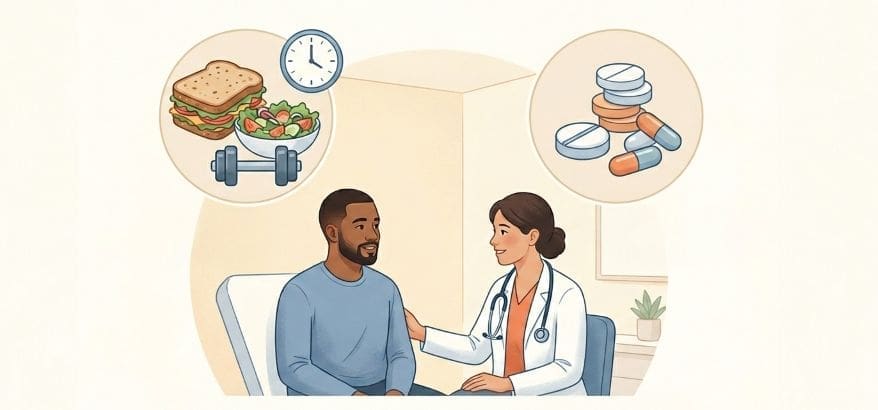
Lipid-lowering therapy (LLT) refers to a diverse group of medical treatments—including lifestyle changes and pharmaceutical agents—designed to reduce high levels of fats (lipids) and lipoproteins in the blood. Overall, lipid-lowering therapies play a central role in the APOB test cost quest and are a cornerstone of modern medicine, primarily used to prevent and manage atherosclerotic cardiovascular disease (ASCVD), which remains a leading cause of death worldwide.
In recent study, the APOB test cost quest has gained attention as researchers and clinicians search for more accurate and cost-effective ways to assess cardiovascular risk. Traditionally, doctors relied on LDL cholesterol. However, the APOB test cost quest is now reshaping how we think about prevention, risk prediction, and long-term treatment strategies.
Key Takeaways
- ApoB testing can be more cost-effective than traditional LDL cholesterol goals.
- Non-HDL-C and ApoB better predict heart disease risk.
- Pharmacy careers require strong foundations in chemistry, biology, and math.
- Health economics is a growing field within pharmaceutical sciences.
Understanding the APOB Test Cost Quest in Modern Research
Heart disease remains the leading cause of death worldwide. For decades, doctors used LDL cholesterol to guide treatment decisions. At the same time, newer markers have emerged as better predictors. For instance, a recent JAMA study examined three lipid markers. These include LDL-C, non-HDL-C, and apolipoprotein B (apoB). Within the broader APOB test cost quest, this study found that ApoB-guided treatment produced the most health benefits while remaining cost-effective.
Importantly, the study found apoB goals produced the most health benefits. In the context of the APOB test cost quest, this highlights the growing importance of data-driven decision-making. To explore further, the research team used computer simulations to modeled outcomes for 250,000 US adults without heart disease. All participants were eligible for statin therapy. The results showed apoB-guided treatment was highly cost-effective.The findings showed that the APOB test cost quest is not just about accuracy—but also about optimizing healthcare spending.
What Are LDL-C, Non-HDL-C, and ApoB?
Understanding Cholesterol Markers
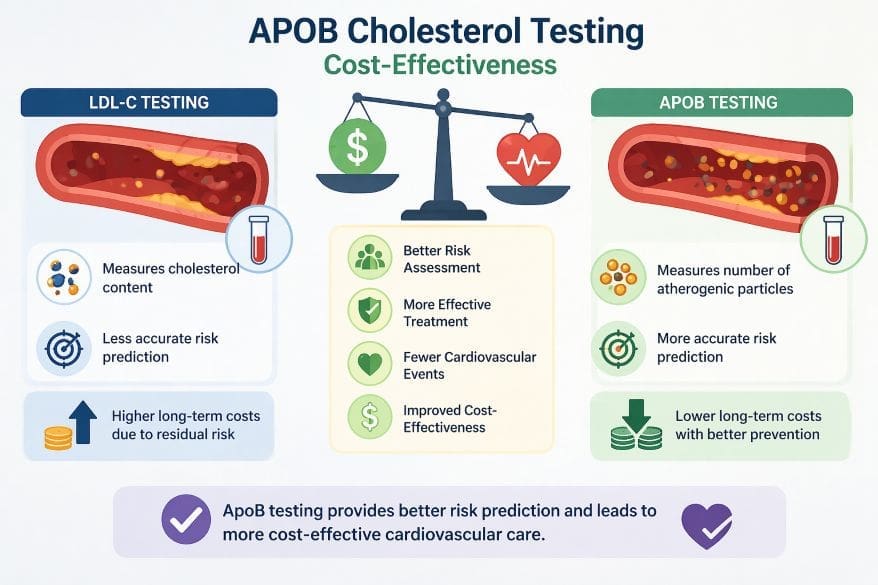
LDL-C stands for low-density lipoprotein cholesterol. Many call it “bad cholesterol.” Non-HDL-C measures all harmful cholesterol particles combined. Meanwhile, ApoB is a protein found on these particles.
Why ApoB Matters More in the APOB Test Cost Quest
Each harmful cholesterol particle contains one ApoB protein. This makes ApoB a direct count of risky particles. In contrast, LDL-C only estimates cholesterol content, not particle number. To illustrate, think of it this way. LDL-C measures the cargo, whereas ApoB counts the delivery trucks. More trucks mean more potential damage. This distinction is central to the APOB test cost quest, which focuses on improving both prediction accuracy and cost-efficiency.
Within the APOB test cost quest, the study compared three treatment strategies. Each used different lipid goals for therapy decisions.
| Lipid Marker | Treatment Goal | QALYs Gained | Cost Change |
| LDL-C | <100 mg/dL | Baseline | Baseline |
| Non-HDL-C | <118 mg/dL | +965 | −$2.1 million |
| ApoB | <78.7 mg/dL | +2,289 total | +$40.2 million |
QALYs = Quality-Adjusted Life-Years (Luebbe et al., 2026)
Cost-Effectiveness Results and the APOB Test Cost Quest
Using apoB goals cost about $30,300 per quality-adjusted life-year gained. Notably, this falls well below the $120,000 threshold. At this threshold, treatments are considered cost-effective. In addition, the apoB strategy was optimal in 65% of analyses. However, higher costs came from longer life expectancy. People lived longer, so they needed preventive treatment longer. The actual apoB test itself added minimal expense.
However, higher overall costs were mainly due to increased life expectancy. In other words, patients lived longer and required preventive care for extended periods. Importantly, the ApoB test itself added minimal expense—an important factor driving the APOB test cost quest forward.
Why APOB Test Cost Quest Is for Future Pharmacy Professionals
Health Economics Is Growing
Pharmacists do more than dispense medications today. They help healthcare systems make smart financial decisions. For example, studies like this one guide treatment protocols nationwide. As a result, pharmacy programs now include health economics training. Consequently, students learn to evaluate drug cost-effectiveness. This skill set is increasingly valuable.
Clinical Research Opportunities
Pharmaceutical scientists design studies like this JAMA research. In fact, they build computer models and analyzed population health data. Furthermore, they translate findings into practice guidelines.
Core K-12 Subjects for a Pharmacy Career
To prepare for pharmacy school, focus on these subjects:
- Chemistry – Essential for understanding drug interactions and formulations
- Biology – Covers human physiology and disease processes
- Mathematics – Required for dosage calculations and statistical analysis
- Physics – Helps with understanding drug delivery systems
- English – Critical for scientific writing and patient communication
Recommended High School Courses
- AP Chemistry or IB Chemistry
- AP Biology
- Statistics or Pre-Calculus
- Anatomy and Physiology (if offered)
- Health Sciences electives
Career Paths Related to This Research
By all means, pharmacy offers diverse career options. Here are paths connected to lipid management research:
- Clinical Pharmacist – Manages patient medication therapy
- Pharmaceutical Researcher – Develops new lipid-lowering drugs
- Health Economist – Analyzes treatment cost-effectiveness
- Medical Science Liaison – Connects research to clinical practice
- Regulatory Affairs Specialist – Ensures drug approval compliance
The Bottom Line: APOB Test Cost Quest and the Future of Care
The APOB test cost quest represents a major advancement in cardiovascular prevention. Notably, ApoB-guided therapy offers better health outcomes at reasonable costs, making it a powerful tool in modern medicine. In fact, this JAMA study provides strong evidence for apoB-guided therapy. It offers better health outcomes at reasonable costs.
For students interested in pharmacy, this research shows the field’s real-world impact. In essence, pharmacists help translate research into patient care. In essence, the APOB test cost quest is not just about a lab test—it reflects the future of smarter, more efficient healthcare systems.
At this point, cardiovascular disease prevention continues evolving. As a result, new markers like apoB may become standard practice and future pharmacists will help implement these changes.
Frequently Asked Questions (FAQs) about APOB test cost quest
What is the APOB test cost quest?
The APOB test cost quest refers to ongoing efforts to evaluate whether ApoB testing is a more accurate and cost-effective way to assess cardiovascular risk compared to traditional cholesterol markers like LDL-C.
Why is ApoB considered better than LDL cholesterol?
ApoB measures the actual number of harmful cholesterol particles, while LDL-C only estimates the cholesterol they carry. This makes ApoB a more precise predictor of heart disease risk.
Is ApoB testing cost-effective?
Yes. In fact, research shows that within the APOB test , ApoB-guided therapy provides better health outcomes at a reasonable cost, often well below accepted cost-effectiveness thresholds.
What does the APOB test cost quest mean for patients?
In other words, it means patients may receive more accurate risk assessments and more effective treatment strategies. As the APOB test cost quest progresses, care is becoming both more personalized and more cost-efficient.
How does the APOB test cost quest improve risk prediction?
In addition, it improves risk prediction by focusing on the number of harmful cholesterol particles rather than just their cholesterol content. As a result, clinicians can identify high-risk patients more accurately and tailor treatments more effectively.
References
Luebbe, S., Sniderman, A. D., & Moran, A. E. (2026). Cost-effectiveness of ApoB, non–HDL-C, and LDL-C goals for primary prevention lipid-lowering therapy. JAMA. https://doi.org/10.1001/jama.2026.2986
Sniderman, A. D., Thanassoulis, G., Glavinovic, T., Navar, A. M., Pencina, M., Catapano, A., & Ference, B. A. (2019). Apolipoprotein B particles and cardiovascular disease: A narrative review. JAMA Cardiology, 4(12), 1287–1295. https://doi.org/10.1001/jamacardio.2019.3780
Grundy, S. M., Stone, N. J., Bailey, A. L., et al. (2019). 2018 AHA/ACC guideline on the management of blood cholesterol. Circulation, 139(25), e1082–e1143. https://doi.org/10.1161/CIR.0000000000000625
- Author
- Latest Posts

Ramya Dobbala is a pharmacist and science communicator dedicated to bridging the gap between complex pharmaceutical research and public understanding. A 2024 B.Pharmacy graduate, Ramya has a strong foundational background in formulation science, having spearheaded research into the evaluation and formulation of anti-acne creams. Her work focused on optimizing topical delivery systems to enhance treatment efficacy and skin health.
Transitioning from the laboratory to the forefront of scientific discourse, she now leverages her technical expertise to translate intricate healthcare concepts into accessible, engaging content. As an author and communicator, Ramya is passionate about empowering audiences with evidence-based insights, particularly in the realms of dermatology and pharmaceutical innovation.