Discover Onder Albayram's groundbreaking research on fish oil and its potential dangers for brain health after injuries.
Fish Oil Shock: Could EPA Slow Brain Healing After Hits?

Estimated reading time: 7 minutes
For years, fish oil has been a superstar supplement. People take it for heart health. They take it for brain function. But new groundbreaking research flips this idea on its head. Recent Onder Albayram fish oil research, including a 2026 study, shows a surprising effect. After a brain injury, a key component in fish oil might actually impair healing. Indeed, this discovery changes everything we thought we knew about nutrition and brain recovery. Also, it suggests that what helps a healthy brain could harm an injured one. In fact, this research is crucial for athletes, patients, and anyone concerned with brain health.
Key Takeaways
- Context Matters: Eicosapentaenoic acid (EPA) from fish oil impaired repair in injured brains but was not studied in healthy ones.
- Mechanism Discovered: EPA reprograms metabolism in brain blood vessels, shutting down crucial repair signals.
- Human Evidence: Postmortem brains from athletes with CTE showed similar fatty acid imbalances and vascular damage.
- Behavioral Impact: Mice given EPA after a brain injury performed worse on memory tests.
Onder Albayram’s Fish Oil Research: A Paradigm Shift
Dr. Onder Albayram and his team at the Medical University of South Carolina (MUSC) published their work in Cell Reports. Their study challenges assumptions. Prior to this, fish oil was broadly considered beneficial. The team focused on traumatic brain injury (TBI). They used mouse models and human cells. They also analyzed postmortem brain tissue from athletes with Chronic Traumatic Encephalopathy (CTE). Their goal was to see how omega-3 fatty acids behave after injury.
The Unexpected Accumulation
The researchers made a key observation. After a brain injury, one fatty acid built up significantly. This was not DHA, another common omega-3. It was specifically Eicosapentaenoic acid (EPA), a key component of fish oil. This accumulation of a fish oil-derived fatty acid was the first clue. It suggested EPA was actively involved in the brain’s response to damage. This finding was unexpected. It pointed to a specific biological role for EPA in the injury process.
Fish Oil Compound EPA and Metabolic Reprogramming After Brain Injury
The buildup of EPA, a major fish oil compound, had a dramatic effect. had a dramatic effect. It essentially reprogrammed the brain’s vascular cells. The study found that EPA shifted how these cells functioned. It suppressed genes needed for repair. This included genes for angiogenic signaling and extracellular matrix organization. These processes are vital for healing. By shutting them down, EPA created a metabolic vulnerability. The brain’s ability to fix its blood vessels was severely weakened.

How Fish Oil (EPA) Disrupts Brain Repair
To explain further, the team tested human cells. They grew human brain microvascular endothelial cells. These cells line our brain’s blood vessels. The researchers exposed them to EPA, fish oil supplements.. This was done in a fatty acid-rich environment. This mimicked conditions after a brain injury. The results were clear. The cells formed weaker networks. Their barrier integrity was compromised. This means the vital barrier between blood and brain became leaky. This dysfunction is a hallmark of poor recovery after TBI.
Fish Oil, EPA and CTE Connection
The research extended to human disease. The team examined brain tissue from donors with CTE. CTE is linked to repetitive head injuries. They found a fatty acid imbalance in these brains. The metabolic pathways were disrupted. Thereafter, these signatures aligned perfectly with the EPA-linked vulnerabilities seen in mice. This translation from mouse to human is powerful evidence. It suggests the same harmful mechanism occurs in people. Therefore, these findings raise concerns about fish oil use in individuals with repeated brain injuries.
The Real-World Effects of Fish Oil (EPA) Consequences
This isn’t just about cell biology. The effects translated to real behavioral outcomes. Mice were fed EPA, mimicking high intake from fish oil after experiencing a brain injury. Later, they were tested on spatial memory tasks. These tasks involve navigating a maze. The EPA-fed mice performed significantly worse. Their blood vessels were destabilized. Finally, this promoted the buildup of toxic tau protein. Tau buildup is a key feature of CTE and Alzheimer’s disease.
Rethinking Nutritional Advice
Above all, this study calls for precision nutrition. Broad recommendations for fish oil may be outdated. The advice must consider context. For a healthy brain, omega-3s may still be good. For a brain recovering from injury, high EPA could be risky. As Dr. Albayram’s work shows, it might impair healing. Therefore, future research will need to define safe and effective protocols.
What You Need to Know
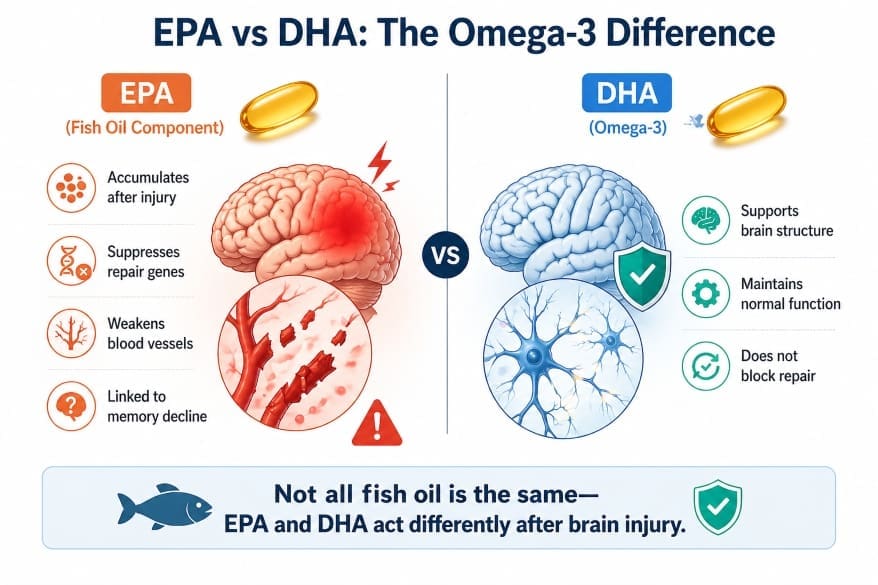
- Not All Omega-3s Are the Same: This study specifically implicates EPA, not DHA, in disrupting repair after brain injury.
- Injury Changes Everything: A substance that is beneficial for a healthy brain can have the opposite effect on an injured brain.
Summary of Key Findings
| Aspect of Study | Finding | Implication |
|---|---|---|
| Primary Fatty Acid | Eicosapentaenoic acid (EPA) accumulated post-injury. | Targets EPA specifically, not all fish oil components. |
| Cellular Effect | Reprogrammed metabolism, suppressing repair genes. | Explains the mechanism behind impaired healing. |
| Human Evidence | CTE brains showed similar fatty acid imbalance. | Confirms the relevance of the finding to human disease. |
| Functional Outcome | Worse memory performance in EPA-fed mice post-TBI. | Links the biological change to a real-world cognitive deficit. |
Why the difference between EPA and DHA?
In general, EPA and DHA share some features. By and large, both are omega-3 components. To put it differently, they act in tissues uniquely. With the result that, outcomes diverge under stress. At any rate, EPA changed energy use pathways. DHA did not block normal repair programs. To repeat, context and dose shape risk. At least, that is what data suggest (Albayram et al., 2026).
Conclusion
In conclusion, Onder Albayram’s fish oil research is a major breakthrough. It reveals a critical nuance in nutritional science. What is good for one state of health may be bad for another. This work urges caution and more personalized approaches to supplements. After all, brain health is too important for one-size-fits-all solutions.
Frequently Asked Questions (FAQs)
Can fish oil slow brain recovery after injury?
Recent research suggests that onder albayram fish oil—specifically eicosapentaenoic acid (EPA)—may slow brain recovery after traumatic brain injury (TBI). As a matter of fact, the study led by Onder Albayram found that EPA can impair repair mechanisms in injured brains by disrupting blood vessel healing and metabolic balance.
Is fish oil safe to take after a traumatic brain injury (TBI)?
Fish oil is not universally harmful, but its safety after TBI is now being questioned. High levels of EPA may negatively affect recovery. Experts suggest avoiding self-supplementation after brain injury without medical advice until more research confirms safe guidelines.
What is the difference between EPA and DHA in brain health?
EPA and DHA are both omega-3 fatty acids, but they behave differently. EPA may interfere with brain repair after injury, while DHA is generally associated with supporting brain structure and function. This highlights the importance of targeted nutrition rather than general fish oil use.
Why does EPA affect brain healing differently after injury?
EPA alters how brain blood vessel cells function by reprogramming metabolism. As a result, it suppresses key repair processes like angiogenesis and barrier integrity, which are essential for healing after injury. This disruption may weaken the brain’s recovery response.
Does fish oil increase the risk of CTE or Alzheimer’s disease?
There is no direct evidence that fish oil causes these diseases. However, the study found that EPA-related changes may promote tau protein buildup, a hallmark of conditions like Chronic Traumatic Encephalopathy and Alzheimer’s disease in injured brains.
References
Karakaya, E., et al. (2026). Eicosapentaenoic acid reprograms cerebrovascular metabolism and impairs repair after brain injury, with relevance to chronic traumatic encephalopathy. Cell Reports, 45(3), 117135. https://doi.org/10.1016/j.celrep.2026.117135
- Author
- Latest Posts

Ramya Dobbala is a pharmacist and science communicator dedicated to bridging the gap between complex pharmaceutical research and public understanding. A 2024 B.Pharmacy graduate, Ramya has a strong foundational background in formulation science, having spearheaded research into the evaluation and formulation of anti-acne creams. Her work focused on optimizing topical delivery systems to enhance treatment efficacy and skin health.
Transitioning from the laboratory to the forefront of scientific discourse, she now leverages her technical expertise to translate intricate healthcare concepts into accessible, engaging content. As an author and communicator, Ramya is passionate about empowering audiences with evidence-based insights, particularly in the realms of dermatology and pharmaceutical innovation.