Cyclospora cayetanensis is a microscopic parasite that causes cyclosporiasis.
This Invisible Parasite Is Hiding in Your Fresh Salad
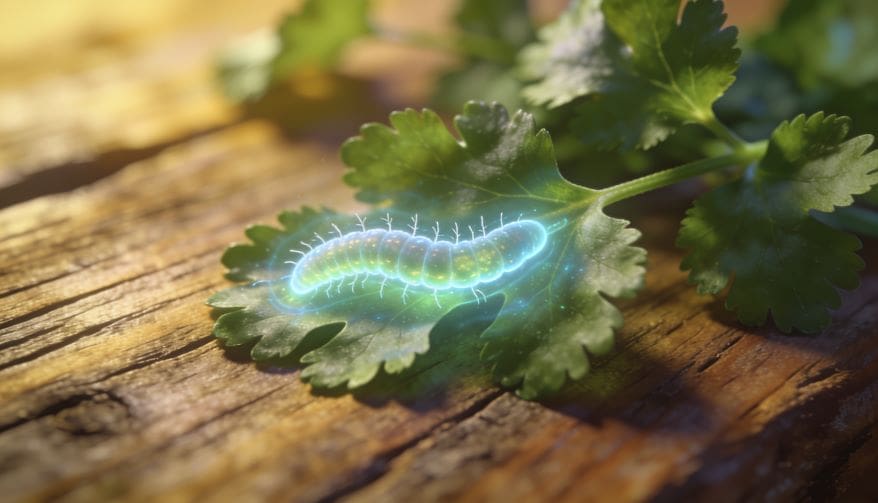
You wash your vegetables. You eat fresh salads, by thinking you are being healthy. But what if a microscopic parasite is hiding right there — in your cilantro, your berries, or your bagged lettuce? The CDC Cyclospora outbreak reports confirm this is not a horror story. It is real biology.
Cyclospora cayetanensis is a single-celled parasite that infects the human small intestine. It spreads through contaminated food and water. As of late 2023, 2,272 lab-confirmed cases were reported across 40 U.S. states — all from people who had not traveled internationally.
Key Takeaways
- Cyclospora cayetanensis is a microscopic parasite that causes cyclosporiasis.
- It spreads only through contaminated food or water — not person to person.
- The parasite infects the small intestine and causes watery, explosive diarrhea.
- Fresh produce such as cilantro, berries, and bagged salads are common sources.
- CDC scientists discovered in 2023 that Cyclospora has at least three distinct populations.
What Exactly Is Cyclospora — And Why Should You Care?
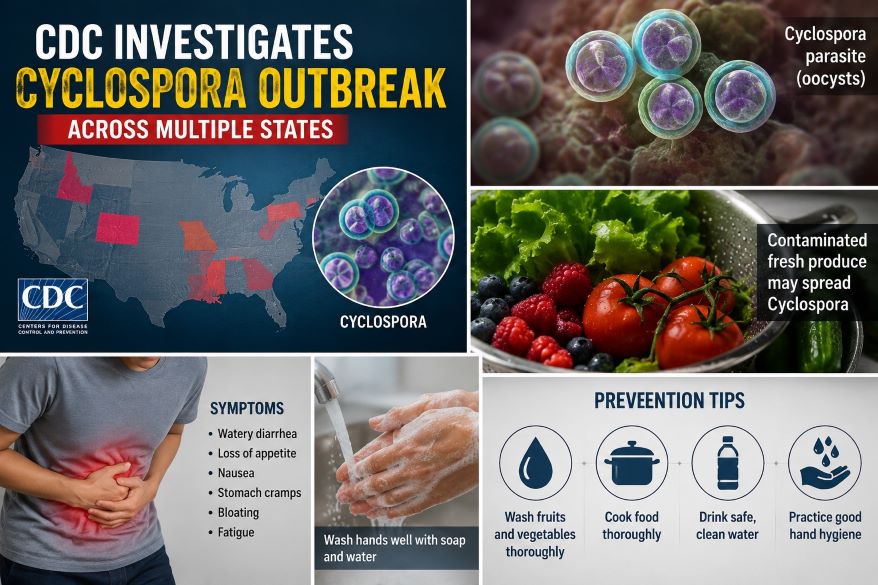
At this point, let us connect this to your Class 11 Biology. You study parasites in your chapters on human health and disease. Cyclospora cayetanensis is a real, living example of that chapter coming to life.
According to the CDC, cyclosporiasis is an intestinal illness caused by the microscopic parasite Cyclospora cayetanensis, also known simply as Cyclospora. People can become infected by consuming food or water that contains the parasite.
The Parasite Life Cycle
To explain the parasite’s life cycle clearly, here are the key steps:
- Cyclospora produces oocysts — tiny egg-like structures — that pass out in human stool.
- At first, these oocysts are not immediately infectious.
- It takes at least 1–2 weeks outside the body for the oocysts to become infectious.
- After that, if contaminated water reaches crops, the infectious oocysts transfer to food.
- As a result, a person who eats that food ingests the oocysts and becomes sick.
This is why direct person-to-person transmission is unlikely. The parasite needs time in the environment to mature. This detail is crucial — and it is exactly the kind of biological mechanism you learn in your parasitology lessons.
Signs and Symptoms: What Happens Inside the Body
In like fashion, understanding the symptoms helps you connect microbiology to human physiology. To list the common symptoms of cyclosporiasis:
- Watery diarrhea — often frequent and explosive
- Nausea, vomiting, and stomach cramps
- Fatigue and loss of appetite
- Weight loss over time
- Symptoms that seem to go away, then return (relapse)
If not treated, the illness may last from a few days to over a month. In general, most healthy people recover. However, people with weakened immune systems face a higher risk of severe illness.
How the CDC Tracks a CDC Cyclospora Outbreak
Seeing that you may have studied epidemiology in your health science or biology electives, here is how scientists actually track a CDC Cyclospora outbreak in the real world.
In June 2023, a total of 47 cases of cyclosporiasis were linked to a Mexican-style restaurant in Alabama. Analysis of case-control data identified cilantro as the likely food source. Lab specimens were sent to the CDC for genotyping — a technique that identifies the genetic fingerprint of the parasite.
Genotyping: Where Biology Meets Data Science
To put it differently, genotyping is like giving each parasite a unique barcode. CDC scientists discovered in 2023 that Cyclospora is not one singular organism. It has at least three distinct populations. This discovery may help public health officials trace the source of cyclosporiasis outbreaks far more accurately in future.
What’s more, of the 24 major foodborne illness outbreaks investigated by the FDA in 2023, four (17%) were attributed to Cyclospora cayetanensis. In three of those four outbreaks, scientists could not conclusively identify the food source. This shows us how difficult food traceback science actually is.
Why Is Traceback So Hard?
To enumerate the core challenges scientists face:
- Cyclospora oocysts are extremely small — hard to detect even in lab tests.
- There are no animal models or lab culture systems to grow Cyclospora in a lab.
- Stool specimens must be collected on multiple days to reliably detect the parasite.
- Special stool tests are required — routine labs miss it completely.
- Produce often passes through multiple distributors, making traceback complex.
All things considered, this makes Cyclospora one of the most challenging foodborne pathogens to study and control. Scientists urgently need better tools.
Also read: Scientists Just Used AI to Build Smarter Vaccines
Frequently Asked Questions
Q1: Is cyclosporiasis dangerous for teenagers?
In essence, most healthy teenagers recover without serious complications. However, the illness can last a month or longer without treatment. People with weakened immune systems are at greater risk. Treatment with the antibiotic trimethoprim-sulfamethoxazole is effective in most cases.
Q2: Can washing vegetables prevent Cyclospora infection?
While it may be true that washing reduces risk, it does not guarantee complete safety. Cyclospora oocysts are tiny and can cling to produce surfaces. Proper food handling and avoiding water contamination at the farm level are more effective long-term solutions.
Q3: How does the CDC confirm a Cyclospora outbreak?
The CDC uses specialized stool tests and genotyping to confirm cases. Standard stool tests miss Cyclospora entirely. Doctors must specifically request Cyclospora testing. Lab samples are then sent to CDC for genetic cluster analysis.
References
- Centers for Disease Control and Prevention. (2024, September 4). About cyclosporiasis. National Center for Emerging and Zoonotic Infectious Diseases. https://www.cdc.gov/cyclosporiasis/about/index.html
- Chacin-Bonilla, L., & Santin, M. (2023). Cyclospora cayetanensis infection in developed countries: Potential endemic foci? Microorganisms, 11(3), 540. https://doi.org/10.3390/microorganisms11030540
- Goetzman, J., Carter, A., Oliveira, A., & Ingram, L. A. (2025). Outbreak of cyclosporiasis among patrons of a Mexican-style restaurant — Limestone County, Alabama, May–June 2023. Morbidity and Mortality Weekly Report, 74(13). https://doi.org/10.15585/mmwr.mm7413a1
- Author
- Latest Posts

I am an inspirational writer and emerging science blogger with a deep-rooted passion for understanding and sharing the wonders of the world around us. My journey began with a Bachelor of Science in Chemistry from AKI’s Poona College of Arts, Commerce and Science, where I developed not only a strong foundation in scientific principles but also a mindset that values curiosity, observation, and critical thinking. Studying chemistry has taught me to approach problems with logic, to look beyond the obvious, and to see patterns where others might only see complexity. These experiences have shaped the way I perceive life and influence the way I express my thoughts, both scientifically and creatively.
I have always believed that knowledge is only as powerful as the way it is shared. This belief has guided me to create content that bridges the gap between science and everyday life. I aim to simplify complex scientific ideas so they become approachable, relatable, and engaging for everyone—whether someone has a formal background in science or is simply curious about the world. Science, in my view, is not confined to textbooks and laboratories; it is a way of thinking, understanding, and connecting with the world around us. By making science accessible, I hope to inspire curiosity, ignite learning, and encourage people to see the beauty and relevance of scientific discovery in their daily lives.
Alongside my love for science, I am deeply passionate about motivational writing. I believe words carry the power to transform perspectives, encourage self-reflection, and inspire action. By combining analytical thinking with creativity, I create content that is intellectually stimulating yet emotionally resonant. Whether I am breaking down a chemical concept, exploring a scientific phenomenon, or crafting motivational narratives, my goal is to communicate ideas in a way that is clear, meaningful, and impactful.
Through my work, I strive to empower my readers – not just by helping them understand the science around them, but by inspiring them to grow, learn, and realize their full potential. Every article, post, or story I write reflects my commitment to turning knowledge into inspiration. I want to spark curiosity, encourage self-improvement, and show that learning and personal growth are deeply connected. For me, writing is not just a craft; it is a way to touch minds, connect hearts, and make ideas come alive in a way that truly resonates.