Synthetic Cell Technology Demonstrates Complete Artificial Cell Cycle
Synthetic Cell Technology Creates Self Replicating Artificial Cells
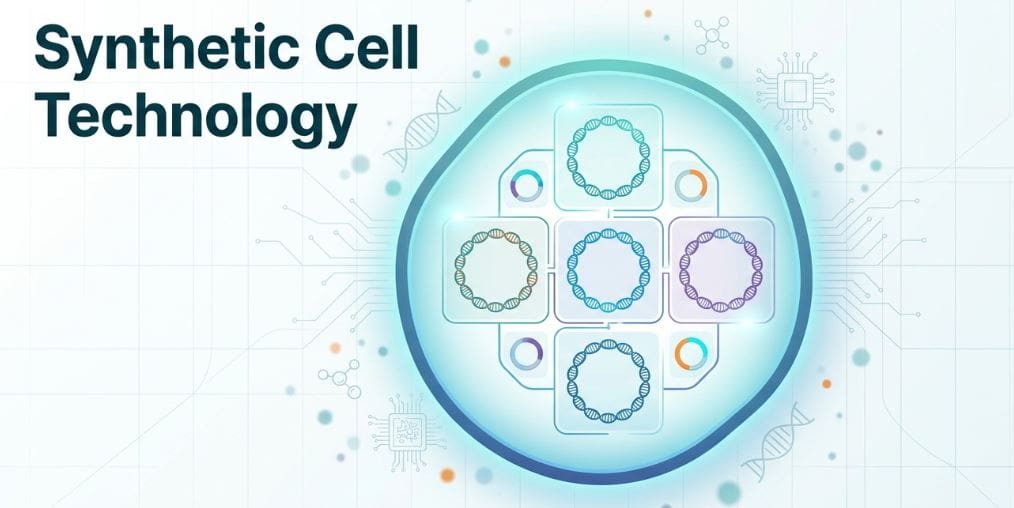
SpudCell is a synthetic cell made from simple, purified, non-living molecules. In fact, synthetic cell technology is at the heart of its creation. It is not built from parts taken from living cells. The researchers designed it to carry out several life-like activities. It can grow, copy its DNA, divide into new cells, and compete with other cells over many generations. Scientists often use these abilities as signs of living systems. They built SpudCell by combining DNA, proteins, and a protective membrane. As a result, it behaves in many ways like a natural cell. SpudCell gives scientists a simple way to study the basic processes of life. It also helps them understand how complex cell functions can arise from simple parts. This work is a major step forward in synthetic biology and brings scientists closer to understanding the basic principles of life.
Key Takeaways
- First, scientists created SpudCell, a synthetic cell from purified chemical parts instead of living cells, demonstrating the potential of synthetic cell technology in advancing science and innovation.
- Unlike earlier artificial cells, SpudCell does not rely on a preexisting cell structure, which highlights the progress made possible by synthetic cell technology.
- Next, researchers designed SpudCell to perform several life-like activities, including growth, DNA replication, and division. This advancement is rooted in developments within the realm of synthetic cell technology.
- In addition, the cell can pass genetic information to the next generation, demonstrating another feature enabled by synthetic cell technology.
- To support growth, scientists supply nutrients through tiny lipid vesicles that fuse with the cell membrane. Such methods stem from innovations in synthetic cell technology.
- As a result, SpudCell gains the materials it needs to make proteins and expand, which is a breakthrough for synthetic cell technology and its applications.
- Moreover, the cell copies its DNA before it divides, reflecting ongoing progress in synthetic cell technology development.
- Then, proteins build up on the membrane and create forces that help the cell split into daughter cells. This process benefits from the latest learning in synthetic cell technology.
Prior Progress in Minimal and Synthetic Cell Construction
- First, scientists used a top-down approach. They removed genes from simple living cells to make minimal cells with only the genes needed to stay alive. This work stands in contrast to current advances in synthetic cell technology.
- However, these minimal cells still relied on parts they inherited from natural living cells, unlike synthetic cell technology, which builds entirely from defined components.
- Next, researchers created cell-free systems using purified molecules instead of living cells. These advances contributed important steps in the development of synthetic cell technology.
- These systems could read DNA and make proteins without using a living cell, opening new doors for synthetic cell technology research.
- Scientists also studied one cell function at a time instead of trying to build a complete cell all at once, a method further refined by synthetic cell technology.
- They tested simple membranes, proteins, RNA, peptides, and other molecules to understand how each part works, paving the way for rapid progress in synthetic cell technology.
- They found that some of these simple systems could change the shape of membranes and carry out basic division-like processes—insights now used in synthetic cell technology.
- However, all of these systems worked only under carefully controlled laboratory conditions. Today’s synthetic cell technology is moving toward more robust and autonomous cells.
90-kbp Genome Across Seven Plasmids
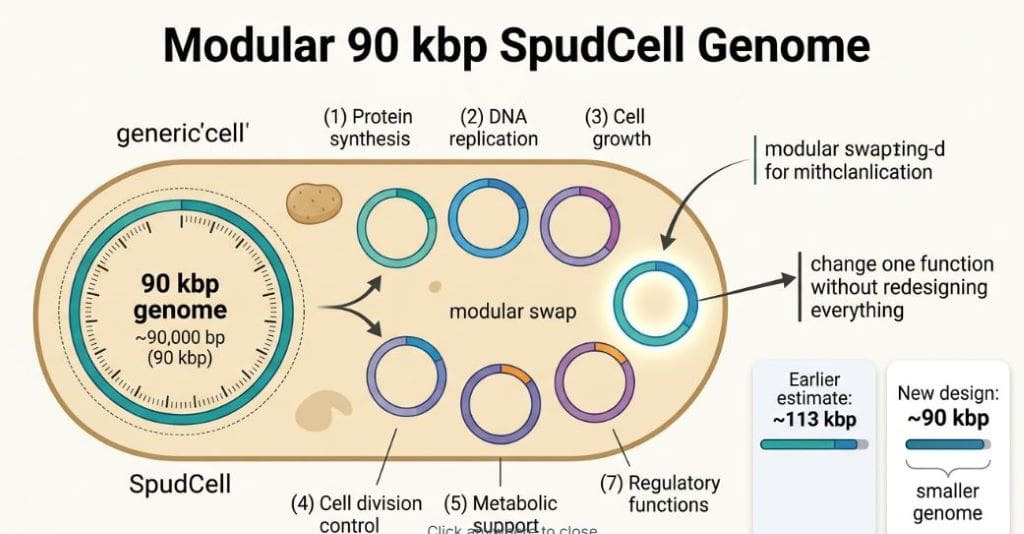
Researchers gave SpudCell a small genome with about 90,000 DNA base pairs (90 kbp). They split the genome into seven plasmids instead of placing all the genes on one chromosome. Each plasmid contains genes for a specific job, such as making proteins, copying DNA, helping the cell grow, or controlling cell division. This modular design lets scientists change one cell function without changing the whole genome. It also makes SpudCell easier to build, test, and improve. Even though the genome is small, it has enough genetic instructions for the cell to grow, copy its DNA, and divide. This modular approach is one of the many innovations driven by synthetic cell technology. The 90-kbp genome is smaller than the earlier estimated minimum genome size of about 113 kbp for a simple living cell.
Conclusion
In conclusion, the researchers showed that scientists can build a synthetic cell from fully defined, non-living components and still achieve many key features of life. For the first time, a bottom-up synthetic cell completed a full cell cycle by feeding, growing, copying its DNA, and dividing. Moreover, SpudCell demonstrated selection and competition across generations, linking its genetic information to its reproductive success. Importantly, the study proved that many life-like behaviors can emerge from a system whose components and functions are fully known. At the same time, the researchers emphasized that SpudCell is not yet a fully autonomous living cell because it still depends on externally supplied ribosomes, nutrients, and feeding mechanisms. To sum up, these findings show how synthetic cell technology sheds light on the origins and future possibilities of life.
Frequently Asked Questions
What is SpudCell?
SpudCell is a synthetic cell made only from purified, non-living parts. It is the first bottom-up synthetic cell that can complete a full cell cycle. It can grow, copy its genome, divide into new cells, and compete with other cells over many generations.
How does SpudCell grow and reproduce?
SpudCell grows by joining with feeder liposomes that are full of nutrients. These liposomes provide lipids, ribosomes, enzymes, and other essential molecules. The cell then copies its DNA, expands its membrane, and divides into two daughter cells. Genes control each step of this process.
Is SpudCell considered alive?
Scientists do not consider SpudCell to be alive. It can take in nutrients, grow, copy its DNA, divide, and compete with other cells. However, it still needs outside support and does not have many features of natural living cells. Because of this, scientists still debate whether SpudCell should be called a living cell.
Reference
Biotic. (n.d.). A chemically defined synthetic cell capable of growth and replication . Biotic. https://www.biotic.org/research/spudcell/spudcell-manuscript.pdf For further reading on synthetic cell technology, refer to this resource.
- Author
- Latest Posts

I completed my Master of Science from the University of Allahabad in 2017 with a strong academic background in life sciences and chemistry. My specialization included Molecular Biology, Microbiology, Genetics, Plant Breeding, Phycology, Paleobotany, and Bioinformatics, along with Organic Chemistry, Inorganic Chemistry, and Physical Chemistry. This multidisciplinary training provided me with a comprehensive understanding of biological systems and analytical scientific approaches.
After completing my postgraduate studies, I gained valuable professional experience in both the education and social development sectors. I worked at A.M. Oxford Public School, where I was actively involved in guiding students toward academic excellence. In this role, I focused on creating an engaging learning environment, encouraging critical thinking, and nurturing students’ curiosity for scientific learning. My experience as an educator strengthened my communication, mentoring, and classroom management skills.
In addition to my teaching experience, I worked with Jeevan Jagriti Foundation, where I contributed to community-based initiatives aimed at improving educational access and awareness among underprivileged sections of society. Through this work, I participated in programs designed to support social development and promote the value of education in marginalized communities.
These professional experiences helped me develop strong interpersonal, leadership, and organizational skills while reinforcing my commitment to education and community service.