An AI vaccine uses machine learning to design antigens that are powerful on their own.
Scientists Just Used AI to Build Smarter Vaccines
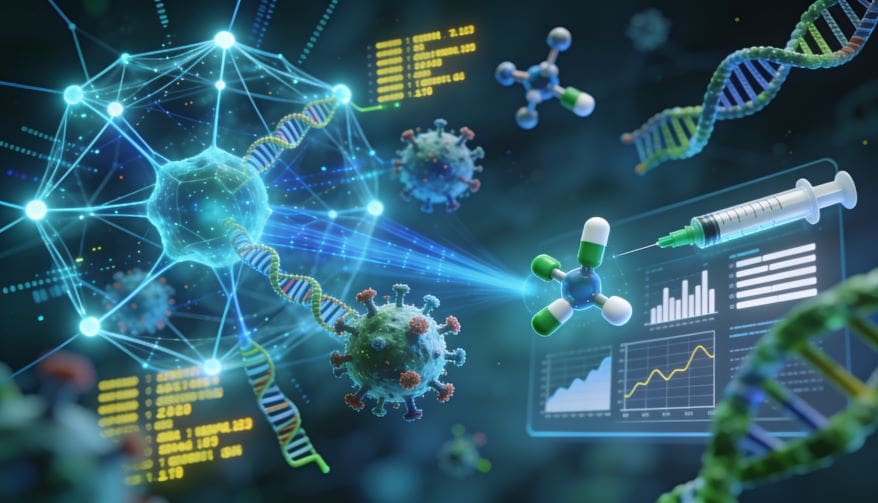
Imagine your body as a fortress. Every vaccine you take sends soldiers inside to train your immune army. But here is the problem. Most vaccines need a chemical helper — called an adjuvant — to make that training strong enough. Some of those chemicals cause side effects. They are hard to make. They do not always work the same in every person. Now, a bold new hypothesis published in 2026 says artificial intelligence could replace those chemicals entirely. At first, this idea sounds impossible. Provided that AI can design smarter antigens, your immune system may not need the chemical helper at all.
Key Takeaways
Prior to reading further, here is what you need to know at a glance:
- An AI vaccine uses machine learning to design antigens that are powerful on their own.
- Classical adjuvants boost immunity but come with side effects and manufacturing problems.
- A 2026 hypothesis proposes that AI-designed antigens could gradually replace adjuvants.
- Tools like AlphaFold already predict protein shapes with near-experimental accuracy.
What Are Adjuvants — And Why Does Your Body Need Them?
Before we get into AI, let us cover what you may have learned in Class 11 Biology. When you get a vaccine, your body receives an antigen — a small piece of a pathogen. Your immune system then learns to recognize it.
The problem? Antigens alone are often too weak. They do not trigger a strong enough immune response. So, scientists add adjuvants. Think of adjuvants as the alarm bells that wake up your immune system.
Classical Adjuvants: The Old Guards
Common adjuvants include:
- Alum (aluminum salts): Used in vaccines for decades. Triggers inflammation at the injection site.
- Oil-in-water emulsions: Found in flu vaccines. Stimulates a stronger immune response.
- Toll-like receptor agonists: Mimic bacterial signals. Alert the immune system to danger.
While it may be true that adjuvants work, they come with real problems:
- They can cause redness and swelling at the injection site.
- They respond differently across species, making animal testing tricky.
- They are complex and expensive to manufacture.
- Regulatory approval takes a long time.
All in all, classical adjuvants have done a great job. But they are not perfect. That is where AI steps in.
How an AI Vaccine Could Change Everything

Artificial intelligence and core subfields such as machine learning are now transforming vaccine design. AI enhances antigen engineering, delivery system optimization, immunogenicity modeling, and in silico screening of novel immune potentiators.
To explain what this means for you: AI does not replace scientists. Instead, it acts like a super-powerful calculator. It analyzes millions of protein sequences and immune system data points at once. After that, it suggests the best possible antigen design.
The Big Hypothesis: AI as the New Adjuvant
A 2026 paper by Jose G. Marchan-Alvarez from Karolinska Institutet proposes a speculative yet testable hypothesis: AI-guided antigen design may progressively replace the bioactive properties of classical adjuvants.
To put it differently: instead of adding a chemical booster to a weak antigen, you design an antigen that is already powerful. The AI builds the alarm bell right into the soldier.
By embedding adjuvant-like functions directly into computationally designed antigens, AI-designed vaccines could replicate or even exceed the mechanistic roles of traditional adjuvants.
This is not science fiction. It is a testable scientific hypothesis — and that is exactly the kind of thinking you practice in your science labs.
Also Read: Magic Mushroom Brain Effect
What AI Tools Are Being Used?
To list the key tools scientists currently use in AI vaccine design:
- AlphaFold: AI models such as AlphaFold have the potential to transform every aspect of vaccine development, from discovery to clinical development, manufacturing, and regulatory processes.
- Machine learning algorithms: These scan genomic databases to find the best antigens.
- Deep learning models: These predict how an immune cell will react to a given protein shape.
- In silico immune simulations: These run virtual experiments before any lab work begins.
What’s more, AI has enhanced clinical trial design and execution. AI-driven bioinformatics platforms provide real-time data interpretation, improving patient stratification and enabling more precise monitoring of adverse events during trials.
FAQs
Q1: What exactly is an AI vaccine?
An AI vaccine is a vaccine whose components — especially the antigen — are designed using artificial intelligence. AI tools analyze large biological datasets to create antigens that are highly immunogenic, meaning they trigger a strong immune response, without necessarily needing a chemical adjuvant.
Q2: Will AI vaccines actually replace current vaccines?
Not immediately. The 2026 hypothesis proposes a gradual replacement — starting with augmentation and moving toward full substitution over time. Provided that more research confirms the safety and effectiveness of AI-designed antigens, traditional adjuvants could become optional.
References
- Marchan-Alvarez, J. G. (2026). Could artificial intelligence gradually replace classical adjuvants? Frontiers in Immunology. https://doi.org/10.3389/fimmu.2026.1710109
- Elfatimi, E., Lekbach, Y., Prakash, S., & BenMohamed, L. (2025). Artificial intelligence and machine learning in the development of vaccines and immunotherapeutics — yesterday, today, and tomorrow. Frontiers in Artificial Intelligence. https://doi.org/10.3389/frai.2025.1620572
- https://www.openaccessgovernment.org/ai-designed-universal-vaccine-candidate-passes-first-human-trial/210199/
- Author
- Latest Posts

I am an inspirational writer and emerging science blogger with a deep-rooted passion for understanding and sharing the wonders of the world around us. My journey began with a Bachelor of Science in Chemistry from AKI’s Poona College of Arts, Commerce and Science, where I developed not only a strong foundation in scientific principles but also a mindset that values curiosity, observation, and critical thinking. Studying chemistry has taught me to approach problems with logic, to look beyond the obvious, and to see patterns where others might only see complexity. These experiences have shaped the way I perceive life and influence the way I express my thoughts, both scientifically and creatively.
I have always believed that knowledge is only as powerful as the way it is shared. This belief has guided me to create content that bridges the gap between science and everyday life. I aim to simplify complex scientific ideas so they become approachable, relatable, and engaging for everyone—whether someone has a formal background in science or is simply curious about the world. Science, in my view, is not confined to textbooks and laboratories; it is a way of thinking, understanding, and connecting with the world around us. By making science accessible, I hope to inspire curiosity, ignite learning, and encourage people to see the beauty and relevance of scientific discovery in their daily lives.
Alongside my love for science, I am deeply passionate about motivational writing. I believe words carry the power to transform perspectives, encourage self-reflection, and inspire action. By combining analytical thinking with creativity, I create content that is intellectually stimulating yet emotionally resonant. Whether I am breaking down a chemical concept, exploring a scientific phenomenon, or crafting motivational narratives, my goal is to communicate ideas in a way that is clear, meaningful, and impactful.
Through my work, I strive to empower my readers – not just by helping them understand the science around them, but by inspiring them to grow, learn, and realize their full potential. Every article, post, or story I write reflects my commitment to turning knowledge into inspiration. I want to spark curiosity, encourage self-improvement, and show that learning and personal growth are deeply connected. For me, writing is not just a craft; it is a way to touch minds, connect hearts, and make ideas come alive in a way that truly resonates.