The nervous system performs critical functions necessary for organism survival, including cognitive processing, sensory perception, and voluntary and involuntary movement coordination. Medical professionals...
Nervous System: Understanding the Body’s Control Centre
Estimated reading time: 6 minutes
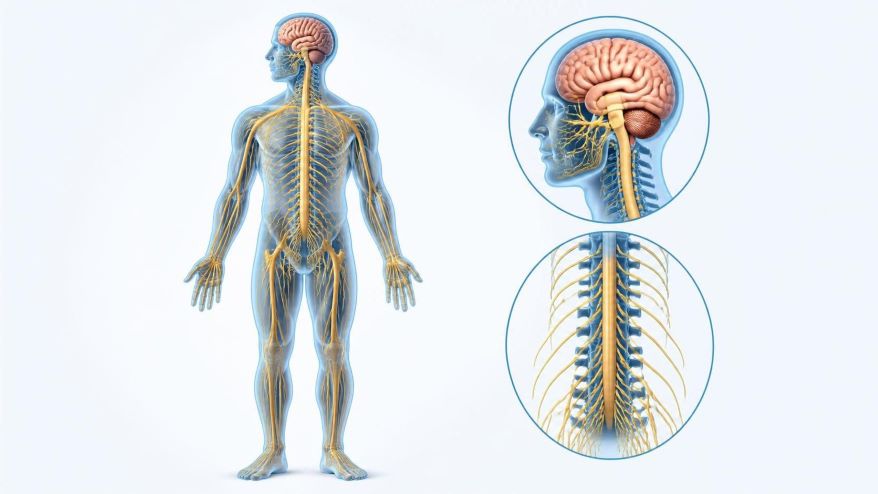
Your brain holds about 86 billion neurones. Each neurone talks to thousands of others. Together they form the nervous system, your body’s command centre. This network controls every thought, breath, and heartbeat. It lets you read these words right now. It also reacts faster than you can blink. A single reflex can fire in milliseconds. Scientists call it the body’s major controlling system. It watches your world all day and night. It never truly powers down. Signals race along its pathways at lightning speed. In short, it runs the whole show. This guide explains how the nervous system works. You will meet its parts, cells, and signals. You will also learn how to keep it strong.
Key Takeaways
- First, the nervous system senses, integrates, and responds to changes in the internal and external environment. As a result, it helps the body coordinate appropriate responses.
- Next, It is divided into two major parts: the central nervous system (CNS) and the peripheral nervous system (PNS). Together, these divisions coordinate communication between the brain, spinal cord, and the rest of the body.
- Furthermore, neurones transmit messages through coordinated electrical and chemical signals. Consequently, these signals allow information to travel rapidly through it
- In addition, the brain contains four major lobes, each with specialised functions. For example, the frontal, parietal, temporal, and occipital lobes work together to control movement, sensation, memory, hearing, and vision.
- Finally, healthy lifestyle habits can support brain function. For instance, adequate sleep, nutritious food, and regular exercise contribute to overall brain health. Therefore, maintaining these habits is important for supporting its function
The Nervous System—Your Body’s Command Centre
It acts as the body’s major control centre. It regulates and coordinates every action you take. It also sends fast messages across your body. Alongside the endocrine system, it maintains homeostasis. Homeostasis keeps your internal conditions stable. Think of your temperature and blood pressure. It monitors both all day long. Its main organs include the brain, spinal cord, nerves, and ganglia. These organs hold nerve, blood, and connective tissues. In fact, all these parts work as one team. The system performs three overlapping jobs. First, it senses changes in your world. Second, it integrates that information. Third, it triggers a response. Scientists call these the sensory, integrative, and motor functions. Each job matters for survival. Without them, you could not react to danger. You could not learn or remember either. As a result, this network shapes your entire experience.
Central Nervous System (CNS)
The central nervous system forms the core of your body’s command centre. It has two main parts: the brain and the spinal cord. The brain sits inside your skull. The spinal cord runs down your back. Both receive, integrate, and respond to sensory input. They also create motor output. This output coordinates behaviour and keeps you balanced. Your skull, meninges, and cerebrospinal fluid protect the brain. These layers shield fragile nervous tissue from harm. In short, the CNS is your processing hub. Every message you feel passes through it first.
Grey Matter vs. White Matter
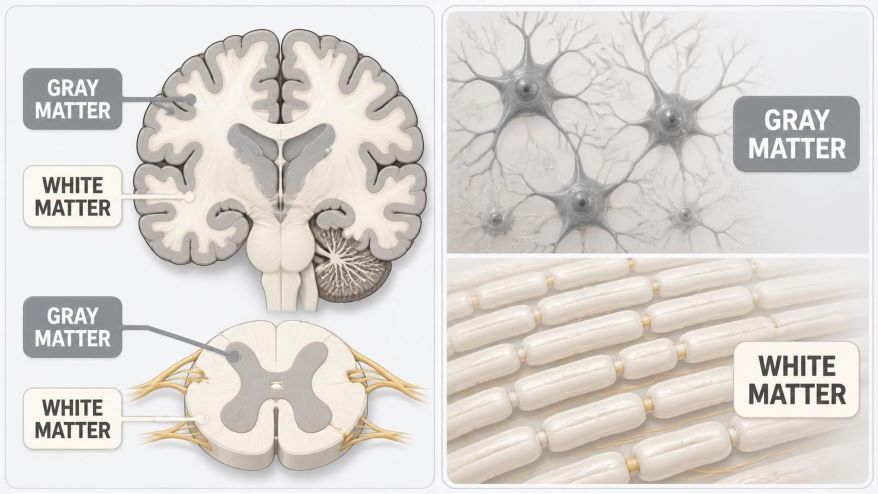
Nervous tissue consists primarily of two types of matter: grey matter and white matter. First, grey matter contains the cell bodies of neurons and plays an important role in processing information and supporting decision-making. In contrast, white matter contains mainly myelinated axons, which transmit nerve signals over longer distances. Furthermore, the arrangement of these two types of nervous tissue differs between the spinal cord and the brain. For example, in the spinal cord, white matter lies on the outside, whereas grey matter forms a characteristic butterfly-shaped region in the center. Conversely, the organization in the brain is largely reversed. Specifically, grey matter forms the outer cerebral cortex, while white matter lies deeper inside. As a result, this specialized arrangement helps organize communication pathways efficiently. Moreover, myelination allows electrical signals to travel more rapidly along axons.
Meninges and Cerebrospinal Fluid
Three layers of protective membranes surround the brain and spinal cord. These layers, known as the meninges, cushion and support the delicate nervous tissue. In addition, cerebrospinal fluid (CSF) circulates around the brain and spinal cord, providing another important layer of protection. Furthermore, CSF helps deliver nutrients, remove waste products, and absorb mechanical shocks. As a result, it helps protect the brain and spinal cord from injury caused by sudden movements or impacts.
Frequently Asked Questions
What is the nervous system?
It is a complex network of nerves and cells that transmit signals between different parts of the body. It also controls bodily functions, processes sensory information, as well as coordinates voluntary and involuntary actions.
What are the main parts of the nervous system?
The nervous system is divided into two main parts: the central nervous system (CNS), which includes the brain and spinal cord, and the peripheral nervous system (PNS), which consists of all the nerves outside the CNS.
How does the brain communicate with the rest of the body?
The brain communicates with the body through the spinal cord and also peripheral nerves. Electrical impulses travel along neurones to transmit information, enabling movement and sensation, as well as regulation of bodily functions.
What role do neurones play in the nervous system?
Neurones are specialised cells that transmit electrical and chemical signals throughout the nervous system. They are essential for processing and transmitting information within the brain as well as between the brain and body.
Can the nervous system repair itself after injury?
The nervous system has limited ability to repair itself. While some regeneration can occur, especially in the peripheral nervous system, damage to the central nervous system, such as the brain or spinal cord, is often permanent or only partially recoverable.
What is the autonomic nervous system?
The autonomic nervous system is a part of the peripheral nervous system that controls involuntary bodily functions like heart rate, digestion, and also respiratory rate. As a matter of fact, it is divided into the sympathetic and parasympathetic nervous systems, which have opposing effects.
References
Margetis, K., Reddy, V., & Singh, P. (2026). Anatomy, central nervous system. In StatPearls [Internet]. StatPearls Publishing. https://www.ncbi.nlm.nih.gov/books/NBK542179/
Bencs, V., Hortobágyi, T., Nagy, A.C. et al. Establishment of a novel human nervous system tissue bank: University of Debrecen tissue bank—introduction and retrospective data analysis. Cell Tissue Bank 27, 47 (2026). https://doi.org/10.1007/s10561-026-10249-9
- Author
- Latest Posts

I am a Master’s qualified in Science with focus on Zoology and Entomology and am a passionate, curiosity-driven science enthusiast aiming to transform complex scientific ideas in a manner that are easy to understand hence, educate, and inspire.
I have an experience of working on the projects in the field of Entomology which has provided me hands-on experience with various research techniques. Besides, I have also gained experience of lab work as well as developed communication skills during the course of my bachelors and masters.
With a strong foundation in life sciences and a growing interest in Medical and Biological research, I have cultivated a writing style that merges scientific facts with creativity.
My experience in teaching has also taught me to develop an understanding of what are the interests of people and how to communicate them effectively.
I am committed to lifelong learning, actively engaging in Interdisciplinary learning, so as to broaden my perspective.
- Author
- Latest Posts

I completed my Master of Science from the University of Allahabad in 2017 with a strong academic background in life sciences and chemistry. My specialization included Molecular Biology, Microbiology, Genetics, Plant Breeding, Phycology, Paleobotany, and Bioinformatics, along with Organic Chemistry, Inorganic Chemistry, and Physical Chemistry. This multidisciplinary training provided me with a comprehensive understanding of biological systems and analytical scientific approaches.
After completing my postgraduate studies, I gained valuable professional experience in both the education and social development sectors. I worked at A.M. Oxford Public School, where I was actively involved in guiding students toward academic excellence. In this role, I focused on creating an engaging learning environment, encouraging critical thinking, and nurturing students’ curiosity for scientific learning. My experience as an educator strengthened my communication, mentoring, and classroom management skills.
In addition to my teaching experience, I worked with Jeevan Jagriti Foundation, where I contributed to community-based initiatives aimed at improving educational access and awareness among underprivileged sections of society. Through this work, I participated in programs designed to support social development and promote the value of education in marginalized communities.
These professional experiences helped me develop strong interpersonal, leadership, and organizational skills while reinforcing my commitment to education and community service.