Plants and fungi help life on Earth. They support food, air, soil, and water. The many plants and fungi importance for healthy ecosystems are increasingly under threat. Yet many species face serious threats. Habitat loss…
Plants and Fungi Importance : State of World Plants Fungi 2026

Plants and fungi help life on Earth. They support food, air, soil, and water. The many plants and fungi importance for healthy ecosystems are increasingly under threat. Yet many species face serious threats. Habitat loss harms many plants and fungi. Climate change creates new risks. Human actions add more pressure.
To address these problems, the 2026 State of the World’s Plants and Fungi report shows new scientific tools. The report explains how artificial intelligence helps plant research. AI can sort and study large amounts of data. It can find species more quickly. It can also help predict which species face the greatest risk.
Key Takeaways
- AI helps scientists find plant species fast.
- Online records give access to many plant data.
- Climate change changes bloom times in many plants.
- New tools help find unknown plants early.
- Good data help save plants and fungi.
The Digital Biodiversity Revolution
Digital tools are changing plant and fungi importance research. In many parts of the world, scientists put collection records online. Because of this change, millions of records are easy to use. In other words, researchers can find data with less effort.
At the same time, online records help people share information. Due to this wider access, studies move ahead more quickly. On top of that, digital databases help track species over time. With the help of these tools, scientists can spot changes more easily.
Supporting Scientific Endeavours
Science helps people understand plants and fungi importance through careful study. In many parts of the world, researchers gather data from museums, herbaria, and field surveys. Because of digital records, information moves easily across institutions and countries. For this reason, scientists can study specimens without visiting collections.
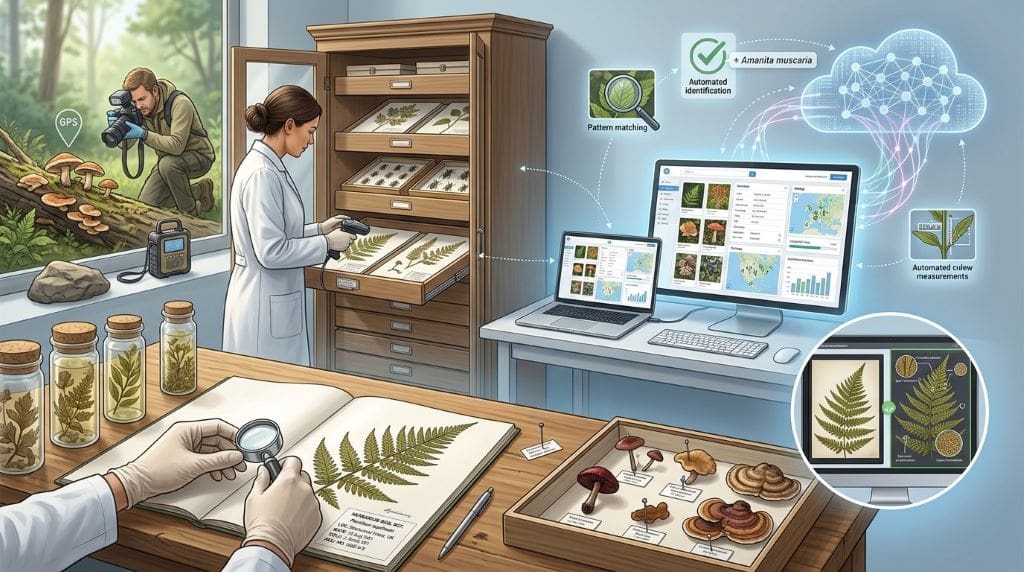
In addition to wider access, large digital collections store important biological information. Due to this growing resource, researchers can find records quickly and test ideas faster. On the other hand, very large datasets can be hard to examine by hand.
With the help of artificial intelligence, scientists can process huge amounts of data. In many cases, AI helps match species and detect unusual patterns. As a matter of fact, these tools can complete tasks much faster than manual methods given in State of the World’s Plants and Fungi
The Increasing Scope of Collections
Plant and fungi collections keep growing around the world. In many countries, collections hold dried specimens, living plants, seeds, fungi, and DNA samples. In addition to these materials, some collections store living cultures for research.
Because of wider collecting efforts, institutions gather specimens from more places. Along with professional scientists, local researchers and community groups add useful records and knowledge. Due to this broader work, collections show a better picture of global biodiversity in accordance of Plants and Fungi Importance.
With the growth of digital systems, collection records are easier to use. For this reason, millions of specimen records and images are now online. From almost any place, researchers can view data and plan studies.
Questioning the Data
In many datasets, important gaps still exist. Some plants and fungi importants species have very few records. Because of these gaps, scientists check data before they begin a study. In many cases, they review species names, locations, and collection notes.
In some parts of the world, collecting work remains limited. For this reason, remote areas often have fewer records. In comparison with well-studied regions, isolated habitats receive less attention. Due to this uneven coverage, important knowledge gaps remain for Plants and Fungi Importance.
With only a small number of samples, some rare species seem to be missing. Even so, these species may still live in the wild. On top of that, older collections reflect past collecting habits. In many cases, scientists collected more specimens near roads, towns, and cities. As a consequence, some areas have far more records than others.
With more records online, scientists can find data with ease. Because of this wider access, they can study large datasets in less time.
Even so, some online records contain mistakes. Wrong names or wrong locations can affect results. In some cases, the same record may appear more than once. Due to this problem, species counts may be too high. In addition, missing details can lower data quality.
A Novel Toolset for Plant Scientists
- In recent years, plant studies have gained new tools. These tools help people work faster and better.
- With more records online, scientists find information easily. Online records help people work across countries.
- In addition, clear pictures show small plant parts. Scientists can study samples from a distance.
- By using DNA tests, scientists tell species apart. DNA data show how species are linked.
As digital collections expand, researchers study biodiversity at scale. Because of large datasets, scientists conduct broader analyses. For this purpose, artificial intelligence processes complex information quickly. In addition, AI detects patterns within large datasets. In many cases, machine learning helps identify plant species. It also supports classification and prediction tasks. Along with AI tools, geographic information systems improve mapping for Plants and Fungi Importance. Consequently, scientists can track species distributions accurately. Overall, these tools transform biodiversity research and conservation planning
Frequently Asked Questions
Why are plants and fungi important?
Plants and fungi importants support life on Earth. They provide food, medicine, raw materials, and ecosystem services. They also help regulate climate and maintain healthy ecosystems.
How is artificial intelligence helping plant and fungal research?
Artificial intelligence helps scientists analyze large datasets quickly. It can identify species, detect patterns, estimate extinction risks, and track changes such as shifts in flowering times
What role do digital collections play in biodiversity research?
Digital collections give researchers access to millions of specimen records and images. These online resources support faster research, global collaboration, and improved conservation planning.
Reference
- Royal Botanic Gardens, Kew. (2026). State of the world’s plants and fungi 2026: The digital biodiversity revolution. https://www.kew.org/sites/default/files/2026-06/State-of-the-World-s-Plants-and-Fungi-2026.pdf
- Royal Botanic Gardens, Kew. (n.d.). State of the World’s Plants & Fungi. https://www.kew.org/science/state-of-the-worlds-plants-and-fungal
- Elkins, A. (2026, June 16). AI could help win ‘race against extinction’ of vital plants, say botanists. The Guardian. https://www.theguardian.com/environment/2026/jun/16/ai-could-help-win-race-against-extinction-of-vital-plants-say-botanists
- Author
- Latest Posts

I completed my Master of Science from the University of Allahabad in 2017 with a strong academic background in life sciences and chemistry. My specialization included Molecular Biology, Microbiology, Genetics, Plant Breeding, Phycology, Paleobotany, and Bioinformatics, along with Organic Chemistry, Inorganic Chemistry, and Physical Chemistry. This multidisciplinary training provided me with a comprehensive understanding of biological systems and analytical scientific approaches.
After completing my postgraduate studies, I gained valuable professional experience in both the education and social development sectors. I worked at A.M. Oxford Public School, where I was actively involved in guiding students toward academic excellence. In this role, I focused on creating an engaging learning environment, encouraging critical thinking, and nurturing students’ curiosity for scientific learning. My experience as an educator strengthened my communication, mentoring, and classroom management skills.
In addition to my teaching experience, I worked with Jeevan Jagriti Foundation, where I contributed to community-based initiatives aimed at improving educational access and awareness among underprivileged sections of society. Through this work, I participated in programs designed to support social development and promote the value of education in marginalized communities.
These professional experiences helped me develop strong interpersonal, leadership, and organizational skills while reinforcing my commitment to education and community service.