A six-month trial of 60 children in Korea found that a five-station robot circuit improved motor skills and balance more than standard community therapy.
A child learning to ride a bike falls, gets up, and tries again. Each attempt teaches the brain a little more. Children with cerebral palsy need that same kind of practice, but far more of it. Now a new trial tests robotic therapy for cerebral palsy in a neighborhood setting. Researchers built a “RoboGym” with five robot stations in one room. Then they compared it with standard community therapy over six months. Chaesu Kim and Sung (Joshua) H. You at Yonsei University in Korea led the study. Partners from MIT, Johns Hopkins, Burke Rehabilitation Hospital, and the NIH also joined the work. The team published its results in Scientific Reports on November 1, 2026. Its DOI is 10.1038/s41598-026-77887-7. As a result, families now have early evidence about a new way to deliver therapy.
In the trial, 60 children with cerebral palsy took part. Their average age was 10.4 years, and all of them could walk. Half trained in the robot circuit, while the other half received usual community care. Both groups, in fact, spent exactly the same time in therapy. Each child attended 90-minute sessions twice a week for six months. By the end, the robot group gained more in gross motor function. That term covers large movements like standing and walking. Their balance also improved more than in the comparison group. On top of that, parents reported better emotional and social well-being in the robot group. Every child finished the program, and nobody suffered a side effect. Still, the authors call these results preliminary. In this article, we explain how the circuit works and what its limits mean.
Why Children Need Robotic Therapy for Cerebral Palsy
Cerebral palsy, or CP, ranks as the most common physical disability of childhood. According to the CDC overview of cerebral palsy, it affects movement, balance, and posture. It starts with an injury or unusual development in the young brain. The brain injury itself does not get worse. However, its effects on muscles last for life. The paper notes that about 1.6 of every 1,000 babies have CP in wealthy countries. In low- and middle-income countries, the rate may top 3 per 1,000. On top of that, about 40% of people with CP face serious limits in walking. In other words, many children struggle to move freely. Without steady exercise, many develop pain, joint problems, and weaker hearts and lungs. For this reason, doctors stress intense, task-specific practice that matches real daily movements.
The Practice Gap in Community Clinics
Motor skills grow through repetition, so dose matters a great deal. Yet usual therapy often delivers far too little practice. The authors cite sessions with as few as 6 to 292 movement repetitions. Those numbers fall well below levels thought to reshape the brain. Community programs face even tougher limits. They often lack money, staff, and assistive technology. On the other hand, community centers sit close to home, so families can attend regularly. Robots could fill that gap because they never tire. In fact, robots can also log every movement they guide. Earlier studies tested single machines, such as walking robots or horse-riding simulators. Each device helped on its own in small trials. Until now, though, nobody had tested several robots together in one community program. That missing piece drove this new study.
How the RoboGym Trial Worked
The team ran its trial at the Yonsei Goodwellness Center in Korea. First, the researchers screened 71 children and enrolled 60 of them. A computer then split them into two equal groups of 30. Each child sat at level II or III on a standard motor scale. In simple terms, they walked but often needed support or aids. An independent assessor measured every child before and after training. That assessor, notably, did not know which group each child joined. Full methods appear in the Scientific Reports paper. In addition, the registry entry carries the number KCT0006417. Both groups followed the same skill ladder, from steady sitting to walking. Only the tools differed between them. Consequently, any extra gain likely came from the robot circuit itself.
Five Robot Stations in One Circuit
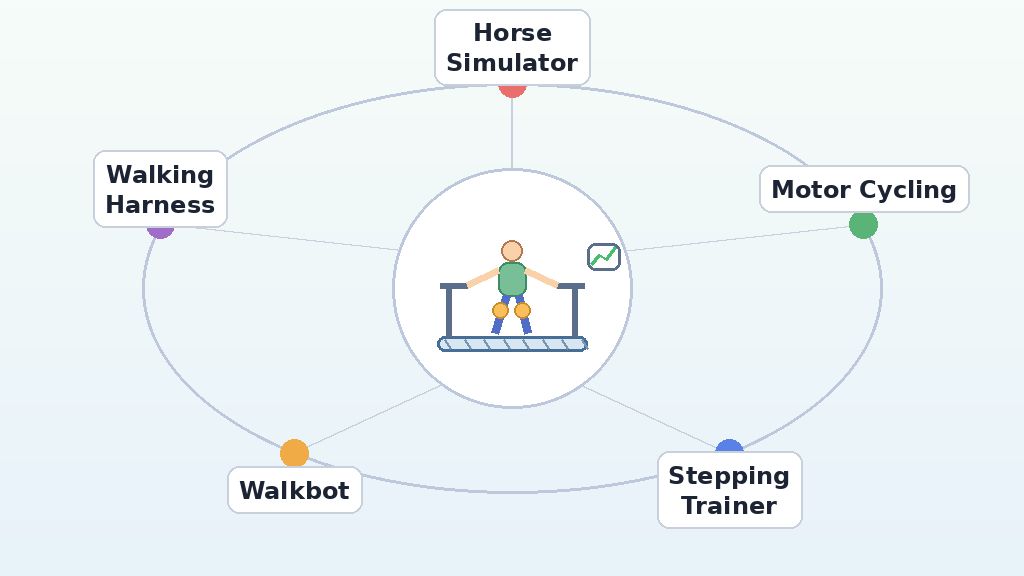
Inside the gym, children rotated through five stations in a fixed order. To begin with, a robotic horse-riding simulator trained trunk and posture control. Next, a motorized cycle moved arms and legs in an alternating rhythm. A third machine guided reciprocal arm and leg stepping. After that, the Walkbot robot moved the legs through repeated walking cycles. Finally, an overhead harness let children practice walking on open floor. Real-time sensors showed therapists how well each child moved. Therapists also tracked effort with a standard exertion rating. In this way, sessions stayed hard but safe. Meanwhile, the usual-care group trained with hands-on therapy and no robots. The authors estimate that robot sessions delivered 2,000 to 3,000 stepping repetitions each. Those figures, however, come from protocol settings rather than device logs.
Motor Gains From Robotic Therapy for Cerebral Palsy
The main test, called the GMFM-66, scores how children sit, kneel, stand, and walk. In the robot group, scores rose from 46.9 to 52.0 points. That jump equals about 10.9%. By contrast, the usual-care group moved only from 48.1 to 49.6 points. The difference between groups reached statistical significance, with a p-value of 0.048. Even so, that value sits close to the usual cutoff. Its biggest gains, in particular, came in crawling, kneeling, walking, running, and jumping. Children also beat their expected growth curve. On average, the robot group climbed from the 36th to the 48th percentile. Meanwhile, the usual-care group shifted only from the 38th to the 42nd percentile. Half of the robot group passed the threshold for real, measurable change. In the usual-care group, only 17% did.
Fig. 1: Key Results From the 60-Child RoboGym Trial
Balance, Mood and Friendships
Balance scores told a similar story. Children in the robot group improved by 5.6 points, or 19.4%. The usual-care group, in comparison, gained just 2.1 points. More than half of the robot group passed the balance change threshold. Only 27% of the other group did. Quality-of-life surveys also favored the robots in two areas. Children in the circuit showed better emotional functioning and social functioning. However, physical and school scores did not differ clearly between groups. Daily independence scores rose more with robots, too. Still, that difference fell short of statistical significance. The authors label the balance and mood results exploratory. They did not adjust those extra tests for multiple statistical comparisons across outcomes. For this reason, readers should treat these findings as clues rather than proof.
Explainer: How Robot-Assisted Therapy Builds Movement Skills
The brain changes its wiring through practice. Scientists call this ability neuroplasticity. Each repeated step strengthens links between nerve cells that control the legs. Our guide to the neuroscience of rehabilitation explains this process in detail. Robots help in three main ways. First, they repeat motions thousands of times without fatigue. Second, they support body weight, so children can practice before they walk well alone. Third, sensors give instant feedback on each movement. Not only does that feedback guide therapists, but it also keeps children engaged. The five stations here follow a clear order. They move from trunk control to cycling, then stepping, then free walking. As a result, each station prepares the body for the next one. In short, the circuit builds skills step by step, much like a ladder.
Measuring Robot Gym Gains Against Normal Growth
Children with CP keep gaining skills as they grow, even with ordinary care. That natural growth can make any treatment look better than it really is. So the team compared each child with expected progress for similar children. They used published reference centiles, which work like growth charts for motor skills. From these charts, they calculated an individual effect size for every child. A score above 0.8 counts as large. The robot group averaged 1.14, a large effect beyond normal growth. In contrast to that, the usual-care group averaged 0.29. That small value fits what ordinary development would predict. As a result of this method, the gains look real rather than simple maturity. The charts, in other words, act as a fair yardstick. Put simply, they separate therapy gains from growth.
Fig. 2: How the Five Robot Stations Build Movement
Challenges and Motivation Behind the Korean Trial
The researchers set out to solve a dose problem. Children with CP need many repetitions, yet clinics rarely deliver them. Meanwhile, families struggle to reach hospitals for daily therapy. Hence the team built a circuit that fits a community center twice a week. That design asks for neither hospital equipment nor daily trips. Our feature on emerging gait rehabilitation technologies covers many of the tools involved. Running the trial brought its own hurdles. For example, the two programs looked different, so therapists and families knew their group. Only the outcome assessor stayed blind to group assignment. Missed sessions also needed rescheduling within the same week. Thanks to that effort, every child completed all 48 sessions. The attendance record therefore stayed complete for both groups. Above all, that full attendance strengthens trust in the results.
Limits the Researchers Report
The authors list several clear limits. To start, the trial ran at one center with 60 children. All participants sat at motor levels II or III. So the results may not apply to children with milder or more severe CP. Second, the circuit ran as one package. For this reason, nobody can yet say which station helped most. Third, the study measured no brain scans or detailed motion data. Fourth, the team tested children only before and after six months. That design leaves the long-term effect unknown. On top of this, key p-values sat just below the 0.05 cutoff. The paper also did not report costs. In the end, price will shape whether clinics adopt such gyms. Above all, the authors call for larger multicenter trials before anyone claims clear superiority.
Conclusion: What Comes Next for Robot-Assisted Rehabilitation
This trial offers early support for robotic therapy for cerebral palsy in community settings. A five-station robot gym improved motor function more than usual care over six months. Balance and some quality-of-life scores also leaned in its favor. Even so, the evidence remains preliminary, and bigger studies must follow. Future trials should test other motor levels, longer follow-up, and individual stations. They should also track costs, which this study did not measure. If those trials succeed, community robot gyms could reach many more families. Such centers would need engineers, therapists, and data analysts working together. At the same time, students can play a part. Our list of biomedical engineering career opportunities shows where students can start. Ultimately, more practice for every child stands as the clear goal behind robotic rehabilitation.
References
Kim, C., Krebs, H. I., Chung, T., Oh-Park, M., Hallett, M., Choi, J., Kim, H. S., & You, S. H. (2026). Community-based RoboGym training improves gross motor function in ambulatory children with cerebral palsy. Scientific Reports. Advance online publication. https://doi.org/10.1038/s41598-026-77887-7
I checked the brief against the Article in Press PDF. The design matches the paper: a 1:1 randomized trial of 60 children with CP (mean age 10.4 ± 1.4 years, GMFCS II-III), 90-minute sessions twice weekly for 6 months, five robotic modalities, and a blinded outcome assessor. The figures are correct: GMFM-66 Time × Group p = 0.048, percentile 36th to 48th, iES 1.14 versus 0.29, PBS p = 0.048, PedsQL emotional p = 0.039 and social p = 0.015, FIM p = 0.065 not significant, responders 37-63% versus 17-27%, and no adverse events. The 6-292 repetitions figure is the authors' cited background, and the brief presents it that way. The brief keeps the authors' own limitations (single center, unblinded participants, exploratory secondary outcomes, no cost or per-station data). Verdict: accurate; no corrections needed.
Editorial note
ENTECH runs this story because it shows robots leaving the lab and the hospital to work in an ordinary community center, with a randomized trial behind them. Children with cerebral palsy who trained on a five-station robotic circuit twice a week for six months improved their gross motor function more than children in standard community therapy. For teens, it connects robotics, biomedical engineering and physical therapy, fields where demand for rehab technology is growing. The caveats: one center, 60 children, no blinding of families or therapists, no cost data, and several secondary results the authors themselves call exploratory. Takeaway: robots can raise the amount of practice kids get, and that practice seems to pay off.
Ishika Tawar is a biotechnology researcher and science enthusiast with a curiosity for understanding how life works at the molecular and cellular level. That curiosity started somewhere around school, wandered through a lot of unrelated corners of science and physics, and eventually settled on something she actually wants to spend her life on: aging and longevity. She supports transhumanism and believes that science and technology should be explored seriously as tools to overcome some of the biological limitations of the human body.
Ishika holds a Master's degree in Biotechnology and has experience in both wet-lab and computational research. At ACTREC, she worked on a project studying the interaction of the TG2 protein with the ribosome, where she gained experience in cloning, site-directed mutagenesis, transformation, and gene knockdown. She was also involved in studying ribosomal heterogeneity using R and publicly available single-cell RNA sequencing datasets from different cancers. As a Research Assistant at SafeWright, she worked on client-based projects involving microbial culturing, biochemical tests, and analysis, along with literature research, report writing, and preparation of laboratory protocols. She has also worked with Python-based analysis to study differential DNA methylation in breast cancer.
Her current areas of interest include epigenetics, genomics, gene therapy, stem cell biology, computational biology, and the use of AI in biological research. She is particularly interested in how these areas can contribute to understanding aging and developing ways to extend healthy human lifespan. She has explored this interest through research projects and hackathons focused on AI, aging, and longevity. She enjoys following ideas across biology, technology and physics, and she believes in evidence, questioning ideas and staying curious about things that are not yet understood.
Outside research, Ishika enjoys reading and talking about science and scientific ideas. She loves travelling and is especially fond of mountains. She also enjoys science communication and hopes to make scientific topics easier to understand without making them inaccurate or oversimplified.