With thousands of new satellites orbiting Earth, the night sky is getting crowded. Scientists fear this growth could interfere with space telescope research.
15,000+ Satellite Constellations Threaten Space Observations
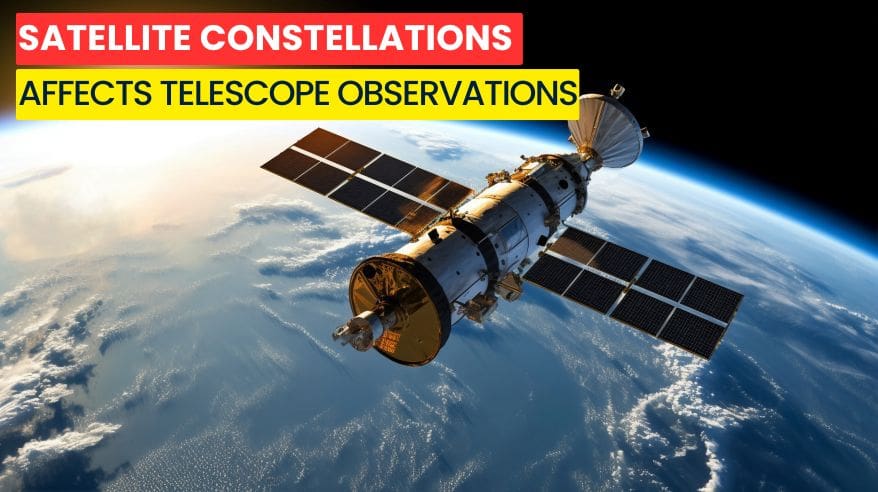
Satellite Constellations Threaten Space Telescope Observations as artificial satellites orbiting Earth have grown from 15,000 in 2025 to predictions of over 500,000 by the late 2030s. This explosive increase stems from reduced launch costs and next-generation heavy rockets like Starship and New Glenn. As these mega-constellations become reality, they create a rising problem for space-based astronomical observations.
Impact of Satellite Constellations on Space Telescope Observations
Space Telescope images capture light from distant galaxies and stars. Unfortunately, reflected sunlight from passing satellites creates bright streaks known as satellite trails. These trails ruin exposure quality and reduce scientific value.
For instance, the Hubble Space Telescope, already affected by satellite interference, shows trail-contaminated images in about 4.3% of exposures between 2018 and 2021. As the number of satellites grows exponentially, this fraction will climb steeply.
Number of Satellites in Orbit Growing Fast
Before 2019, the Iridium system had the largest constellation at 75 satellites. Now, over 15,000 satellites circle Earth in Low Earth Orbit (LEO). Projects like Starlink plan to launch tens of thousands more by the late 2030s. Should all filings to the US Federal Communications Commission (FCC) proceed, Earth might hold up to half a million satellites in orbit soon.
Also Read: Explore Astronautical Engineering
LEO Constellations and Their Effects on Observation Quality
The growing constellations mostly occupy altitudes between 500 km and 700 km. These orbits overlap with many space telescopes including Hubble and upcoming projects like the Chinese Xuntian Space Telescope.
A recent study predicts that if approximately 560,000 satellites launch as planned:
- Hubble Space Telescope images could have an average of two satellite trails per exposure.
- Xuntian Telescope, designed for deep-sky surveys, might see up to ninety trails per image.
- Ninety-six percent or more exposures on new space telescopes will show at least one trail.
The sheer number drastically reduces clean observation time for astronomers worldwide.
Failed Mitigation Attempts So Far
Makers have tried reducing satellite brightness using dark coatings or optical shields. However:
- Tweaks only lowered visible magnitudes slightly—satellites remain bright enough to disrupt observations.
- Larger solar panels on newer telecom satellites increase reflected light instead of reducing it.
- Telescope downtime during twilight avoids some trails but restricts key observation windows necessary for asteroid tracking and other research.
As artificial satellite counts reach into hundreds of thousands, contamination risks threaten decades worth of astronomical data. – Research published in Nature News
Also Read: Ocean Water Found on Mars!
Satellite Constellations Threaten Space Telescope Observations: A Future at Risk
The increasing clutter across all orbital altitudes severely threatens both ground-based and space infrared observations alike. This problem calls for cooperative efforts among regulators, industry leaders, scientists, and engineers globally to manage satellites sustainably.
In conclusion, while satellite megaconstellations bring immense connectivity benefits worldwide, astronomers must now innovate to protect our window into the cosmos.
Additionally, to stay updated with the latest developments in STEM research, visit ENTECH Online. Basically, this is our digital magazine for science, technology, engineering, and mathematics. Also, at ENTECH Online, you’ll find a wealth of information.
Reference: Satellite Constellations Threaten Space Telescope Observations
- Borlaff, A. S., Marcum, P. M., & Howell, S. B. (2025). Satellite megaconstellations will threaten space-based astronomy. Nature. https://doi.org/10.1038/s41586-025-09759-5
- Author
- Latest Posts

Ashwini Kshirsagar holds a graduate degree in Chemistry and a postgraduate degree in Environmental Science from Shivaji University, Kolhapur. With a strong foundation in scientific principles and a creative flair, she blends her expertise in environmental science with skills in technical writing, graphic design, and video editing. Proficient in Adobe software, Ashwini excels at transforming complex scientific concepts into clear, engaging, and visually compelling content. Her unique ability to merge science and storytelling allows her to create impactful communication materials that are both informative and accessible to a wide audience.