Although closely related, space engineering vs aerospace engineering have distinct focuses. Both fields involve designing and managing vehicles and technology that fly or travel in space. Aerospace engineering covers both airplanes and spacecraft, while space…
Space Engineering vs Aerospace Engineering: 7 Critical Differences That Determine Your Career
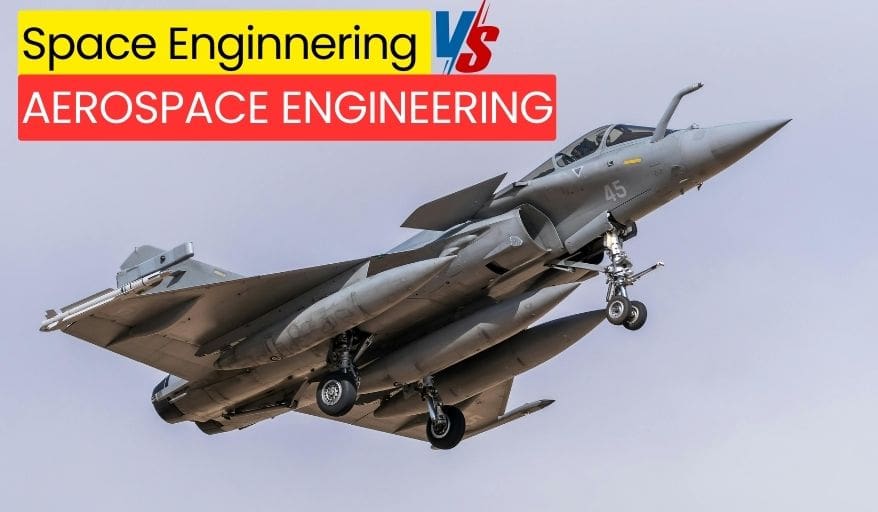
Although closely related, space engineering vs aerospace engineering have distinct focuses. Both fields involve designing and managing vehicles and technology that fly or travel in space. Aerospace engineering covers both airplanes and spacecraft, while space engineering focuses on vehicles and technology used beyond Earth’s atmosphere. Examples of space engineering include rockets and satellites.
Despite their distinct areas of focus, space engineering vs aerospace engineering share a close relationship. Aerospace engineering is mostly about making planes and spacecraft that can fly in the air on Earth. It focuses on things like the vehicle’s structure, aerodynamics, propulsion, and materials. Space engineering focuses on the unique challenges of exploring space. The field includes satellites, missions to other planets, and orbital mechanics. As space exploration grows, it is increasingly important to understand the main differences between space engineering vs aerospace engineering. Such knowledge will help us make new technologies and carry out successful missions.
This article wants to explain the main differences and connections between space engineering vs aerospace engineering. It will look at the problems they face and how they solve them. It will also show how both fields work together to move science and technology forward today. By showing what makes each field special, we can better understand how they help us improve flying and exploring. Together, they shape the future of travel, communication, and how we learn about space.
Key Takeaway
- Space engineering vs aerospace engineering are two different but related fields of engineering. Aerospace engineering covers a wider range of things, including flying machines that work both in space and on Earth. Aerospace engineers design everything from planes to spacecraft that can fly in space.
- Space engineers, on the other hand, focus on the problems that come with working in space, like how to propel things in a vacuum, how to protect astronauts from heat, and how to keep them alive. Space engineering is all about how things work in space, while aerospace engineering is all about how things work in the atmosphere, like aerodynamics, structural strength, and performance optimization.
Defining Space Engineering vs Aerospace Engineering
Both space engineering vs aerospace engineering involve designing, building, and testing advanced vehicles and systems. However, space engineering is more focused on spacecraft and technologies that work outside of Earth’s atmosphere. Space engineers have to deal with problems that are unique to their field, such as the vacuum of space, harmful radiation, and very hot and cold temperatures. Aerospace engineering usually deals with aircraft and atmospheric flight systems, but their job is to make sure that space missions stay safe and reliable even when things are rough.
Also Read: An Introduction to Aerospace Engineering for Beginners
Space engineering vs aerospace engineering both use the same basic engineering ideas, but they work in different settings. Aerospace engineering is the study of flight both in space and in the atmosphere of the Earth. It uses knowledge of materials, aerodynamics, and structural design to make planes and spacecraft. Aerospace engineers work on things like commercial and military planes, rockets, and satellites. Their goal is to make these vehicles safe, efficient, and new. Space and aerospace engineers have some of the same basic skills, but they deal with different problems that are unique to their fields.
Also read: Exploring the Future with Astronautical Engineering
Key Skills Required in Both
Both space engineering vs aerospace engineering need a strong base in basic engineering rules. It is critical to know a lot about math and physics. These fields use complicated math and models to ensure that designs are safe and work as they should. Engineers in both fields also need to understand materials science so they can choose materials that can handle tough conditions. To tackle the various challenges each field encounters, one must possess strong problem-solving and thinking skills.
Space engineering vs aerospace engineering require good communication and the ability to work well with others. Most projects in these areas need teams of experts from different fields. Engineers need to be able to explain complicated technical ideas to both experts and people who don’t know much about the topic. They also need to be able to manage their time, money, and other resources well in order to do their jobs well. To keep projects on track and safe, it’s also important to follow the rules, standards, and best practices of the industry.
Also read: The Top 14 Aerospace Engineering Subjects to Learn
Explore the essential skills needed for success in space engineering vs aerospace engineering careers.
It is becoming more and more important to know how to use software tools for design and simulation in both space engineering and aerospace engineering. Technology keeps changing engineering, and professionals who know how to use tools like CAD and finite element analysis, as well as programming and data analysis skills, can plan and test complex systems better.
In these fields that change quickly, you also need to be flexible and willing to learn new things for the rest of your life. Engineers need to keep up with the latest technologies and problems so they can stay useful and effective. For projects to be safe and successful, it’s also important to know and follow the rules and best practices of the industry. By honing these skills, engineers in space engineering vs aerospace engineering can handle more difficult tasks and move both aerospace development and space exploration forward..
Also Read: https://entechonline.com/understanding-the-basics-of-thermodynamics-for-beginners/
Educational Pathways for Engineers
Aspiring engineers interested in space engineering vs aerospace engineering can follow a variety of educational paths, starting with a bachelor’s degree in engineering from an accredited institution. This foundational education covers key concepts in mathematics, physics, and engineering design while providing hands-on experience through labs and projects. Pursuing a master’s or Ph.D. can deepen expertise, open opportunities for specialized roles, enable advanced research, and prepare individuals to become leaders in either space or aerospace engineering.
Internships provide valuable real-world experience in both space engineering vs aerospace engineering, allowing students to apply the knowledge they’ve gained in the classroom to practical projects. Also, getting professional certifications and joining engineering groups that are relevant to your field can make your credentials stronger, help you meet more people in your field, and open up job opportunities in either field.
Review the educational requirements and degree options for aspiring space engineering vs. aerospace engineering professionals.
Students who want to work in space engineering vs aerospace engineering need to learn things that are specific to each field. This often includes classes in propulsion systems, orbital mechanics, and spacecraft design for space engineering. If you want to work in aerospace engineering, you need to know a lot about aerodynamics and materials science. A lot of colleges and universities have programs that cover both areas, which lets students look into a lot of different subjects and career options.
Taking part in student projects or contests, like rocketry teams or design challenges, is a great way to learn how to work with others and use your skills in real life. Students can do research on new problems and ideas in space and aerospace engineering thanks to partnerships between universities, businesses, and the government. Overall, people who want to be space engineers vs aerospace engineers do well when they combine good grades, hands-on experience, and specialized training.
Career Opportunities in Each Field
There are a lot of jobs in space engineering vs aerospace engineering that fit a wide range of skills and interests. People who work in space engineering can work for the government, like NASA, or for private companies that study satellites, space exploration, and planetary science. They may work on designing spacecraft, planning missions, and systems engineering, which all help make technologies that help us learn more about the universe. On the other hand, aerospace engineering jobs often involve designing and improving aircraft, spacecraft, and related systems in both the commercial and defense sectors. This shows how these two fields are similar but also different.
On the other hand, the aerospace industry has a lot of job openings in aviation, defense, and making commercial and military aircraft. Aerospace engineers can work on designing and testing systems for planes, making them safer and more fuel-efficient, or moving the field of unmanned aerial vehicles (UAVs) forward. They might also work in regulatory compliance and quality assurance to make sure that aerospace products meet strict safety standards.
Space engineering, on the other hand, is mostly about spacecraft, satellites, and exploration missions. It usually requires knowledge of propulsion, orbital mechanics, and space systems. Both aerospace engineering vs space engineering benefit from ongoing technological advancements and new ideas. This means that skilled engineers and scientists are needed to shape the future of air and space travel.
Investigate various career paths within the space engineering vs aerospace engineering industries.
It is critical that both space engineering vs aerospace engineering products meet strict safety and performance standards. Engineers in aerospace engineering can explore advanced materials to create aircraft components that are strong yet lightweight, while also conducting research and development on emerging technologies such as electric propulsion or hypersonic travel. Similarly, space engineers work on cutting-edge materials and technologies for spacecraft, satellites, and space exploration systems. Innovations in both fields have the potential to transform the future of air and space travel..
Space engineering vs aerospace engineering both have jobs that require people to work with people from other fields, such as data analysis, software development, and project management. This integration lets professionals use their skills in artificial intelligence, simulations, and systems integration to solve hard problems. As more people want eco-friendly and efficient transportation, job openings in both fields keep growing, giving people plenty of room to grow and specialize. Space engineering vs aerospace engineering are both exciting and rewarding careers for people who love engineering and coming up with new ideas.
Future Trends in Engineering Disciplines

The field of engineering is changing quickly because of new technologies and a growing focus on sustainability. This is true for both space engineering vs aerospace engineering. New technologies like artificial intelligence and machine learning are changing how things are designed and making operations more efficient in both fields. Engineers in space and aerospace are better able to improve performance and lower the lifecycle costs of products and systems thanks to the growing use of digital twins and predictive analytics. Also, additive manufacturing methods like 3D printing are making it possible to make complex, one-of-a-kind designs that were not possible before. This is pushing the limits of traditional engineering methods in both space and aerospace engineering.
Additionally, The focus on sustainability is changing the priorities in space engineering vs aerospace engineering. There is a strong focus on using green materials, integrating renewable energy, and finding ways to cut down on waste.
It is more common for engineers in both disciplines to be asked to develop novel concepts. This is a result of problems like resource scarcity and climate change. As a result, engineers have to collaborate with lawmakers, municipal planners, and environmental scientists.
When they work together, they create better systems and stronger structures. People in space and aerospace engineering must be open to learning and adapting in order to stay up with these changes. This enables kids to prosper in a world that is changing quickly.
Examine emerging technologies and trends shaping the future of space and aerospace engineering
New ideas in space engineering vs aerospace engineering are pushing the limits of technology and exploration. Space missions are being advanced by new technologies in space engineering, such as reusable launch vehicles and satellite servicing in orbit. New engines, like electric and hybrid ones, are used by businesses to improve the efficiency and cleanliness of space travel. Concurrently, the use of CubeSats and small satellites is expanding. This facilitates access to space for a large number of people, enabling more organizations to participate in space technology and research.
Private aerospace firms and government space organizations are collaborating more. Both space engineering and aerospace engineering are advancing more quickly as a result of this collaboration. This has led to many projects aimed at making a permanent human presence on the Moon and Mars. As these technologies improve, they will have a huge effect on satellite communications, planetary exploration, and even space tourism. This points to a future where things that were once thought to be impossible become real.
To sum up, both aerospace and space engineering begin with the fundamentals of flight and vehicle design. They do, however, concentrate on various fields and competencies.
Space exploration and technology are the focus of space engineering. This covers the design of satellites and spacecraft as well as working in the vacuum of space.
The scope of aerospace engineering is broader. It includes aircraft and launch vehicle design as well as flying in the air and in space.
Future engineers and industry professionals should be aware of the distinctions and similarities as both disciplines expand.
FAQs
What are the primary differences in focus and application between space engineering and aerospace engineering?
Space engineering is primarily concerned with spacecraft propulsion, space object motion, and space mission planning. Space and air travel are both included in aerospace engineering. It deals with spacecraft and aircraft design. This involves researching materials, engines, and aerodynamics for both space and the air. Aerospace engineering includes space engineering. All forms of flight are covered by aerospace engineering. Flying both inside and outside of Earth’s atmosphere falls under this category.
How do the educational requirements and skill sets differ for professionals in space engineering compared to those in aerospace engineering?
The design, construction, and operation of spacecraft and satellites are the main topics of space engineering. It requires an understanding of rocket engines, space conditions, and how objects move in space. Individuals in this area are frequently well knowledgeable about space missions and hold advanced degrees in aerospace or space engineering.
Spacecraft and aero planes are both included in aerospace engineering. It calls for more comprehensive knowledge of materials, air and fluid movement, and the construction of sturdy structures. Although they may not just work on space projects, aerospace engineers require a strong foundation in math and physics.
Both professions require teamwork, strong problem-solving abilities, and familiarity with engineering software.
What special difficulties do space engineers face that aerospace engineers who work on atmospheric flight do not usually face?
Space engineers face unique challenges such as designing for extreme conditions in vacuum, radiation exposure, and temperature fluctuations. They must ensurespacecraft can operate without atmospheric support, requiring advanced thermal control and propulsion systems. They also have to deal with long missions, which require dependable life support and autonomous systems because communication is slow. Launch and orbital dynamics introduce complexities like microgravity effects on materials and structures. Space missions are typically more expensive and risky. For long-term profitability and safety, they require fresh concepts. Regular flights in the atmosphere are not the same as this.
Additionally, to stay updated with the latest developments in STEM research, visit ENTECH Online. Basically, this is our digital magazine for science, technology, engineering, and mathematics. Furthermore, at ENTECH Online, you’ll find a wealth of information.
References
- Agarwal, R. K. (2024). Grand challenges in aerospace engineering. Frontiers in Aerospace Engineering, 3. https://doi.org/10.3389/fpace.2024.1383934
- Santos, S. O. P. D. (2019). Persistence in aerospace engineering: Why students choose and leave aerospace engineering. https://www.researchgate.net/publication/368984161_Persistence_in_aerospace_engineering_Why_students_choose_and_leave_aerospace_engineering. https://doi.org/10.13140/rg.2.2.28381.90087
- Chew, P. (2023). Pioneering Tomorrow’s AI system through Aerospace Engineering: An Empirical study of the Peter Chew Method for Overcoming Error in Chat GPT. SSRN Electronic Journal. https://doi.org/10.2139/ssrn.4646033
- Author
- Latest Posts

Charudatta Pathak was a student at St. Aloysius High School in Bhusawal, established in 1874, making it one of India’s oldest convent institutions. He earned his bachelor’s degree in mechanical engineering from SSVPS College of Engineering, Dhule in 1995, demonstrating exceptional academic achievement. Thereafter, he launched his career as a CNC programmer in a toolroom. He has utilized FANUC, Deckel, Maho, and Mikron controllers to operate 2-axis and 3-axis machines for the fabrication of jigs, fixtures, dies, and molds. He commenced his career as an academic in 1996, when he assumed the role of lecturer at SSVPS College of Engineering, Dhule. Additionally, he earned his post-graduate degree in CAD/CAM from L. D. College of Engineering, Ahmedabad, in 2000, and then acquired a Ph.D. from COEP in 2011 while concurrently engaged in teaching. Until 2023, he occupied many academic roles, including lecturer, assistant professor, professor, dean, principal, director, and vice chancellor at both public and private universities throughout India. From 2008 to 2010, he served as the project lead in the CAE department of a European multinational firm. During his 28-year professional tenure, he identified a need for dependable books targeted at students in grades 8 to 12, particularly for nascent career planning. He founded ENTECH Digital Magazine, a free monthly publication available on entechonline.com and magzter.com. Teens with a strong interest in Science, Technology, Engineering, and Mathematics (STEM) who aspire to pursue careers in these fields may find ENTECH Digital Magazine beneficial.