If you pay a visit to a farm these days, you might come across some machines that would bear more resemblance to a robot laboratory than to a working farm. You might find a minuscule sensor buried in the ground. You might find a drone buzzing over a wheat field and a driverless tractor that is moving carefully in a straight line.
This is what smart agriculture technology looks like: technologies and data-processing techniques involving sensors, AI, as well as automation. In partnership, enabling farmers to produce more while using fewer resources like fuel, water, and intuition. This technology, no longer in the exploratory stages, is already quantified by the government in its annual percentage point gain in adoption and is expected to see an increase of more than doubling in global expenditures on smart farm tools over the next 10 years. Below we explore how this equipment really works, just how much impact it has already delivered, and new careers that are emerging in the smart farming space. And what STEM students might do by understanding these emerging Smart Agriculture Technologies.
Sense, Think, Act: The Tech Stack Rewiring The Field
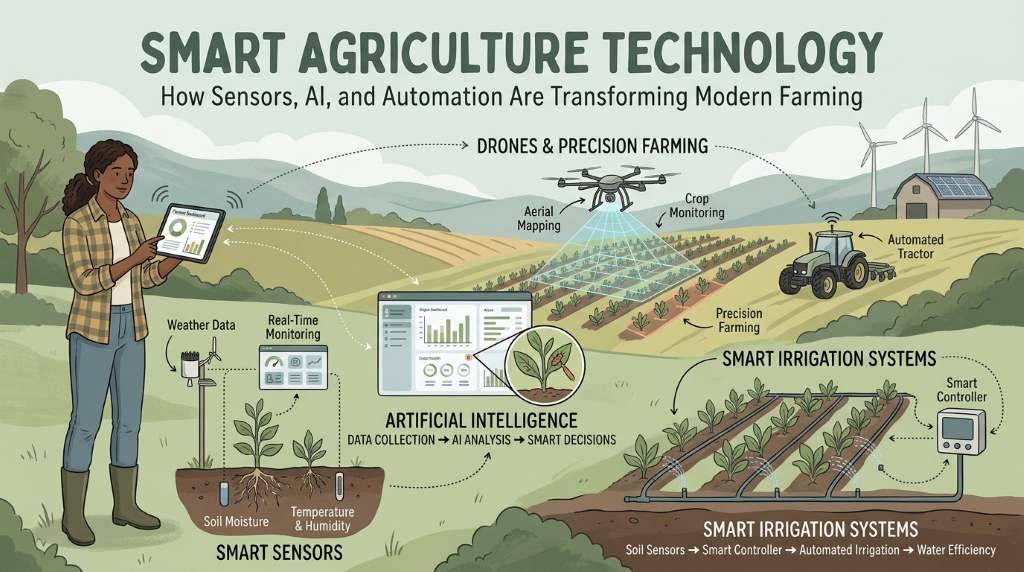
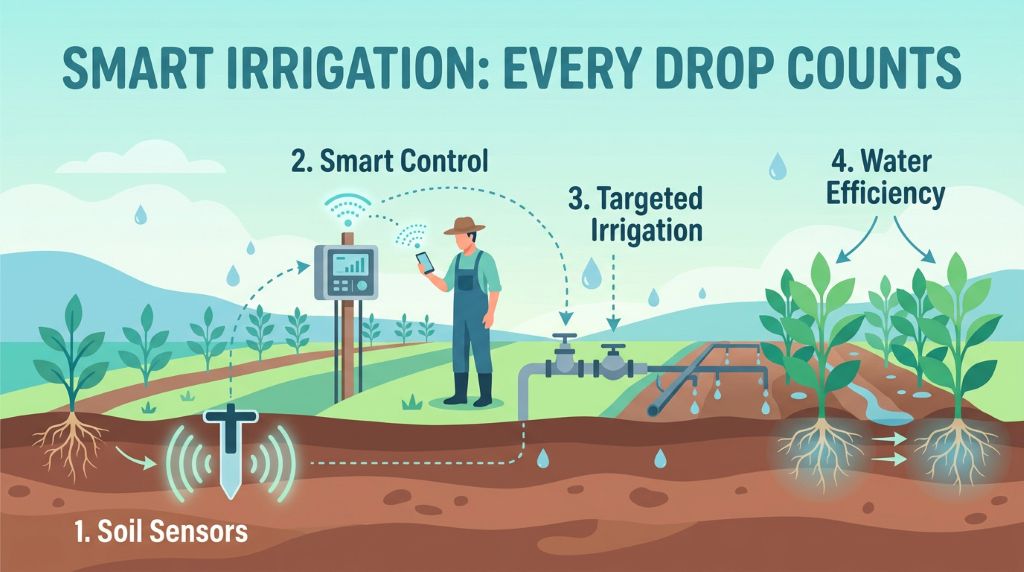
Smart farming is based on three interconnected layers of technology. Sensing is the first layer. However, Tiny, battery-powered sensors are placed in the soil or along irrigation lines to continuously measure moisture, temperature, nutrients, and humidity. These sensors simultaneously send the collected data to the farmer’s computer or mobile phone. Farmers use this IoT-based method, known as precision agriculture, to monitor and manage their fields efficiently.
Fig.1: How sensors monitor crops and soil
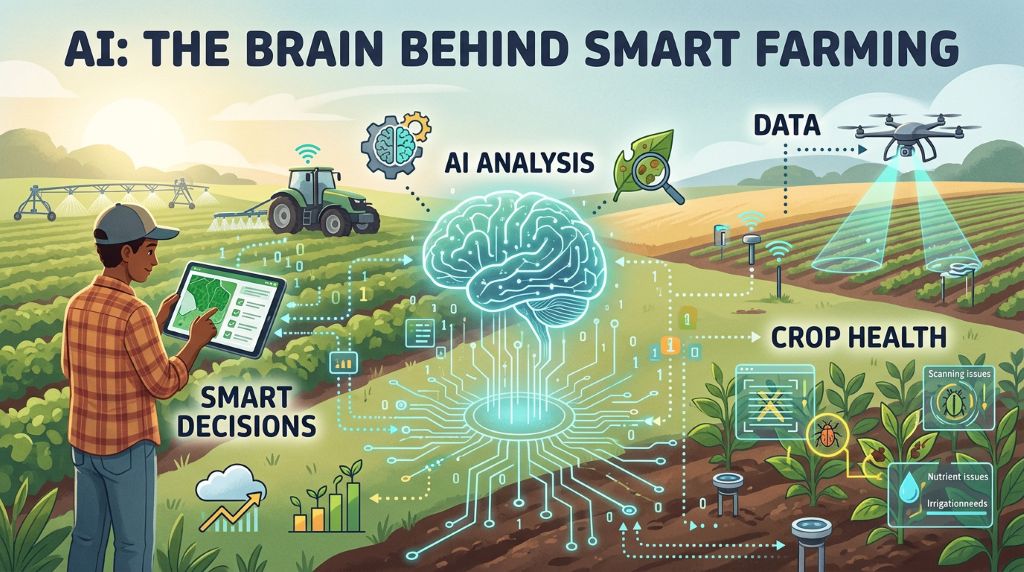
The second layer is artificial intelligence. Using images of plants, machine learning models help detect signs of disease or pests. Damage more quickly than a human could. The last layer is automation, which converts information into action. With the help of GPS navigation, tractors are now able to work on their own. Thus, this means that they can take precise routes without the need for human intervention.
Only 27% of all farms in the U.S. are currently employing the concept of precision agriculture. Proving that this field has much to improve. According to the Agricultural Research Service of the U.S. Department of Agriculture, simple tractor guidance systems can boost field efficiency by nearly 20% through reductions in overlapping trips. This can otherwise result in wasted resources.
Automation on Larger Farms
This is no longer a story of science fiction. The Economic Research Service of the United States Department of Agriculture found that, by 2023, 52% of midsize farms and 70% of large farms used guidance auto-steer systems. This represents a significant increase from the single-digit adoption rates recorded two decades earlier.
Fig.2: Artificial Intelligence in Agriculture
Smart Agriculture Technology in India
India is already adopting similar initiatives through the Digital Agriculture Mission and the NAMO Drone Didi scheme. Under the latter, the government trains women’s self-help groups to operate drones for agricultural activities. These initiatives are being implemented across the country.
According to a report by DataIntelo titled Global Smart Agriculture Technology Market, there has been a remarkable increase in adaptive agricultural practices on farms around the world. Where sensors, AI technologies, and automated machinery are increasingly being used in an interconnected way instead of as separate technologies.
The total value of smart agriculture technologies in 2025 was $22.8 billion and is expected to reach $48.6 billion by 2034. With an expected CAGR of 9.2% during the 2026–2034 timeframe.
Government Support and Digital Agriculture
The transition is being supported by governments as well. In total, the USDA together with the National Science Foundation funded nearly $200 million in precision agriculture research and development between 2017 and 2021, mainly focusing on AI-based projects.
Notably, India has taken similar measures by introducing the Digital Agriculture Mission in September 2024 after it was approved by the Union Cabinet. The mission involves expenditures of Rs. 2,817 crore, among which Rs. 1,940 crore is the central government expenditure, aiming to produce digital infrastructure such as farmer IDs and crop advisories.
The mission is expected to issue digital IDs for 11 crore (110 million) farmers and will be implemented in phases until 2027, with 19 states already involved.
Talking about automation, India has already approved the usage of 2,122 drones for agriculture from 2023–24 to 2025–26, including drones under its NAMO Drone Didi program. A total of 1,094 of these drones were allocated to women self-help groups in 2023–24 alone.
From Classroom To Cropland: Learning The New Farming
Getting into agriculture is not about making a decision between farming and technology but about blending the two. Programs in agricultural engineering or biosystems engineering incorporate robotics, data systems, and sensors together with conventional courses in crop science.
Fig.4: Benefits and Challenges of Smart Agriculture
Computer science and electronics programs that focus on machine learning and the Internet of Things are equally important. Students in these fields develop the code, connect hardware components, and train models away from agricultural fields. In India, the Indian Council of Agricultural Research (ICAR) and State Agricultural Universities offer specialized college programs that lead to bachelor’s degrees in agriculture, with a focus on precision farming and agricultural informatics.
Real education is just as important as theoretical learning. For example, a student can participate in a fun science project. Where they build a soil moisture sensor using basic devices such as an Arduino or Raspberry Pi.
It is also beneficial to learn basic remote sensing skills through free online guides in satellite image processing and obtain a Remote Pilot License for flying agricultural drones in the country if aged 18 years or older. In fact, internships offer good opportunities too, according to the government’s investment promotion agency. India now has over 1,000 agri-tech companies.
Mini-Project: Building a Soil Moisture Monitor at Home
Step 1: Connect a soil moisture sensor to an Arduino or Raspberry Pi and place the sensor into a small pot of soil.
Step 2: Program the microcontroller to read moisture levels and display the readings through a computer or simple screen.
Step 3: Add a basic alert that signals when the soil becomes too dry, helping demonstrate how sensors can turn real-world farm conditions into useful data.
Where The New Farm Jobs Are Sprouting: Smart Agriculture Technology
Fig.5: The Future of Smart Agriculture
Smart farming has generated new job positions that largely did not exist a few years ago. Precision farming experts help farms select and tune sensors and mapping systems. Agricultural data analysts convert sensor readings to guide decisions on planting and watering.
Drone professionals have been especially active in India lately. As part of the Agricultural Mechanization Sub-Mission, small farmers and women have the right to receive a subsidy of 50 percent, up to Rs. 5 lakh, for the purchase of an agricultural drone. Service centers also offer farmers access to trained drone operators who can provide required spraying and monitoring services without farmers needing to buy a drone themselves.
On the hardware side, IoT and robotics engineers design equipment able to withstand dust, rain, and rough treatment in the field, while software-savvy agronomists are in demand among government and private agritech companies.
Significant employers vary from well-known manufacturers and established companies to innovative startups. They include global agricultural equipment companies making driverless tractors, national agricultural research bodies such as ICAR, USDA-supported initiatives that are part of the nearly $200 million research funding, and rapidly emerging agricultural technology startups focused on providing farmers with applications, sensors, and machine learning consulting services.
Entry-level positions are usually gained through working in the field, installing sensors, or collecting data and later moving on to analysis work or product development.
Small Seeds, Big Future: Getting Started
To begin with, one should keep it simple. One could do something as basic as a soil sensor project independently or with a microcontroller kit, join a school science or robotics club, and even visit a nearby farm and ask about its farming practices.
Getting up to speed with agricultural research from governmental organizations and participating in STEM competitions using agri-tech projects. And taking an online course in Python or GIS are not hard next steps to take.
Agri-tech is one of the rare fields where a solid understanding of technology comes in handy in the direct pursuit of providing food for people.
References
DataIntelo: Global Smart Agriculture Technology Market. https://dataintelo.com/report/global-smart-agriculture-technology-market
Press Information Bureau, Government of India. (2024, September 2). Cabinet approves the Digital Agriculture Mission with an outlay of Rs. 2,817 crore. https://www.pib.gov.in/PressReleaseIframePage.aspx
The article provides an engaging overview of how AI, IoT, and automation are transforming modern agriculture. Its practical examples and student-focused project make the topic accessible and relevant. Please ensure that the adoption statistics, government initiatives, and technical claims are accurately referenced and up to date.
Editorial note
This article highlights how emerging technologies are reshaping agriculture through smarter, more efficient, and sustainable farming practices. Its practical examples and career insights offer students an exciting perspective on how STEM innovations can help address real-world agricultural challenges.
Ashish Kolte is a Marketing Manager at DataIntelo with expertise in marketing, market intelligence, and business strategy. He combines marketing insights with industry research to help organizations understand market dynamics, identify growth opportunities, and make data-driven decisions. His areas of interest include emerging technologies, artificial intelligence, healthcare, industrial markets, and global business trends. Through his writing, Ashish shares research-backed perspectives on evolving industries and strategic market developments.