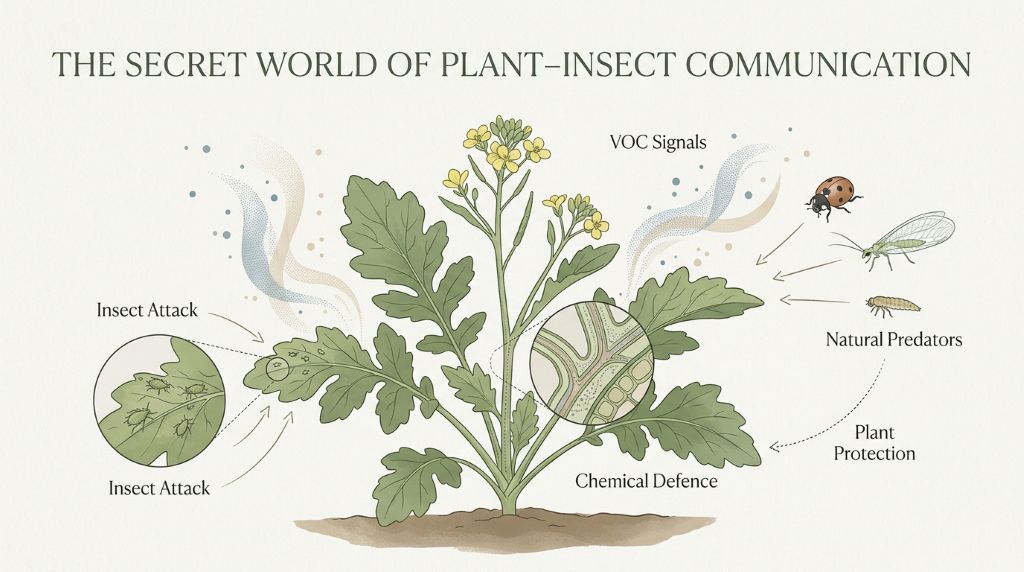
A green plant may look still and silent, but beneath the surface an intense biological battle is taking place. When an aphid lands on a leaf and begins to feed. The plant can detect the attack within minutes and activate a complex chemical defense system. This article explores how Plant-Insect Communication happens, produce chemical weapons such as glucosinolates, and release volatile signals that call in the natural enemies of their attackers, and why this hidden language matters for sustainable agriculture.
The Hidden Chemical Language of Plants: Plant-Insect Communication
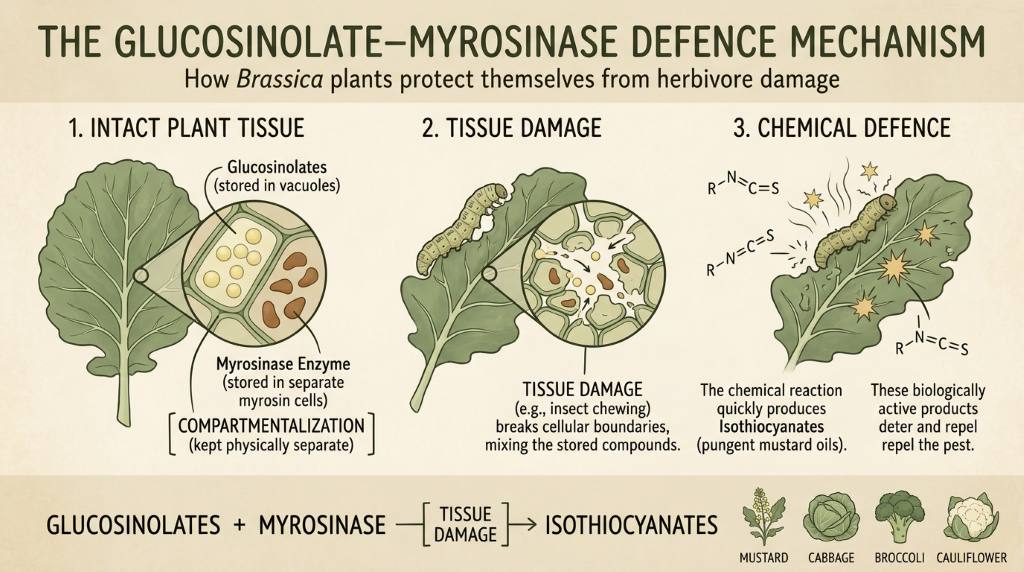
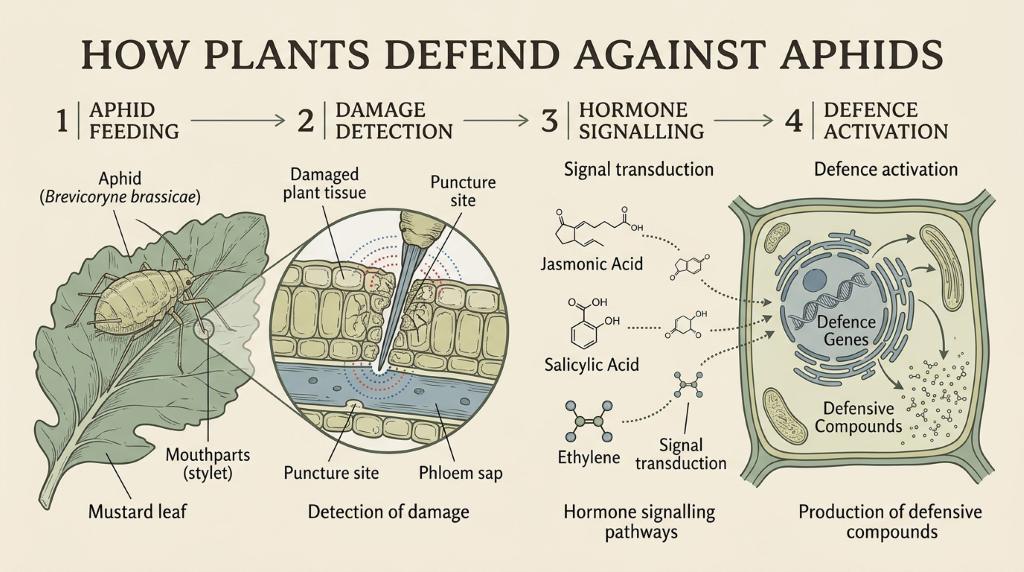
A tiny aphid lands on a mustard leaf and begins to feed on phloem sap. However, the nutrient-rich fluid is transported through the plant. Within minutes, the plant detects the damage and activates a defensive response. Hormones such as jasmonic acid, salicylic acid and ethylene act as the plant’s internal emergency signals. Switching on defense genes as well as the production of chemical weapons called secondary metabolites. Brassica crops, including mustard, cabbage, broccoli and cauliflower, store glucosinolates. When insect feeding damages tissues, these compounds meet the enzyme myrosinase and are converted into biologically active products. Such as isothiocyanates, the chemicals behind the pungent taste of mustard and radish. Not every plant fights equally.
Fig. 1: The Glucosinolate–Myrosinase Defence System
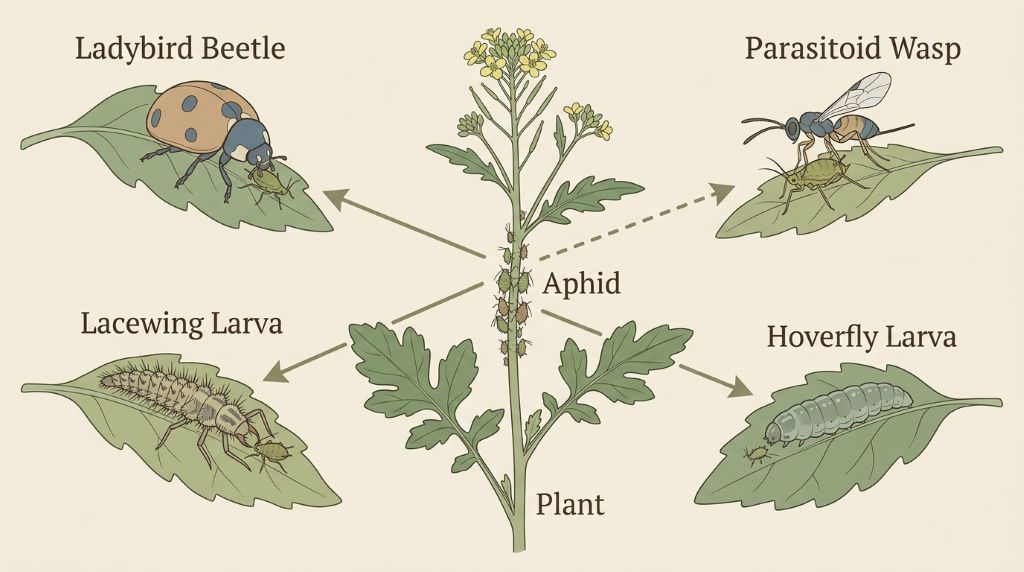
Different cultivars of the same crop vary in genetics, chemistry and physical traits, and breeding programmes screen varieties for natural resistance to pests such as the mustard aphid, Lipaphis erysimi, which feeds on cell sap and reduces growth and yield. The battle is never one-sided. A single plant may sit at the centre of a trophic web, feeding an aphid that is hunted by ladybird beetles. Lacewings and hoverfly larvae are parasitized by wasps, so that predators and parasitoids contribute to natural pest regulation. Attacked plants also release volatile organic compounds (VOCs) into the air, chemical signals that can attract the natural enemies of their herbivores. These interactions form the scientific basis of integrated pest management. A strategy that reduces reliance on chemical pesticides by combining resistant varieties, conservation of natural enemies, biological control and careful monitoring.
Chemical Defense ToolkitJasmonic acid & salicylic acid: Internal signalling molecules that switch on the plant’s defence programme.
Glucosinolates: Chemical weapons stored in Brassica crops; when tissues are damaged, myrosinase converts them into pungent isothiocyanates.
Volatile organic compounds (VOCs): Airborne signals that can attract predators and parasitoids of the attacking insect.
Educational Opportunities: Plant-Insect Communication
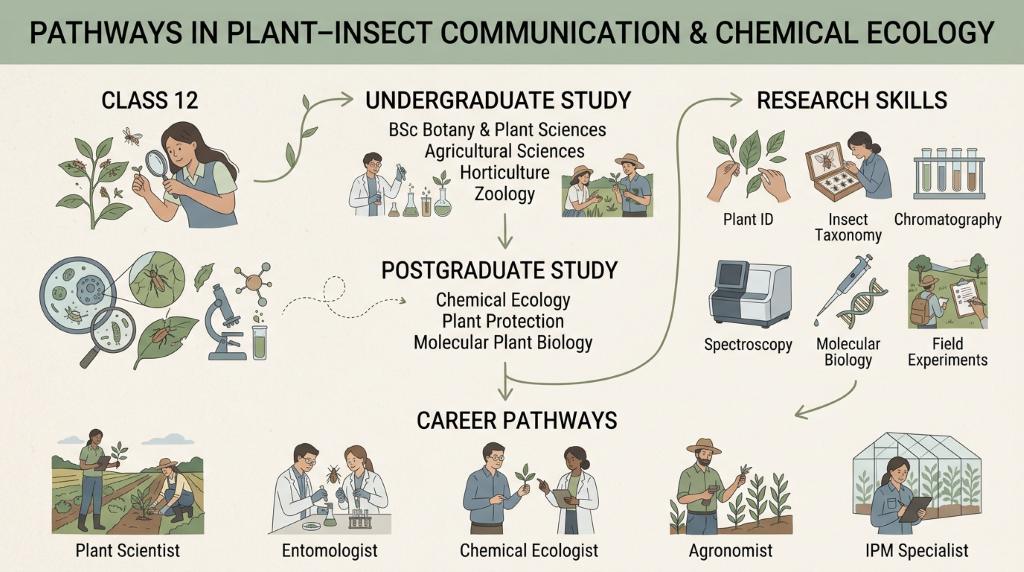
The study of plant–insect interactions sits at the crossroads of botany, entomology, chemistry and ecology, and offers many educational pathways. However, after Class 12, students can pursue a BSc in Botany, Plant Sciences, Agricultural Sciences, Horticulture or Zoology. With a focus on entomology, followed by an MSc in specializations such as Chemical Ecology. Plant Protection or Molecular Plant Biology. However, Agricultural universities in India and abroad offer degree and diploma programmes in Agriculture and Horticulture, where courses on crop protection, pest management and soil science build practical skills. For hands-on training, vocational and polytechnic courses in agriculture, along with certificate programmes in integrated pest management. Thus, Biological control and pesticide application provide accessible entry points.
Fig. 2: Key Takeaway of Plant-Insect Communication
Key skills to develop include plant identification, insect taxonomy, and laboratory techniques such as chromatography as well as spectroscopy for analyzing plant chemistry. Molecular biology methods and statistical analysis of field experiments. Students can gain experience through summer internships at agricultural universities, ICAR institutes and research stations. Sponsored projects often involve screening crop varieties for pest resistance or studying natural enemies. Participation in science fairs, student research programmes and online courses in ecology and plant science strengthens a portfolio, and many universities offer funded research projects and fellowships for postgraduate students.
Career Path
The skills learned in this domain (Plant-Insect Communication) open doors to a growing job market. However, at the entry level, graduates can join as research assistants, laboratory technicians or field officers in agricultural universities, ICAR institutes and state agriculture departments, helping to screen crop varieties, monitor pest populations or maintain insect cultures. With experience and a postgraduate degree, professionals can progress to scientist positions in research institutions, where they design experiments on plant resistance, chemical ecology or biological control. Job roles include plant scientist, entomologist, chemical ecologist, agronomist and integrated pest management specialist. The private sector offers roles in seed companies, agritech startups and the biopesticide industry, where expertise in crop protection is in high demand.
Fig. 3: Career Paths in Plant-Insect Communication
Major employers include the Indian Council of Agricultural Research (ICAR), agricultural universities, and CSIR laboratories. The National Bureau of Agricultural Insect Resources, international organizations such as FAO and CGIAR centres, and companies developing biological control products. Funded projects, including government schemes supporting sustainable agriculture, provide research opportunities for early-career scientists. As global agriculture moves toward reducing pesticide use, specialists who understand natural pest regulation are increasingly valued, making this a promising and purpose-driven career path.
Conclusion: Plant-Insect Communication
Fig. 4: How Plants Detect Insect Attacks
The next time you see an insect feeding on a leaf, remember that you are witnessing only the visible part of a much larger biological conversation. The plant is sensing, the insect is responding, predators may be approaching, and chemical signals are moving through the ecosystem. Nature is not silent; we simply need the scientific tools to understand its language. For students who want to explore this world further, here are three practical starting points:
Student Next Steps
Observe local aphid colonies with a magnifying glass. Find a mustard or other Brassica plant, watch how aphids feed, and look for ladybird beetles, lacewings, or hoverfly larvae nearby. You are watching a real trophic interaction.
Try simple leaf chromatography. However, separate the pigments and compounds in leaves at home or in the school laboratory. And see how plant chemistry can be studied with basic tools.
Explore integrated pest management databases. Learn how scientists and farmers use natural enemies and resistant varieties to protect crops with fewer pesticides.
These small steps are the beginning of a journey into chemical ecology, a field where a single question can lead to discoveries like Plant-Insect Communication that help feed the world more sustainably.
References:
Angelino, D., Dosz, E. B., Sun, J., Hoeflinger, J. L., Van Tassell, M. L., Chen, P., Harnly, J. M., Miller, M. J., & Jeffery, E. H. (2015). Myrosinase-dependent and independent formation and control of isothiocyanate products of glucosinolate hydrolysis. Frontiers in Plant Science. https://doi.org/10.3389/fpls.2015.00831
Mahanta, D., Komal, J., Samal, I., Bhoi, T. K., Kumar, P. V. D., Mohapatra, S., Athulya, R., Majhi, P. K., & Mastinu, A. (2025). Plant defense responses to insect herbivores through molecular signaling, secondary metabolites, and associated epigenetic regulation. Plant-Environment Interactions. https://doi.org/10.1002/pei3.70035
Rahimi, F., & Rahmanpour, S. (2020). Overcoming glucosinolate-myrosinase-isothiocyanate defense system by plant pathogenic fungi. International Journal of Secondary Metabolite. https://doi.org/10.21448/ijsm.697516
Zhou, W., Arcot, Y., Medina, R. F., Bernal, J. S., Cisneros-Zevallos, L., & Akbulut, M. E. S. (2024). Integrated pest management: An update on the sustainability approach to crop protection. ACS Omega. https://doi.org/10.1021/acsomega.4c06628
The article presents an engaging overview of plant–insect communication and the fascinating defense mechanisms plants use against insect attacks. It effectively connects chemical signaling with ecological interactions. The topic is relevant and informative for young readers. Please ensure scientific accuracy when explaining signaling pathways and plant defense responses.
Editorial note
The article offers an interesting insight into how plants communicate and defend themselves against insect attacks through fascinating chemical signals. Its engaging approach makes a complex biological process accessible and informative for young readers.
Archana ShuklaTeaching Associate | Sam Higginbottom University of Agriculture Technology and Sciences
Author
Dr. Archana Shukla is a zoologist, educator, and researcher specializing in plant–insect interactions, insect ecology, pollinator biology, and sustainable agriculture. She is associated with the Department of Biological Sciences at Sam Higginbottom University of Agriculture, Technology and Sciences (SHUATS), Prayagraj, Uttar Pradesh, India, where she has been involved in teaching and academic activities.
Dr. Shukla completed her doctoral research in Zoology with a focus on plant–insect interactions and tri-trophic relationships in agricultural ecosystems. Her research examined the interactions among mustard plants, the mustard aphid (Lipaphis erysimi), and its natural predators, particularly ladybird beetles. Her work combines ecological observations with biochemical approaches to understand how crop plants respond to insect infestation and how natural enemies contribute to pest regulation.
Her research interests include insect–plant interactions, chemical ecology, biological control, plant defence mechanisms, pollinator health, honey bee biology, biodiversity conservation, and sustainable pest management. She has experience with several laboratory and analytical techniques, including HPLC, NMR-based metabolite profiling, PCR, gel electrophoresis, DNA sequencing, and physiological measurements using portable photosynthesis systems. Through the integration of field ecology, laboratory analysis, and molecular approaches, she aims to better understand the complex biological relationships that influence agricultural ecosystems.
Dr. Shukla has contributed to scientific publications in the areas of insect ecology, agricultural entomology, plant–insect interactions, and honey bee health. Her research has also involved investigating the population dynamics of mustard aphids and their coccinellid predators, as well as studying biochemical changes associated with insect infestation in mustard cultivars.
Alongside research, Dr. Shukla has a strong interest in science education and communication. As an educator, she believes that scientific concepts should not remain confined to laboratories and research papers but should be communicated in ways that students and the wider public can understand and appreciate. She is particularly interested in connecting classroom biology with real-world environmental problems, including food security, biodiversity loss, pollinator decline, agricultural sustainability, and climate-related challenges.
Her broader scientific goal is to contribute to research and education that promote a better understanding of how organisms interact with one another and with their environment. She is especially interested in approaches that combine ecological knowledge with modern biological and biotechnological tools to develop more sustainable solutions for agriculture and environmental conservation.
Through her teaching, research, and scientific writing, Dr. Shukla hopes to inspire young learners to look beyond the visible world and discover the remarkable biological processes occurring around them—from the chemical signals exchanged between plants and insects to the essential role of pollinators in maintaining ecosystems and global food production.