Researchers tracked Solar Active Region NOAA 13664 for over three solar rotations, showing how its magnetic complexity sustained intense flaring activity.
Tracking Solar Active Region NOAA 13664 Across Three Solar Rotations
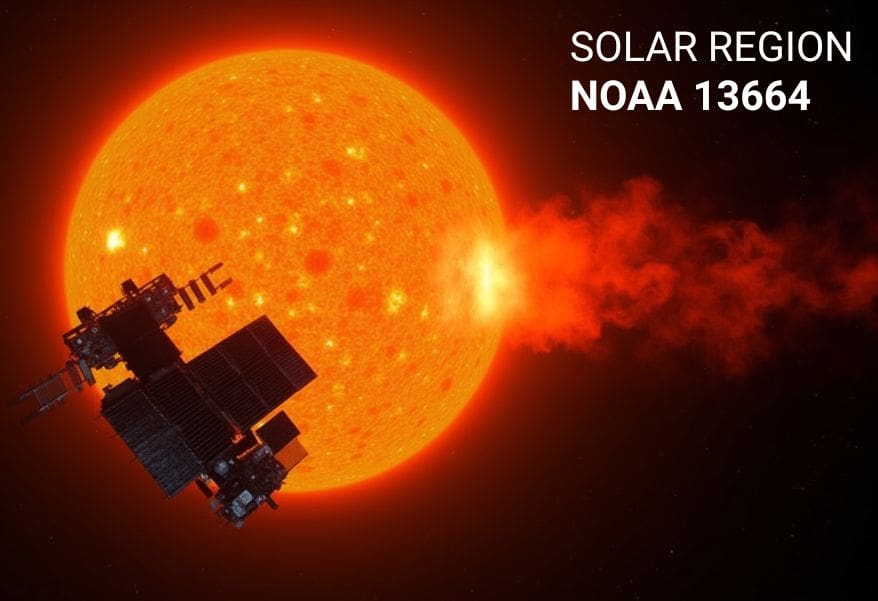
The Sun’s magnetic activity fascinates scientists and space enthusiasts alike. One of the most intriguing features on our star is the solar active region, which can produce intense flares and influence space weather. Recently, researchers tracked Solar Active Region NOAA 13664 continuously for over three full solar rotations. Their findings provide new insights into how these magnetic regions evolve and sustain their complex behaviour.
Magnetic Flux Emergence and Evolution of NOAA 13664
Active regions form when magnetic fields rise from beneath the Sun’s surface. These areas often appear as sunspots and are linked to intense flaring events. Usually, scientists observe an active region for about two weeks because of the Sun’s rotation. However, this study combined data from multiple vantage points, including Earth-facing satellites and those observing the far side of the Sun.
Consequently, they surpassed this time limit by tracking NOAA 13664 for a remarkable 94-day period. This method provided a comprehensive picture of how magnetic flux emerged, intensified, and eventually decayed in this complex solar region.
The Complex Magnetic Behavior Holds Flares Steady
The research showed that multiple episodes of flux emergence happened over twenty days. The active region then reached its peak complexity about one month after its initial appearance. What stood out was that NOAA 13664 maintained high levels of non-potentiality, meaning its magnetic field contained free energy ready to power solar flares.
This continuous high non-potentiality correlated strongly with sustained flaring activity during its lifetime. Therefore, monitoring such parameters can improve predictions about solar activity and potential impacts on Earth.
Why Multi-Vantage-Point Observations Matter
Traditional single-point observations limit scientists to roughly half a solar rotation—about fourteen days—due to observation constraints along the Earth-Sun line. In contrast, multi-vantage-point monitoring gives a continuous dataset that captures every stage. This approach made it possible to track NOAA 13664 through emergence, peak activity, and gradual decay phases without interruption.
This advance helps researchers better understand how magnetic flux behaves underneath the surface as well as on it. Furthermore, it enhances knowledge about processes that trigger powerful solar eruptions.
The Role of Advanced Instruments in Solar Studies
The study relied heavily on data from two key spacecraft: Solar Orbiter and Solar Dynamics Observatory (SDO). These provided photospheric magnetograms showing surface magnetic fields along with extreme-ultraviolet images revealing coronal structures above sunspots.
The combination enabled detailed mapping of plasma flows and flare detection across different layers of the solar atmosphere over an unprecedented timescale.
The Bigger Picture: Linking Solar Magnetism to Space Weather
Solar active regions like NOAA 13664 affect not only solar physics but also everyday life on Earth by influencing space weather conditions. Intense flares may disrupt satellite communications or power grids here at home. Therefore, better monitoring methods empower researchers to forecast these events more reliably.
Additionally, to stay updated with the latest developments in STEM research, visit ENTECH Online. Basically, this is our digital magazine for science, technology, engineering, and mathematics. Also, at ENTECH Online, you’ll find a wealth of information.
Reference
- Kontogiannis, I., Zhu, Y., Barczynski, K., Stiefel, M., Collier, H., McKevitt, J., Durán, J. C., Berdyugina, S., & Harra, L. (2025). Near-continuous tracking of solar active region NOAA 13664 over three solar rotations. Astronomy and Astrophysics, 704, A105. https://doi.org/10.1051/0004-6361/202556136
- Author
- Latest Posts

Ashwini Kshirsagar holds a graduate degree in Chemistry and a postgraduate degree in Environmental Science from Shivaji University, Kolhapur. With a strong foundation in scientific principles and a creative flair, she blends her expertise in environmental science with skills in technical writing, graphic design, and video editing. Proficient in Adobe software, Ashwini excels at transforming complex scientific concepts into clear, engaging, and visually compelling content. Her unique ability to merge science and storytelling allows her to create impactful communication materials that are both informative and accessible to a wide audience.