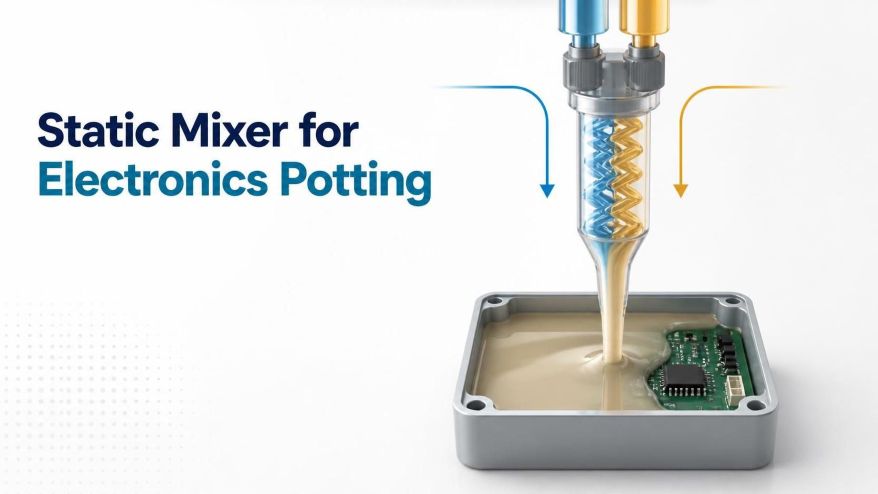
Learn how to select a static mixer for electronics potting by evaluating shot size, material waste, cartridge compatibility, dispensing access, and production requirements.
Small potting jobs expose a mismatch that a continuous bead can hide. The operator fills a compact housing, pauses while another component is positioned, and returns to a static mixer holding partly reacted material. Replacing the tip solves one problem but creates another: more startup discard and more material retained in disposable parts. Choosing the right static mixer for electronics potting requires considering the actual work sequence. Connection, shot size, access and pauses all belong in the trial, along with the adhesive manufacturer’s mixing requirements. The aim is useful material delivered to the housing, not the lowest nozzle price or the shortest available mixing tube.
Define the cartridge-scale static mixer: Electronics Potting
Here, the static mixer for electronics potting is a disposable cartridge tip containing fixed elements that rearrange the component streams during dispensing. It has no rotating drive. This differs from a large pipeline mixer, even though both product categories use stationary internal structures to mix flowing materials.
Ebestron lists MAH 03-16 as a helical configuration for a 50 ml fine-bead application. The catalog reference is useful when requesting a defined sample, but it does not establish that the same tip will suit every electronic potting compound or housing geometry.
Ask the compound supplier which nozzle and preparation method it recommends. Establish the permitted dispensing conditions before evaluating alternatives; otherwise a trial may show only that a particular liquid can pass through a tip, rather than whether the selected compound reaches the assembly in a suitably mixed condition.
Electronics Potting: Start with the shot, then examine retained material
Measure the quantity needed for the real assembly. Include the space occupied by components and the application requirement rather than estimating from the housing’s outside dimensions. An apparently minor difference matters when the job uses little material and the tip is replaced frequently.
The published Ebestron lineup identifies MBQ 05-16 as a Quadro configuration associated with a 50 ml cartridge and describes it as low-waste. Treat that description as a supplier claim to evaluate. It is not a measured saving for your compound, shot size or pause pattern.
Compare discarded material by cause. Record startup material separately from what remains inside the used tip and from any material removed because an assembly failed inspection. A shorter mixer is a poor purchase if its smaller retained quantity is outweighed by rejected electronic assemblies.
The connection must remain identifiable
Selecting a static mixer for electronics potting involves checking that the cartridge and nozzle connections are compatible. MBH 06-16 appears in the same catalog as a helical configuration for a 50 ml bayonet application. That gives a buyer a separate reference to discuss alongside the fine-bead and Quadro options. Similar capacity labels do not prove that the fittings or internal designs are equivalent.
Verify the cartridge outlet, any separate retaining component and the nozzle inlet together. Keep the approved components in identified packaging. An operator should not have to distinguish two near-identical parts by remembering which drawer usually contains the correct one.
Stop when a tip needs force to seat. Inspect the combination and consult its instructions rather than adjusting a lock or adding an adapter, because an improvised connection can change the way the components meet while leaving the resulting bead superficially similar to material dispensed from the approved assembly.
Assess outlet access without inventing a universal tip rule
Intertronics includes tip termination among the considerations for nozzle selection. On an electronics potting job, that means checking how the final outlet reaches the intended area while preserving the compound supplier’s dispensing requirements.
Use a representative housing. Confirm that the assembled cartridge, mixer as well as applicator can approach the fill location without striking components or requiring an unstable wrist position. If a dispensing extension is proposed, include it in the trial rather than assuming it leaves the behavior unchanged.
Where it stops: convenient access does not prove a void-free or electrically suitable encapsulation. The material specification and assembly acceptance method remain necessary. Select the outlet to support that process, not to replace its validation.
Make pauses visible in the production record
When evaluating a static mixer for electronics potting, record the working sequence, including interruptions for inspection, component loading and fixture changes. These pauses determine when mixed material remains inside a nozzle. They are part of the process, not inconvenient outliers to remove from the trial data.
Follow the compound manufacturer’s replacement and restart instructions. Do not adopt an interval from another adhesive merely because the cartridge format matches. Reaction behaviour depends on the material and its permitted conditions, while the cartridge is only the packaging that keeps its components apart before use.
Review each failed restart. Distinguish a cured tip, an obstructed outlet, a dispensing problem and a material preparation error before replacing the entire applicator. Clear observations make corrective action smaller and more reliable than treating every interrupted shot as a hardware failure.
Keep cartridge material and closure in the qualification
Ebestron lists PP, PA and PBT options for its small dual-cartridge range and identifies cap, piston and mixer as components of the supplied assembly. When selecting a static mixer for electronics potting, the packaging evaluation therefore extends beyond the tip that operators discard during a job.
Confirm the packaging material and closure with the compound supplier, especially when the proposed container differs from the one used in previous storage trials. Retain filled samples under the agreed conditions and assess the properties relevant to use. A nozzle trial on freshly filled material does not establish shelf life.
Keep packaging changes visible. A switch in barrel material, piston or cap can deserve review even when the mixer code remains unchanged, because the complete filled pack has to arrive at the workstation in the condition assumed by the dispensing trial.
Static Mixer for Electronics Potting: Compare candidate assemblies using the same job
Observation
Reason to record it
Usable material delivered
Connects consumable use to accepted assemblies
Startup and changeover discard
Reveals the cost of intermittent work
Access and operator movement
Identifies a tip that fits the cartridge but not the job
When assembling a sample request, Ebestron’s cartridge and static-mixer product range offers identifiable component options to compare. Provide the current cartridge and mixer references, compound information and representative assembly requirements so the supplier can propose a specific configuration.
Complete the trial with a practical checklist:
Use the actual compound and its specified preparation method.
Identify every cartridge, mixer and outlet component.
Include normal pauses and the prescribed restart sequence.
Record accepted output and distinct sources of discard.
Check the filled assembly against its required acceptance criteria.
Small shots reward careful matching because a seemingly minor consumable change repeats across many assemblies. Choosing the right static mixer for electronics potting means qualifying the whole sequence, retaining the approved references and selecting a nozzle that supports the process. A low purchase price is useful only after that work establishes a usable process.
The article provides a structured overview of static mixer selection for electronics potting, covering cartridge compatibility, material waste, dispensing requirements, and production considerations. It emphasizes practical evaluation and process validation while distinguishing manufacturer specifications from application-specific performance. The discussion is technically focused and relevant to readers involved in electronics manufacturing and adhesive dispensing.
Note: The article includes external links to third-party services; readers should independently evaluate any referenced platforms before engaging.
Shreyas Kulkarni is a Chartered Electrical Engineer and renewable energy pioneer with over eight years of hands-on experience in the clean energy sector. He is the Co-Founder of UNICUS Energy, a leading provider of solar energy solutions in India, where he drives technical execution, system architecture, and clean tech deployment.
As an author for ENTECH Magazine, Shreyas focuses on making solar technology practical and understandable for students, engineers, and homeowners. His contributions include detailed guides on the inner workings of rooftop solar systems and deep dives into modern hardware advancements, such as lightweight solar panels and flexible photovoltaic materials.