New research suggests short-lived radionuclides, Supernova Cosmic Rays, and nearby stellar explosions play a crucial role in forming rocky, potentially habitable worlds.
How Supernova Cosmic Rays Shape Earth-like Planets
Estimated reading time: 3 minutes
The question of how common Earth-like planets are remains central in astronomy. Our planet’s unique features, such as liquid water and a stable habitable environment, depend on specific conditions during its formation. Recently, scientists explored the role of short-lived radionuclides (SLRs), Supernova Cosmic Rays, and nearby stellar explosions in forming rocky planets like Earth. Their new findings suggest that these cosmic events might be more important than previously believed.
Understanding Short-Lived Radionuclides (SLRs)
SLRs are radioactive elements with half-lives fewer than 5 million years. They include isotopes like aluminum-26 (26Al), beryllium-10 (10Be), and calcium-41 (41Ca). These elements produced heat through radioactive decay, influencing the early Solar System’s development. For example, 26Al caused heating that led to the drying out of asteroid parent bodies, affecting planet formation.
Meteorite studies reveal the abundance of these isotopes at the Solar System’s birth. Since their half-lives are short, SLRs could not have been present before Solar System formation without continuous replenishment.
The Problem With Previous Models
Earlier theories suggested nearby supernova explosions injected SLRs into the protosolar disk. However, these models struggled to explain observed isotope ratios without destroying the disk itself. For instance, excess manganese-53 (53Mn) would appear if supernova ejecta alone supplied necessary isotopes. Also, explosions closer than 0.3 parsecs could obliterate the disk’s delicate structure.
This conflict left scientists searching for a mechanism that fits both isotope data and solar system survival.
Also Read: How Astronomers Captured a Star’s Final Explosion
The Immersion Mechanism and Supernova Cosmic Rays
The recently proposed immersion mechanism offers a promising solution. It explains how cosmic-ray nucleosynthesis during a supernova shockwave can supply correct levels of SLRs without damaging the protosolar disk.
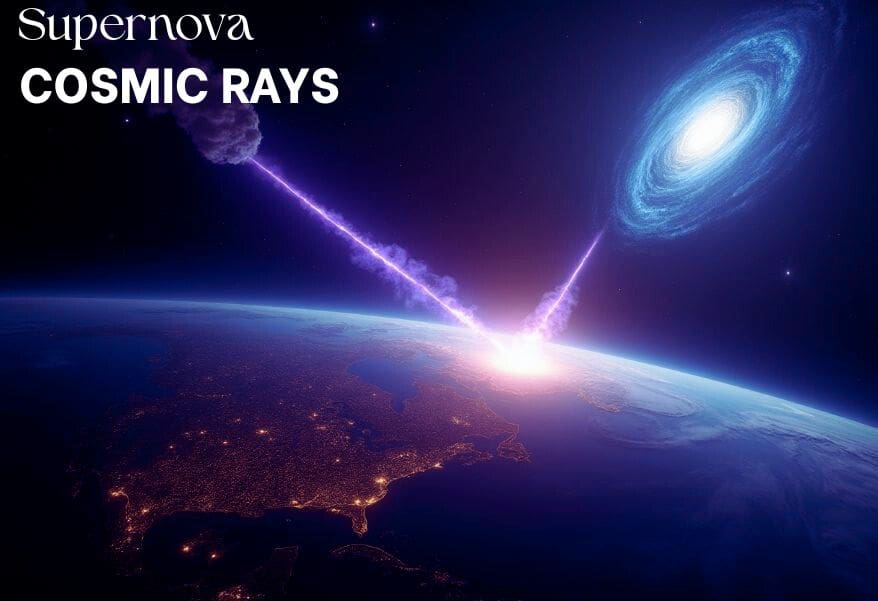
When a supernova occurs about 1 parsec away (roughly 3 light-years), it creates a shockwave filled with accelerated particles called trapped cosmic rays (CRs). These CRs interact deeply with the protosolar disk while some radionuclides from the explosion directly inject into it.
Also Read: The Star That Made Life Possible: 2 Elements and Their Connection With The Origin Of Life
Synthesizing Isotopes In-Situ
This combination produces SLRs like 10Be and 26Al inside the disk itself — a process known as nonthermal nucleosynthesis. The immersion model resolves previous problems by matching observed isotope ratios closely without risking disk destruction.
Implications for Earth-like Planet Formation Across Space
This study indicates that close supernova events near young solar systems might be common during star cluster lifetimes. If so, many planetary systems could experience similar enrichment processes creating SLR abundances needed to form dry rocky planets like Earth rather than water-rich ocean worlds.
Our immersion model suggests solar-type stars often see supernovae close enough to produce these important radionuclides, said lead researcher Dr. Hiroya Yamaguchi.
This means Earth-like rocky planets may be more widespread than thought before. Such planets benefit from internal heating caused by decaying radionuclides that drive geological activity critical for habitability over time.
Also Read: NASA Celebrates 6,000 Confirmed Exoplanets Beyond Our Solar System
Conclusion: More Reasons to Explore Space Science Now!
The immersion model gives hope that Earth-like planets may exist more often than thought before thanks to close stellar neighbors broadcasting their elements using cosmic rays.
This insight inspires curiosity among young minds ready to shape future space explorations or engineering breakthroughs designed around stellar phenomena effects on planet birth environments.
Additionally, to stay updated with the latest developments in STEM research, visit ENTECH Online. Basically, this is our digital magazine for science, technology, engineering, and mathematics. Also, at ENTECH Online, you’ll find a wealth of information.
Reference
- Sawada, R., Kurokawa, H., Suwa, Y., Taki, T., Lee, S., & Tanikawa, A. (2025). Cosmic-ray bath in a past supernova gives birth to Earth-like planets. Science Advances, 11(50), eadx7892. https://doi.org/10.1126/sciadv.adx7892
- Stall, A., Loo, C. K., & Mertsch, P. (2025). Investigating the CREDIT history of supernova remnants as cosmic-ray sources. The Astrophysical Journal Letters, 980(2), L21. https://doi.org/10.3847/2041-8213/adaea8
- Author
- Latest Posts

Ashwini Kshirsagar holds a graduate degree in Chemistry and a postgraduate degree in Environmental Science from Shivaji University, Kolhapur. With a strong foundation in scientific principles and a creative flair, she blends her expertise in environmental science with skills in technical writing, graphic design, and video editing. Proficient in Adobe software, Ashwini excels at transforming complex scientific concepts into clear, engaging, and visually compelling content. Her unique ability to merge science and storytelling allows her to create impactful communication materials that are both informative and accessible to a wide audience.


