India’s electric future depends on rare earth elements like neodymium and dysprosium, but China’s dominance has triggered a global rare earth crisis.
The Rare Earth Crisis and India
What is the Rare Earth Crisis?
You learn about lanthanoids and actinoids in your Class 12 chemistry classes. However, today, the world faces a rare earth crisis because these elements, such as neodymium and dysprosium, which drive everything from electric vehicles (EVs) to smartphones and defense systems, are in limited supply. Moreover, your chemistry theory now intersects with global events and industrial ambitions.
Rare Earth Metals in India: Periodic Table to Real-World Impact
Rare earth elements include 15 lanthanoids, plus scandium and yttrium, which belong to the f-block of the periodic table. Crucially:
- They typically show the +3 oxidation state.
- Lanthanoid contraction makes them chemically similar, which creates difficulty in their separation.
- Methods like solvent extraction and ion‑exchange chromatography are used to separate them

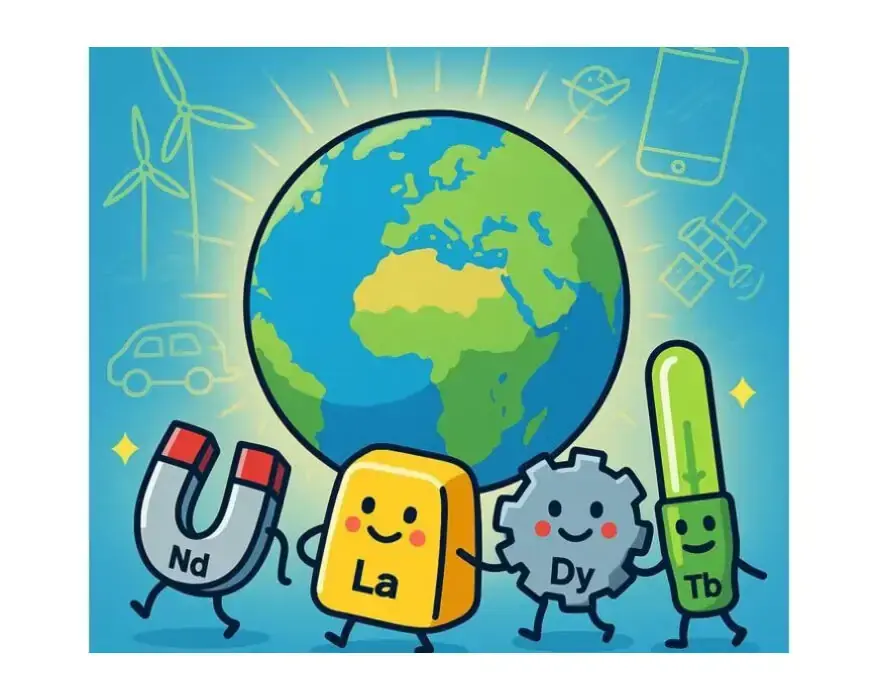
They are highly useful. For example, neodymium (Nd) forms strong permanent magnets, while dysprosium (Dy) enhances heat resistance. Cerium (Ce) is used in catalytic converters, and lanthanum (La) is featured in cameras and batteries.
How the Rare Earth Crisis Intensifies China’s Role
Essentially, China controls over 85% of rare earth metals in India (refined globally), including magnet production. Consequently, when China imposed export restrictions and increased tariffs due to trade tensions, it triggered a rare earth crisis that reverberated worldwide, including India. Therefore, India and other nations felt immediate supply challenges.
How the Rare Earth Crisis Affects India’s EV Ambitions
India now prioritizes clean mobility, yet it imports Chinese rare-earth magnets for electric vehicle (EV) motors. Meanwhile, when China reduced its exports, companies such as Tata Motors, Bosch, and TVS warned of potential EV production delays and cost increases. Therefore, some enterprises considered halting. However, the rare earth crisis also highlighted the need for science, technology, and policy to align to sustain progress.
Rare Earth Metals in India: Resource Strengths and Gaps
India’s Reserve Base
India ranks fifth in REE reserves globally. Specifically, the Department of Atomic Energy found 111,845 tonnes of in-situ REE oxides in Rajasthan alone.
GSI Exploration Efforts
The Geological Survey of India uses the UNFC framework: G4 (reconnaissance), G3 (preliminary), and G2 (detailed). Notably, GSI launched 195 projects nationwide, with 35 in Rajasthan, including areas like Barmer, Bhilwara, Sirohi, and Sikar. Thus, targeting neodymium and dysprosium, which are key EV elements.
Processing Shortfalls
While India mines monazite sands (~13 million tonnes) in states like Kerala, Karnataka, Chandigarh, and Andhra Pradesh, it lacks facilities for alloy production and magnet-manufacturing plants. Current capabilities include beneficiation and metal-oxide refining, but industrial-scale partnership is still developing. Hence, despite strong reserves, the rare earth metals in India need vertical integration to meet modern needs.
Import Reliance
Consequently, India imported ~2,270 tonnes of rare earth elements, both metals and compounds, during 2023–24, primarily from China, then Japan, and Russia. Overall, domestic gaps and global policy shifts intensified the rare earth crisis.
India’s Strategic Response to the Rare Earth Crisis
Policy Interventions
According to PIB, under the National Critical Mineral Mission, India amended the MMDR Act (2023) to streamline exploration licenses. So far, 44 mineral blocks, including REE-rich ones, have been auctioned. Additionally, 23 private exploration agencies and GSI-led deep-georesource discovery are on the rise.
International Collaboration
India partners with Australia, Japan, and the QUAD nations to diversify sources. Furthermore, Toyotsu Rare Earths India Ltd (a Toyota Tsusho subsidiary) refines REEs using IREL-sourced concentrate, which is a sign of increasing technology partnerships.
What Measures Should India Take to Overcome the Rare Earth Crisis?
To address the rare earth crisis and secure India’s EV supply chain, a multi-pronged strategy is essential. This includes structural reforms, international collaboration, and focused investment in research and innovation.
Accelerate Domestic Exploration and Mining
We must scale up our systematic exploration through public agencies and incentivize private players. The newly introduced Exploration Licence for deep-seated minerals is a step in the right direction.
Build an Integrated Value Chain
While India has capabilities up to oxide and metal extraction, it lacks infrastructure for refining, alloy-making, and magnet production. Establishing industrial-scale facilities for rare earth magnet fabrication is vital for EV motors and wind turbines.
Strengthen Foreign Collaborations
India should deepen partnerships with countries like Japan, Australia, and Vietnam to secure long-term rare earth supplies and exchange processing technologies. Existing projects, such as Toyotsu Rare Earths India Ltd. in collaboration with Japan’s Toyota Tsusho, are very positive in this direction.
Promote Recycling and Urban Mining
Rare earth elements are recoverable from discarded electronics and EV components. India should invest in building e-waste recycling plants and support startups working on the sustainable extraction of rare earths from waste streams.
Strategic Stockpiling and Trade Diversification
Just as China uses rare earths as geopolitical tools, India must diversify its import sources and maintain buffer reserves of critical elements to avoid disruptions in its EV ambitions.

Skilling and R&D Investment
Creating a trained workforce in rare earth metallurgy, environmental chemistry, and advanced materials science is non-negotiable. India’s scientific community must be supported with grants and labs dedicated to REE research, especially for refining, magnet-making, and recycling technologies.
Conclusion
In conclusion, the rare earth crisis demonstrates how science, technology, and international policy are interlinked. Rare earth metals in India hold enormous potential, but require refining infrastructure, technology partnerships, and policy action to deliver real impact. Therefore, India must deepen exploration, build processing facilities, and drive innovation through recycling. At the same time, students and future scientists should see this as their opportunity to apply chemistry in real-world problem-solving.
FAQ’s
1. What causes the rare earth crisis?
It arises when a dominant player, mainly China, limits exports. Since India depends on such imports, it feels the shock immediately.
2. Why are lanthanoids hard to extract?
They have nearly identical ionic radii (lanthanoid contraction), so separating them requires multi-stage methods like solvent extraction and ion-exchange chromatography.
3. What is lanthanoid contraction?

Lanthanoid contraction refers to the gradual decrease in the size of atoms and ions of the lanthanoid elements (from lanthanum to lutetium) as their atomic number increases. This happens because, although electrons are being added to the 4f orbitals, these orbitals do not shield the increasing nuclear charge effectively. As a result, the outer electrons are pulled closer to the nucleus, leading to smaller atomic radii.
References
- Balaram, V. (2019). Rare earth elements: A review of applications, occurrence, exploration, analysis, recycling, and environmental impact. Geoscience Frontiers, 10(4), 1285–1303. https://doi.org/10.1016/j.gsf.2018.12.005
- Drobniak, A., & Mastalerz, M. (2022). Rare Earth Elements: A Brief Overview. Indiana Journal of Earth Sciences, 4(1). https://doi.org/10.14434/ijes.v4i1.33628
Additionally, to stay updated with the latest developments in STEM research, visit ENTECH Online. This is our digital magazine for science, technology, engineering, and mathematics. Furthermore, at ENTECH Online, you’ll find a wealth of information.
- Author
- Latest Posts

I am currently pursuing Masters degree in Chemistry from the University of Lucknow, and I hold a keen interest in both the subject and its broader applications. With a particular fascination for physical and organic chemistry, my academic path is complemented by a passion for science communication and writing.
I am also actively involved in extracurricular activities, especially public speaking, and debates, where I learned to think clearly and communicate effectively. These experiences have been instrumental in developing my confidence, critical reasoning, and a sense of responsibility toward effective knowledge-sharing.
My skill set includes research writing and editing, and of course, a constant zeal to learn more from everybody. Alongside academics, I enjoy reading poetry and history. My hobbies include singing and gardening.
I have participated in platforms that support women in science, such as IUPAC’s Global Women’s Breakfast. These engagements have helped shape my perspective and strengthened my resolve to contribute positively wherever possible.